
The Best Upper Body Calisthenics Exercises You Can Do Anywhere
Upper body calisthenics exercises are bodyweight movements that build strength, muscle, and endurance in your chest, back, shoulders, and arms — no gym required.
Here are the most effective ones, organized by level:
Beginner
- Push-ups
- Incline push-ups
- Australian rows (bodyweight rows)
- Bench dips
- Scapular pull-ups
- Plank holds
Intermediate
- Pull-ups
- Dips
- Pike push-ups
- Diamond push-ups
- Decline push-ups
- Inverted rows
Advanced
- Archer push-ups
- Explosive pull-ups
- Weighted pull-ups
- Handstand push-ups
- One-arm push-up progressions
- Muscle-up progressions
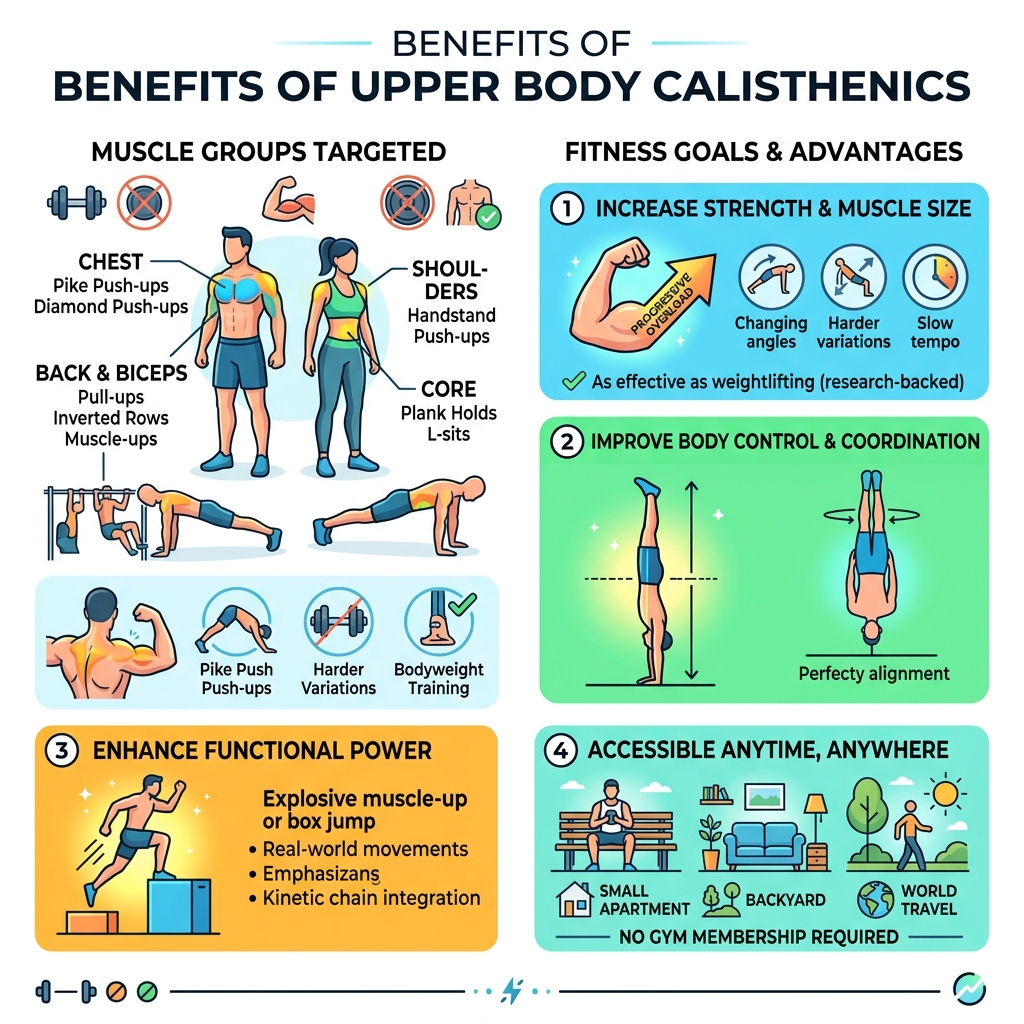
You don’t need a gym membership or heavy equipment to build real upper body strength. Research backs this up — studies suggest calisthenics can be just as effective as weightlifting for building muscle size and strength.
The secret is progressive overload. Instead of adding weight plates, you change the angle, slow down the movement, or advance to harder variations. Your muscles don’t know the difference between a barbell and your own bodyweight — they just respond to tension and challenge.
Calisthenics has roots going back to ancient Greece, but it’s more relevant than ever for busy people who need a practical, equipment-free way to train. Whether you’re working out in a small apartment or a backyard, these exercises travel with you everywhere.
This list covers everything — from your first push-up to advanced skills like handstand push-ups — so you can find exactly where to start and where to go next.
Why Choose Upper Body Calisthenics Exercises?
When we think of a powerful physique, we often imagine someone clanking heavy iron in a crowded gym. However, choosing upper body calisthenics exercises offers a unique path to a defined torso and functional power that weights simply can’t replicate. Calisthenics forces your body to work as a single, cohesive unit. This builds not just muscle size, but incredible body control and “real-world” strength.
The science is on our side here. A 2017 study published in Physiology & Behavior indicated that calisthenics can be as effective as weightlifting for building muscle strength and size. Furthermore, your heart benefits just as much as your biceps. Research has shown that pushup strength may be associated with a significantly lower risk of cardiovascular disease.
Beyond the mirror, calisthenics improves bone density and joint stability. Because you are moving your own mass through space, your tendons and ligaments strengthen alongside your muscles. This leads to better coordination and a reduced risk of injury in daily life. Whether you are lifting a suitcase or pushing a heavy door, the functional benefits are endless.
Targeted Muscles in Calisthenics
One of the best things about these movements is that they are almost always compound exercises. This means you’re getting more “bang for your buck” by hitting multiple muscles at once. Here is what we are typically targeting:
- Pectorals (Chest): Hit through various push-up angles and dips.
- Latissimus Dorsi (Back): The “wings” of your back, built with pull-ups and rows.
- Rhomboids and Traps: Essential for posture, targeted during rows and scapular work.
- Deltoids (Shoulders): Specifically the front and middle heads during pushes and the rear heads during pulls.
- Triceps and Biceps: Your arms act as the primary movers in almost every upper body exercise.
- Core Stabilizers: Unlike bench pressing, where the bench supports you, calisthenics requires your abs and lower back to keep your body rigid.
The Science of Bodyweight Resistance
How do we get stronger if we aren’t adding more weight to a bar? We use the laws of physics. By manipulating leverage and mechanical advantage, we can make an exercise significantly harder. For example, moving from a regular push-up to a decline push-up shifts more of your body weight onto your upper chest and shoulders.
We also focus on Time Under Tension (TUT). By slowing down the lowering phase (the eccentric part) of a movement, we create micro-tears in the muscle that lead to growth. If you’re looking for Building Upper Body Strength: Easy Home Workouts, understanding these principles is your first step toward mastery.
Essential Upper Body Calisthenics Exercises for Beginners
Starting your journey can feel intimidating, but everyone starts somewhere. For beginners, the goal is “foundation building.” We want to prepare your joints and nervous system for the harder work to come.

The standard push-up is the king of beginner moves, but if you can’t do one yet, don’t sweat it! We recommend starting with incline push-ups (hands on a table or bench). This reduces the percentage of body weight you have to lift. To balance the “pushing” with “pulling,” Australian rows (also known as inverted rows) are essential. These build the back strength needed for future pull-ups.
We also suggest incorporating scapular pulls and bench dips. Scapular pulls involve hanging from a bar and simply moving your shoulder blades up and down without bending your arms—this is vital for shoulder health. For a complete Beginners Upper Body Strength Workout, consistency is more important than intensity.
| Exercise | Target Reps | Focus Area |
|---|---|---|
| Incline Push-ups | 3 sets of 10-15 | Chest & Triceps |
| Australian Rows | 3 sets of 8-12 | Back & Biceps |
| Bench Dips | 3 sets of 10 | Triceps & Shoulders |
| Scapular Pulls | 3 sets of 10 | Shoulder Stability |
| Plank Hold | 3 sets of 30s | Core Stability |
If you are looking for an Easy Home Workout Without Equipment, these five moves are your “Big Five.”
Scaling Upper Body Calisthenics Exercises for Success
Scaling is the art of making an exercise easier or harder to match your current ability. If a standard push-up is too much, knee push-ups are a great modification. Another powerful tool is the negative repetition. This involves only doing the “lowering” part of an exercise very slowly. For example, jump to the top of a pull-up bar and take 5 seconds to lower yourself down.
Using resistance bands for assistance is another excellent way to bridge the gap. Bodyweight Exercises for Home only work if you maintain a full range of motion. We always prioritize “form over quantity.” One perfect rep is worth more than ten sloppy ones.
Core Stability for Upper Body Power
You cannot fire a cannon from a canoe. In calisthenics, your core is the “boat.” If your midsection is weak, your arms and chest can’t produce maximum power. We use plank holds and the hollow body position to create a rigid torso.
The bird-dog hold is another favorite of ours for developing cross-body stability. By mastering the pelvic tilt and scapular protraction (pushing your shoulder blades away from each other), you ensure that your Muscle Building Home Workouts for Beginners actually build a balanced, injury-resistant body.
Advanced Progressions and Weighted Training
Once you can easily knock out 20 push-ups and 10 strict pull-ups, it’s time to level up. This is where the “skills” of calisthenics come into play. Advanced upper body calisthenics exercises look like feats of magic, but they are simply the result of consistent progression.
Muscle-ups are the ultimate transition move, taking you from below the bar to above it. Handstand push-ups (HSPU) are the gold standard for shoulder power, while planche leans and front levers develop incredible “straight-arm” strength. If you want to Pump Up Your Pecs Without Leaving the House, moving toward these high-tension moves is the way to go.
Mastering Advanced Upper Body Calisthenics Exercises
To reach the elite level, we introduce explosive pull-ups (pulling the bar to your chest or waist) and archer push-ups. Archer push-ups involve keeping one arm straight while the other does the majority of the work, which is a key progression toward the one-arm push-up.
Pseudo-planche push-ups, where you lean your shoulders forward past your wrists, turn a simple chest exercise into a massive shoulder and core builder. For those following an At-Home Workout for Upper Body, these variations ensure you never hit a plateau.
When to Incorporate Weighted Calisthenics
There comes a point where your body weight might not be enough to trigger new muscle growth for pure strength. This is when we add external resistance using weighted vests or dip belts.
However, don’t rush into this! We recommend a few prerequisites before adding weight:
- 10+ Strict Pull-ups: No kipping or swinging.
- 20+ Clean Dips: Full range of motion.
- 1-Minute Hollow Body Hold: To ensure your core can handle the extra load.
Weighted calisthenics is perfect for hypertrophy (muscle building) phases. We often use “micro-loading,” adding just 1-2kg at a time to keep the progress steady without compromising form.
Structuring Your Routine and Avoiding Mistakes
How you organize your upper body calisthenics exercises is just as important as the exercises themselves. We generally see three effective ways to split your training:
- Push/Pull/Legs: One day for pushing (chest/shoulders/tris), one for pulling (back/bis), and one for legs.
- Full Body: Hitting every muscle group in one session (best for beginners).
- Bent Arm vs. Straight Arm: An advanced split where one day focuses on dynamic moves (dips/pull-ups) and the other on static holds (planche/levers).
For a Sample Upper Body Calisthenics Exercises Program, we suggest training 2-3 times per week with at least one day of rest between sessions. This allows for muscle protein synthesis to actually occur. Don’t forget to include deload weeks every 4-6 weeks, where you reduce the intensity to let your central nervous system recover.
Common Training Errors to Avoid
We’ve seen it all, and most injuries come from these few mistakes:
- Flaring Elbows: In push-ups and dips, keep your elbows at a 45-degree angle to protect your shoulders.
- Sagging Hips: This indicates a weak core. If your hips drop, the exercise is too hard; scale back.
- Rushing Progressions: Trying a muscle-up before you have the pull-up strength is a recipe for a torn rotator cuff.
- Neglecting the Eccentric Phase: Don’t just drop down from a pull-up. Control the descent to build more muscle.
- Poor Breathing: Exhale on the “effort” (the push or the pull) and inhale on the way down.
Importance of Warm-ups and Recovery
Never skip the warm-up! We recommend 5-10 minutes of dynamic stretching. Think arm swings, shoulder circles, and wrist mobility drills. Scapular shrugs are also great for “waking up” the muscles around your shoulder blades.
Recovery is the other half of the equation. You don’t get stronger in the gym (or the park); you get stronger while you sleep. Aim for 7-9 hours of quality rest and ensure your protein intake is high enough to support tissue repair. Active recovery, like light walking or yoga, can also help flush out soreness.
Frequently Asked Questions about Upper Body Calisthenics
Can you build significant muscle with only calisthenics?
Absolutely. Muscle hypertrophy is driven by mechanical tension and metabolic stress. By using progressive overload—making exercises harder via leverage or adding weight—you can create the same “stimulus for growth” as heavy bench pressing. Many elite calisthenics athletes have physiques that rival bodybuilders. Consistency and a slight caloric surplus are key.
What equipment is needed for a home calisthenics setup?
While you can start with nothing, a few tools make a huge difference:
- Pull-up Bar: The most essential tool for back development.
- Parallel Bars or Parallettes: Great for dips and handstand work.
- Gymnastic Rings: These add an element of instability that makes every exercise twice as hard.
- Resistance Bands: Perfect for assisting with difficult moves or adding tension to easy ones.
- Household Alternatives: A sturdy table can work for rows, and two chairs can work for dips (if they are stable!).
How often should I train my upper body with calisthenics?
For most people, 2-3 times per week is the “sweet spot.” This provides enough stimulus to grow while allowing the 48-72 hours needed for full muscle recovery. If you are focusing on skill-based training (like learning a handstand), you might practice more frequently but at a lower intensity.
Conclusion
The journey through upper body calisthenics exercises is one of the most rewarding fitness paths you can take. It’s not just about how you look in the mirror; it’s about what your body can do. From your very first incline push-up to the day you nail your first muscle-up, every milestone represents a new level of physical freedom.
At Casa e Jardim Web, we believe that fitness should be accessible to everyone, anywhere. You don’t need a fancy club membership to be the strongest version of yourself. By embracing a gym-free lifestyle and focusing on skill mastery, you are building a body that is as functional as it is aesthetic.
Ready to start? Check out our At-Home Workout for Upper Body and take that first step today. Remember: stay consistent, keep your form tight, and have fun with the process!
