
Why a Full Body Circuit at Home Is the Smartest Way to Get Fit
A full body circuit at home is one of the fastest, most efficient ways to build strength and burn fat — no gym required.
Here’s a quick overview of how it works:
- Pick 5-10 exercises that target different muscle groups (legs, push, pull, core)
- Do each exercise back-to-back with little to no rest between them
- Rest 60-90 seconds after completing all exercises (that’s one circuit)
- Repeat 2-4 rounds depending on your fitness level
- Aim for 20-40 minutes total, 2-3 times per week
That’s it. No commute. No membership fee. No waiting for machines.
The appeal is real. Research shows that circuit training is more effective at building strength and burning fat than an equivalent amount of steady-state cardio. And you don’t need a fancy setup to make it work — just a small patch of floor and the willingness to move.
Whether you’re a total beginner or someone who just can’t make it to the gym right now, this format fits your life. A circuit can be done in a living room, a backyard, or even a hotel room.
The key is structure. Random exercises thrown together won’t get you far. But a circuit built around smart movement patterns — squatting, hinging, pushing, pulling, and core work — delivers real, balanced results.
This guide walks you through everything: how circuits work, what exercises to do, how to stay safe, and how to keep progressing over time.
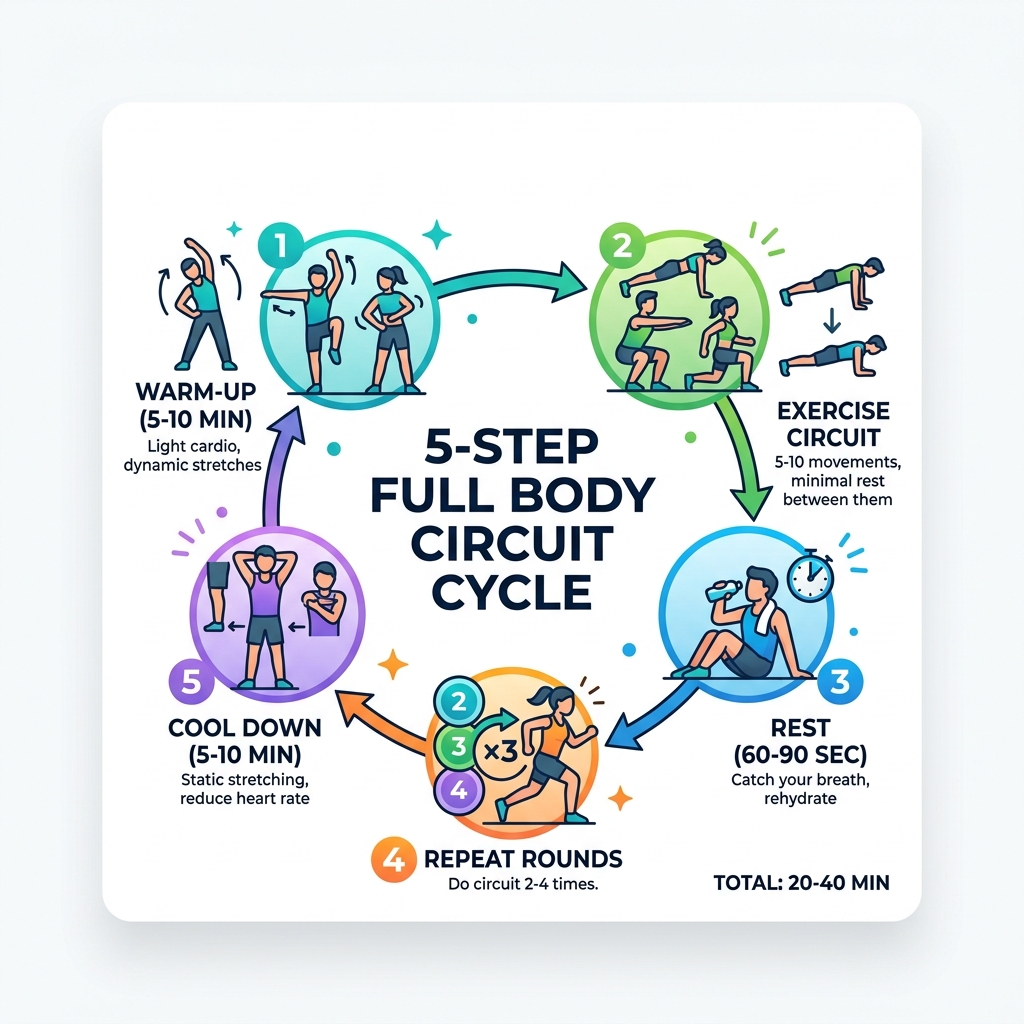
What is a Full Body Circuit at Home and How Does it Work?
At its core, a full body circuit at home is a high-density workout method. “Density” simply means doing more work in less time. Instead of doing a set of squats and then scrolling through your phone for two minutes, you move immediately from your squats to a set of push-ups, then to a plank, and so on.
By minimizing rest, we keep the heart rate elevated, which turns a strength session into a cardiovascular challenge. This is often called “aerobic resistance training.” We aren’t just building muscle; we are improving our heart health and lung capacity at the same time.
The Power of Compound Movements
The secret sauce of an effective circuit is the use of compound movements. These are exercises that involve more than one joint and multiple muscle groups. Think of a squat (knees and hips) versus a calf raise (just ankles). When we use compound moves, we burn more calories per rep and stimulate more muscle growth.
If you are looking for a structured way to start, our Full Body Home Workout Plan offers a great roadmap. By focusing on these big movements, we ensure that every minute spent training yields the maximum possible benefit.
Boosting Your Metabolic Rate
Circuit training doesn’t just burn calories while you’re moving. It also increases your metabolic rate for hours after the workout is over. This is known as the “afterburn effect” or EPOC (Excess Post-exercise Oxygen Consumption). Because the workout is intense, your body has to work harder to return to its resting state, requiring more energy (calories) to repair tissues and replenish oxygen stores. Integrating Bodyweight Exercises for Home into this circuit format is a fantastic way to trigger this effect without needing a single piece of equipment.
Why a Full Body Circuit at Home Beats Traditional Cardio
We’ve all been there: staring at a treadmill screen, watching the seconds tick by like hours. While steady-state cardio (like jogging) has its place, it often fails to build the functional strength that helps us in everyday life.
Fat Burning and Muscle Retention
Scientific research has shown that interval-style circuit training is incredibly effective for burning fat. One reason is that it protects your muscle mass. Pure cardio can sometimes lead to muscle loss if done excessively without resistance training. A full body circuit at home provides the resistance your muscles need to stay “metabolically active.” Muscle tissue burns more calories at rest than fat tissue, so keeping your muscle is key to long-term weight management.
The Efficiency Factor
If you have 30 minutes, you can get a better workout from a circuit than you would from a 30-minute walk. By combining strength and cardio, you are essentially doing two workouts at once. This is why Indoor High-Intensity Interval Training for Weight Loss has become the go-to for busy people. It’s about working smarter, not necessarily longer.
Who Should Start Circuit Training?
The beauty of the circuit format is its scalability. It truly has “something for everyone,” regardless of whether your usual style is yoga, running, or lifting heavy weights.
- Busy Professionals: If your calendar is a minefield of meetings, a 20-minute circuit is your best friend.
- Beginners: It’s a low-barrier way to start. You don’t need to learn 50 different machines; you just need a few solid moves. Our Beginner-Friendly Home Workout Plan is a perfect starting point.
- Home-Bound Parents: You can squeeze a circuit in during a nap time or even have the kids join in for the “fun” moves like frog squats.
- Fitness Enthusiasts: Even if you usually go to the gym, home circuits are a great way to maintain consistency on days when you just can’t make the commute.
Essential Equipment for Your At-Home Routine
While you can get a world-class workout using nothing but your own body weight, having a few key pieces of equipment can help you target specific muscles more effectively.
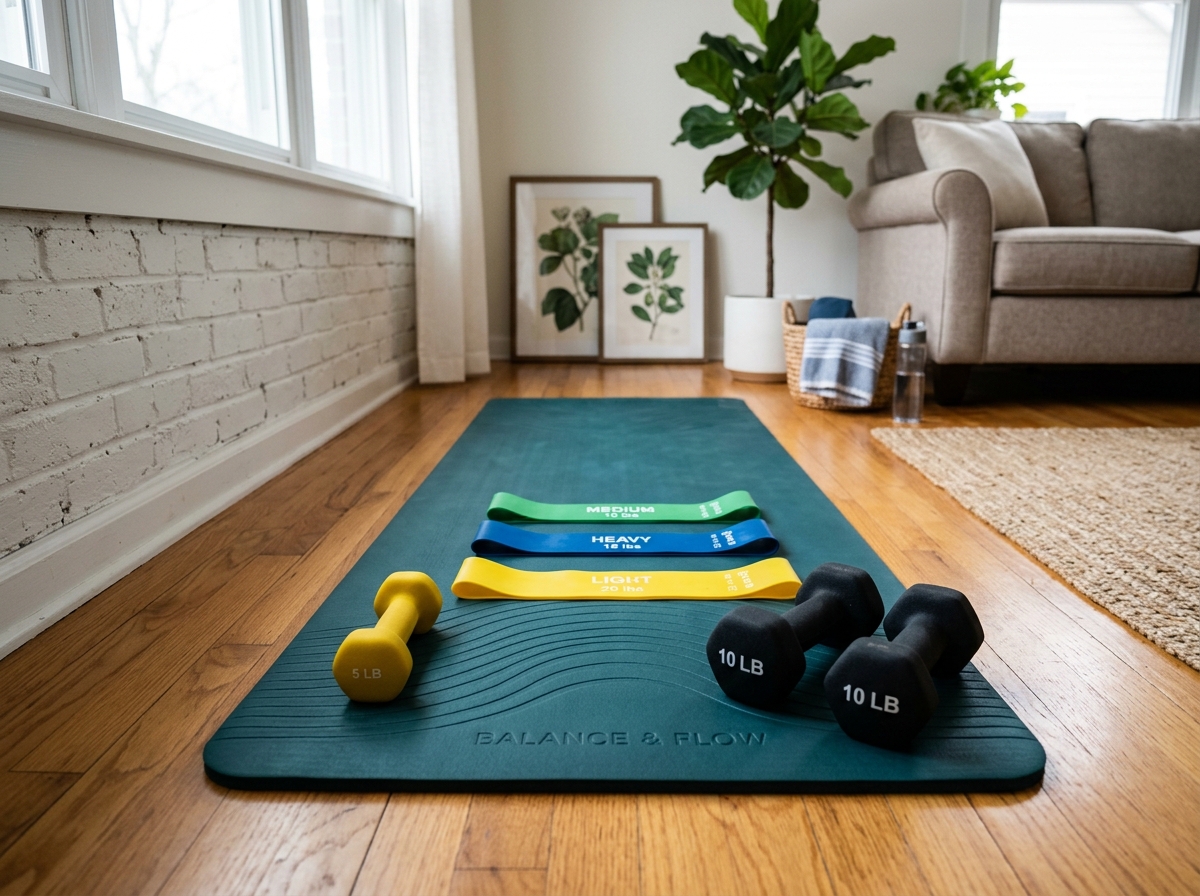
Adjustable Dumbbells
A set of dumbbells (ranging from 5 to 25 pounds for most beginners) is the most versatile tool you can own. They allow you to add “load” to your movements, which is essential for building strength. Check out these Dumbbell Strength Exercises for Home Workouts to see how much variety they provide.
Resistance Bands
Bands are “portable gyms.” They provide tension throughout the entire range of motion and are incredibly joint-friendly. We highly recommend Resistance Band Exercises to Boost Strength for those who want to work on pulling movements (like rows) which are harder to do with just body weight.
Household Items
Don’t have a gym bench? A sturdy chair or a couch works perfectly for tricep dips or step-ups. An exercise mat is also a “must-have” to protect your joints during floor work like planks or glute bridges.
Structuring Your Full Body Circuit at Home for Success
To get the most out of your full body circuit at home, you need to follow a logical flow. Jumping into high-intensity moves with cold muscles is a recipe for injury.
The Dynamic Warm-Up
Spend at least 5 minutes getting your blood pumping. We aren’t talking about static stretching (holding a pose). We want dynamic movement: arm circles, leg swings, and light jogging in place. This prepares your joints and nervous system for the work ahead. For more details on preparation, see our Pre-Workout and Post-Workout Tips.
Work-to-Rest Ratios
The “intensity” of your circuit is controlled by your rest periods. A common beginner ratio is 30 seconds of work followed by 30 seconds of rest. As you get fitter, you can move to 40 seconds of work and 20 seconds of rest. This “time-drop” format is excellent for building endurance. For a deep dive into these structures, our Ultimate Guide to Full Body Weight Training at Home is an invaluable resource.
The Cool-Down
Never just stop and sit on the couch. Spend 3-5 minutes slowing your heart rate down with gentle stretching. This helps prevent blood pooling and reduces muscle soreness the next day.
The Five Key Movement Patterns
Instead of thinking about “biceps” or “quads,” think about movement patterns. This ensures your body stays balanced and functional. A well-rounded full body circuit at home should include one exercise from each of these categories:
- Squatting: Think air squats, goblet squats, or lunges. This targets the front of your legs and your glutes.
- Hinging: Movements like deadlifts or glute bridges. These are vital for your “posterior chain” (hamstrings and lower back).
- Pushing: Push-ups or overhead presses. These work your chest, shoulders, and triceps.
- Pulling: Rows or pull-ups (if you have a bar). These are essential for posture and back strength.
- Core Bracing: Planks or hollow body holds. These stabilize your spine.
For a routine that hits all these marks, look into our Full Body Weight Training Routine at Home.
A Beginner-Friendly Full Body Circuit at Home Routine
Ready to sweat? Here is a simple, no-equipment-needed circuit you can try right now. Perform each move for 30 seconds, rest for 15 seconds between moves, and rest for 90 seconds after the full circuit. Repeat 3 times.
- Jumping Jacks: A classic for a reason. It gets the heart rate up instantly.
- Bodyweight Squats: Keep your chest up and your weight in your heels. If you need more variety, check out these No-Equipment Home Exercises.
- Push-Ups: If a full push-up is too hard, drop to your knees. Focus on keeping your core tight so your hips don’t sag.
- Reverse Lunges: Step back and lower your back knee toward the floor. This is great for balance.
- Plank Hold: Keep your body in a straight line from head to heels. This is the ultimate core stabilizer.
- Glute Bridges: Lie on your back, knees bent, and lift your hips toward the ceiling. Squeeze your glutes at the top!
This routine is a Quick Fat Burning Home Routine that hits every major muscle group. If you find you have a bit more time, try our 20-Minute Fat Burning Workout at Home for an extra challenge.
Safety Tips and Progression Strategies
Safety is our number one priority. In a home setting, without a trainer watching you, you must be your own coach.
Prioritize Form Over Reps
It is better to do five perfect push-ups than twenty “sloppy” ones. Poor form leads to joint pain and injuries. Keep your abs engaged, your spine neutral, and never lock your joints out completely at the top of a movement.
Progressive Overload
To keep seeing results, you have to make the workout harder over time. This is called “progressive overload.” You can do this by:
- Adding more reps.
- Reducing rest time.
- Increasing the weight (if using dumbbells).
- Moving to a harder version of an exercise (e.g., moving from knee push-ups to full push-ups).
Our guide on Muscle Building Home Workouts for Beginners goes into more detail on how to scale your efforts safely.
Hydration and Recovery
Don’t underestimate the power of water. Even a small amount of dehydration can tank your performance. Follow our Hydration Tips for Home Workouts to stay on top of your game. Also, your muscles grow while you rest, not while you’re working out. Give yourself at least one day off between intense circuit sessions. For those focused on weight loss, our Strength Training for Weight Loss: A Beginner’s Guide explains how recovery fits into the bigger picture.
Frequently Asked Questions about Home Circuits
Can I do a full body circuit every day?
We don’t recommend it. While you can move every day, your muscles need time to repair the micro-tears that occur during resistance training. A common rule is to wait 48 hours before training the same muscle group again. Scientific research on recovery and strength suggests that this rest period is vital for muscle repair and growth. On your “off” days, try active recovery like a walk or light stretching.
How long should a home circuit workout last?
The sweet spot for most people is 20 to 30 minutes. Because the intensity is high and the rest is low, you don’t need to spend an hour training. In fact, if you can go for an hour, you might not be working hard enough during your intervals! Our 20-Minute Fat Burning Workout at Home is a perfect example of how much you can achieve in a short window.
What if I don’t have any weights?
No problem! Your body is a weight. You can increase the difficulty of bodyweight moves by increasing “time under tension” (slowing down the movement) or adding explosive elements like squat jumps. Check out our list of No-Equipment Home Exercises for inspiration.
Conclusion
At Casa e Jardim Web, we believe that fitness should be accessible, effective, and sustainable. You don’t need a gym membership or a room full of expensive gear to transform your health. By committing to a full body circuit at home just a few times a week, you can build a stronger, leaner, and more energetic version of yourself.
Consistency is the real “secret” to fitness. Pick a few moves you enjoy, set a timer, and just start moving. Whether you are following our Full Body Home Workout Plan or creating your own, the most important step is the one you take today. Let’s get moving!
