
Why Core Workouts at Home with Dumbbells Beat Traditional Ab Training
Core workouts at home with dumbbells are one of the most effective ways to build real, functional strength — far beyond what endless crunches can deliver.
Quick answer — the best dumbbell core exercises you can do at home:
- Dead Bug – targets deep core, great for beginners
- Russian Twist – hits obliques and rotational strength
- Weighted Sit-Up – builds rectus abdominis
- Dumbbell Wood Chop – trains rotational power
- Renegade Row – challenges anti-rotation stability
- Side Bend – isolates obliques
- Suitcase Crunch – functional lower ab work
- Dumbbell V-Up – advanced full-core challenge
Most people think abs are built with high-rep crunches. They’re not.
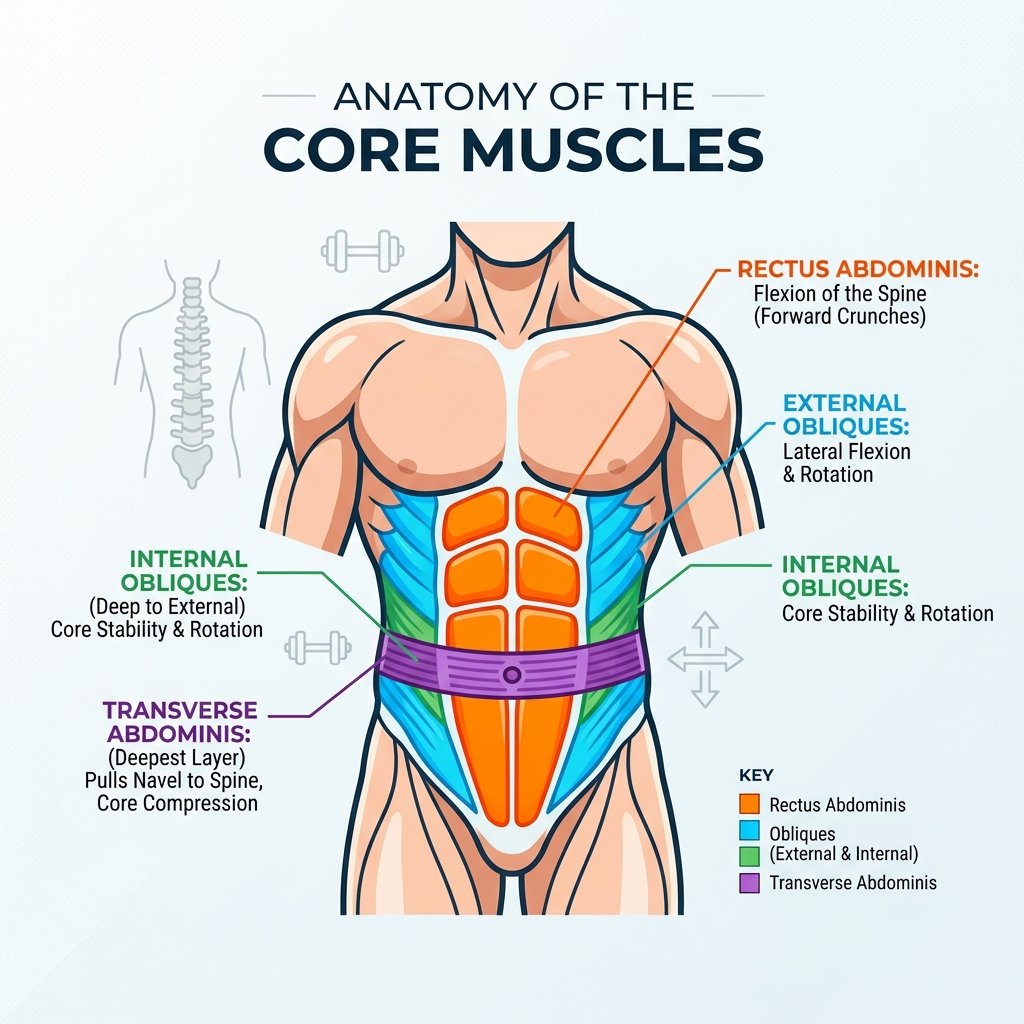
Your core includes multiple muscle groups — the rectus abdominis, obliques, transverse abdominis, and deeper stabilizers along the spine and pelvis. Bodyweight moves alone often miss key areas, especially the obliques and deep stabilizers that protect your lower back.
Adding dumbbells changes everything. The extra resistance forces your muscles to work harder through a principle called progressive overload — the same reason lifting heavier weights builds bigger biceps. Research supports this: dumbbell training promotes greater muscle hypertrophy and definition compared to bodyweight training alone.
And you don’t need a gym for any of it. A single pair of dumbbells and a small floor space is enough to train your entire core from every angle.
The Benefits of Core Workouts at Home with Dumbbells
When we talk about the core, we aren’t just talking about a “six-pack.” We are talking about the central pillar of your entire body. Incorporating core workouts at home with dumbbells offers a range of benefits that go far beyond aesthetics.
Spinal Stability and Back Pain Relief
One of the most significant advantages of weighted core training is improved spinal stability. Research suggests that this 15-minute dumbbell workout can significantly reduce low back pain. By strengthening the deep muscles surrounding the spine, you create a natural “weight belt” that protects your vertebrae from strain. Studies have shown that core stability training is a primary tool for managing chronic low back pain, as it corrects imbalances like anterior pelvic tilt.
Posture Correction and Balance
Do you spend your day hunched over a laptop? We’ve all been there. A strong core acts as the foundation for better posture. When your abdominal and back muscles are strong, they naturally pull your shoulders back and keep your spine aligned. Furthermore, using dumbbells introduces an element of instability. Exercises like the suitcase carry or single-leg deadlifts force your core to work overtime to keep you upright, which drastically improves your balance and coordination.
Metabolic Boost and Athletic Power
Unlike simple crunches, many dumbbell core moves are compound exercises. This means they engage multiple muscle groups simultaneously, leading to a higher caloric burn and a metabolic boost. From an athletic standpoint, power is generated in the core and transferred to the limbs. Whether you are swinging a golf club, running a marathon, or simply picking up a heavy grocery bag, a weighted core provides the explosive force and stability needed for peak performance.
To see how these fit into a broader routine, check out our guide on dumbbell strength exercises for home workouts.
Essential Equipment and Getting Started
You don’t need a massive home gym to see incredible results. At Casa e Jardim Web, we believe in making fitness accessible, and core workouts at home with dumbbells are the epitome of “minimalist but effective.”
Choosing Your Dumbbells
If you are just starting out, we recommend a set of adjustable dumbbells. These allow you to change the weight as you get stronger, saving space and money. For most people, a weight range of 5 to 25 pounds is perfect for core work. Beginners might start with 5–10 pounds for rotational moves and 15–20 pounds for stability moves like carries. If you’re new to weights, our dumbbells 101 for beginners is a great place to start.
Setting Up Your Space
You only need enough room to lie down and extend your arms. A high-quality yoga mat is essential to protect your spine during floor exercises like weighted sit-ups. We also recommend wearing supportive footwear to maintain a stable base during standing exercises.
Safety for Everyone
Weighted training is highly versatile. For instance, at-home strength training for women often focuses on building functional lean muscle, and dumbbells are the perfect tool for this. Always remember to stay hydrated and listen to your body—if your form starts to slip, it’s time to drop the weight or take a break.
The Best Exercises for Complete Core Workouts at Home with Dumbbells
To build a truly strong core, you need to move in every direction: flexion (bending forward), extension (leaning back), rotation (twisting), and anti-rotation (resisting a twist).
The Power of Progressive Overload
The secret sauce of core workouts at home with dumbbells is progressive overload. By gradually increasing the weight or the number of repetitions, you force your muscles to adapt and grow. This is why weighted exercises are often superior to bodyweight-only routines; they provide a clear path for growth.
| Feature | Bodyweight Core Exercises | Weighted Core Exercises (Dumbbells) |
|---|---|---|
| Resistance | Limited to your body weight | Scalable with different dumbbell sizes |
| Muscle Growth | Plateaus quickly | Constant hypertrophy through overload |
| Functional Strength | Good for basic movement | Excellent for real-world lifting/carrying |
| Variety | Can become repetitive | Endless variations and challenges |
If you want a structured approach, consider integrating these into a full body home workout plan.
Targeting Upper and Lower Abs with Core Workouts at Home with Dumbbells
The rectus abdominis (the “six-pack” muscle) is often divided into upper and lower regions in training, though they usually work together.
- Dumbbell Ab Slam: Lie on your back with knees bent. Hold a dumbbell overhead. Perform an explosive sit-up and “slam” (with control!) the weight between your legs. This builds explosive power.
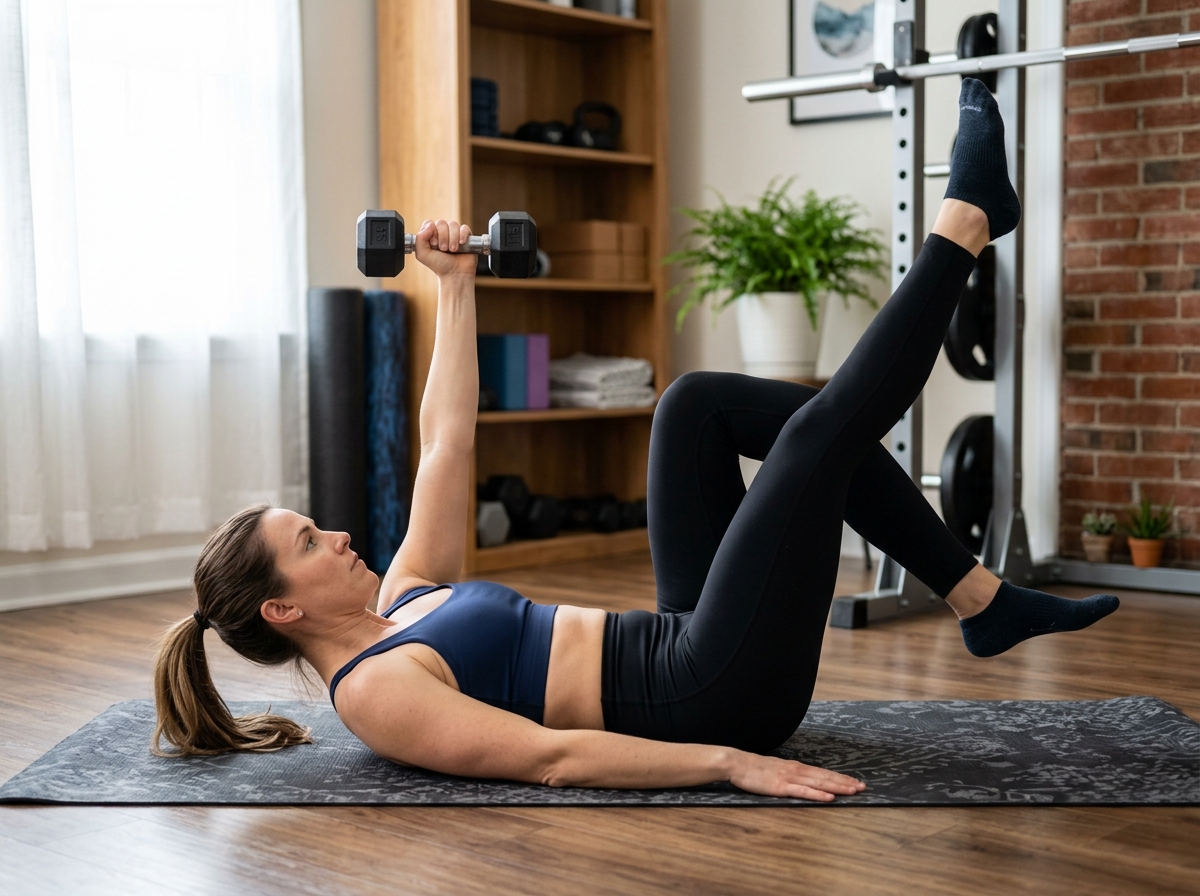
- Suitcase Crunch: This is a fantastic functional move. Lie on your back and bring your knees to your chest while simultaneously bringing the dumbbell toward your shins.
- Weighted Sit-ups: Hold a dumbbell against your chest or overhead to increase the lever length and difficulty.
- Dead Bug with Dumbbell: Hold a single dumbbell with both hands over your chest. As you lower one leg, slowly lower the dumbbell behind your head. This targets the deep transverse abdominis.
- Dumbbell V-Ups: For the advanced trainee, holding a light dumbbell while performing a V-up will set your core on fire.
For more on building total-body strength, see our full body weight training routine at home.
Sculpting Obliques with Core Workouts at Home with Dumbbells
Your obliques are responsible for twisting and side-bending. They are also crucial for protecting your back during rotational movements.
- Dumbbell Russian Twists: Sit on the floor, lean back slightly, and rotate the dumbbell from side to side. Keep your chest up and your back flat.
- Dumbbell Wood Chops: Mimic the motion of swinging an axe. Start with the dumbbell at your hip and “chop” it diagonally across your body to the opposite shoulder. This is one of the best moves for functional power.
- Renegade Rows: Get into a plank position with your hands on two dumbbells. Row one weight to your hip while keeping your hips perfectly still. This is the ultimate anti-rotation exercise.
- Suitcase Carry: Simply hold a heavy dumbbell in one hand and walk. Your obliques on the opposite side must fire to keep you from leaning over.
- T-Pushups: Perform a pushup, then rotate into a side plank while lifting one dumbbell toward the ceiling.
These moves are particularly effective for simple strength training for women at home, as they build a strong, tapered midsection.
How to Structure and Progress Your Routine
Consistency is the name of the game. You don’t need to train your abs every day. In fact, doing so can lead to overtraining.
The Ideal Frequency
We recommend performing core workouts at home with dumbbells 2 to 3 times per week. This allows your muscles enough time to recover and grow. A typical session should last about 15 to 20 minutes, either as a standalone workout or a “finisher” after your main strength routine.
Sets, Reps, and Tempo
- Sets: Aim for 3 to 4 sets per exercise.
- Reps: 10 to 15 repetitions is the “sweet spot” for hypertrophy and endurance.
- Tempo: This is crucial. Don’t rush! Use a controlled 2-second count on the way down and a 1-second explosive count on the way up. Slow, controlled movement ensures your muscles—not momentum—are doing the work.
How to Progress
Once you can easily complete 15 reps with perfect form, it’s time to progress. You can do this by:
- Increasing Weight: Grab a heavier dumbbell.
- Decreasing Rest: Cut your rest time from 60 seconds to 30 seconds.
- Increasing Time Under Tension: Slow down the “lowering” phase of the movement even further.
Maximizing Results: Diet, Body Fat, and Common Mistakes
We have to be honest with you: you can have the strongest abs in the world, but if they are covered by a layer of body fat, you won’t see them.
The 80% Diet Rule
There is a famous saying in the fitness industry: “Abs are made in the gym, but revealed in the kitchen.” Approximately 80% of your visible results will come from your diet. To see muscle definition, you generally need to be in a slight caloric deficit and maintain a low enough body fat percentage. Focus on lean proteins, healthy fats, and complex carbohydrates. For a deep dive, check out our strength training nutrition guide.
Common Form Mistakes to Avoid
- Arching the Back: During floor exercises, keep your lower back pressed firmly into the mat. If your back arches, you are straining your spine instead of working your abs.
- Neck Strain: Don’t pull on your neck during sit-ups. Imagine holding an orange between your chin and your chest.
- Ignoring the Deep Core: Don’t just “suck in” your stomach. Instead, imagine someone is about to punch you in the gut—that “bracing” feeling is your deep core engaging.
Frequently Asked Questions about Weighted Core Training
Can beginners safely perform these dumbbell core exercises?
Absolutely! The beauty of dumbbells is that they are scalable. Beginners should start with very light weights—or even just the movement pattern with no weight at all—to master the form. Exercises like the Dead Bug and the Suitcase Carry are excellent entry points for those new to core training.
How often should I do dumbbell core workouts for optimal results?
As mentioned, 2 to 3 times per week is ideal. Your core muscles need rest just like your biceps or legs. Training them every day can lead to fatigue and poor form, which increases the risk of injury.
Can dumbbell exercises alone give me visible six-pack abs?
Dumbbell exercises will build the muscle required for a six-pack, but visibility depends on your body fat percentage. You need a combination of weighted core training, full-body strength work, and a proper diet to lower your body fat and reveal the muscle underneath.
Conclusion
At Casa e Jardim Web, our mission is to provide you with the tools to build a stronger, healthier version of yourself without needing a gym membership. Core workouts at home with dumbbells are a powerful, versatile, and efficient way to improve your posture, reduce back pain, and build functional strength that carries over into your everyday life.
Whether you are a busy parent looking for a quick 15-minute routine or an athlete aiming to level up your power, these exercises offer something for everyone. Remember to focus on form, stay consistent, and fuel your body with the right nutrients.
Ready to transform your fitness? Start your home strength journey today and explore our wide range of guides tailored for every fitness level!
