
What HIIT for Core Strength Actually Does (And Why It Works)
HIIT for core strength is one of the most time-efficient ways to build a stable, powerful midsection — no gym required. Here’s a quick breakdown of what it delivers:
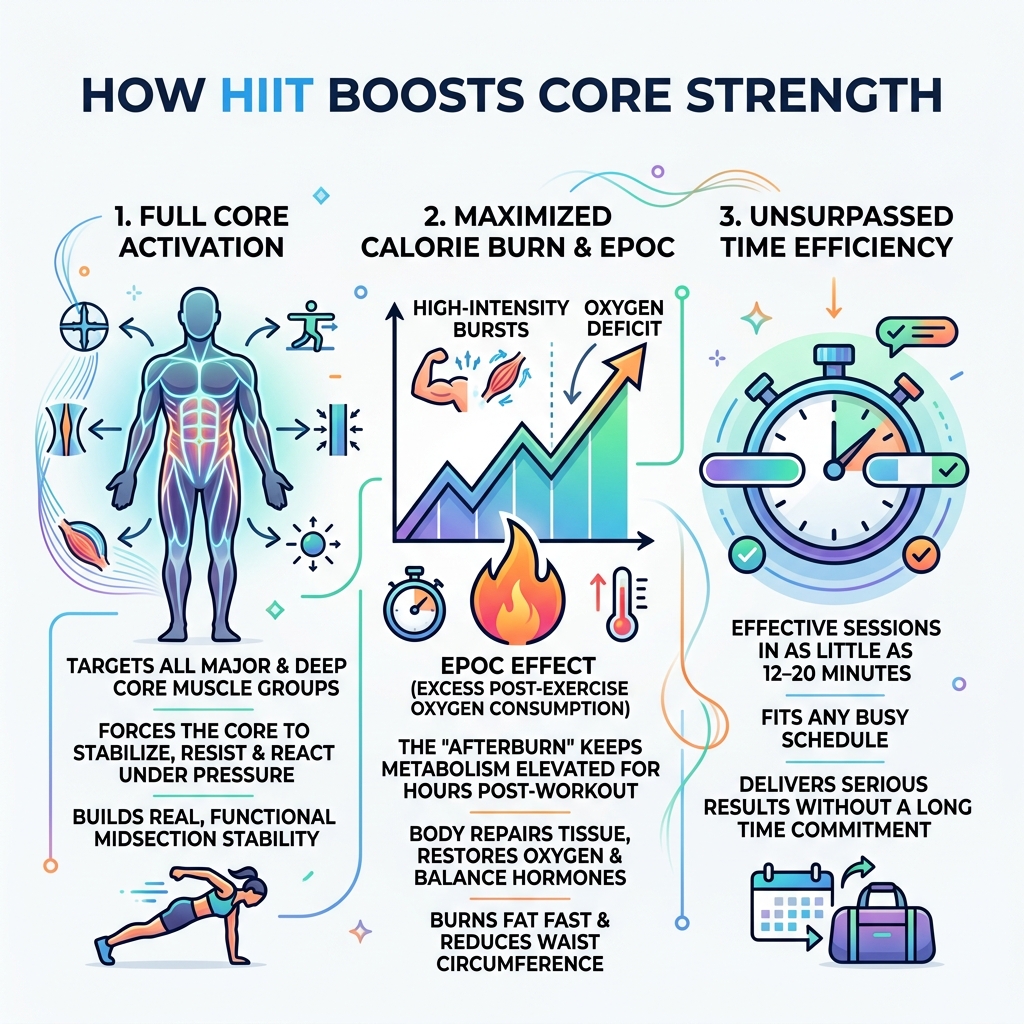
- Burns fat fast — HIIT elevates your heart rate to 80–95% of its maximum, burning more calories in less time than steady-state cardio
- Builds real core stability — exercises target all core muscle groups: rectus abdominis, obliques, and the deep transverse abdominis
- Keeps burning after you stop — the EPOC effect (Excess Post-Exercise Oxygen Consumption) means your metabolism stays elevated for hours post-workout
- Fits any schedule — effective sessions can run as short as 12–20 minutes
- No equipment needed — bodyweight moves alone can deliver serious results
Most people think “core strength” means crunches and a six-pack. It doesn’t.
Your core is the foundation of every movement you make — walking, lifting, twisting, even sitting upright. When it’s weak, your spine pays the price. When it’s strong, everything else gets easier.
That’s where HIIT comes in. By alternating short bursts of intense effort with brief rest periods, HIIT challenges your core muscles in ways that slow, steady exercise simply can’t match. You’re not just flexing your abs — you’re forcing them to stabilize, resist, and react under real pressure.
A review of 13 studies covering over 400 overweight adults found that HIIT reduces waist circumference just as effectively as traditional moderate-intensity exercise — often in far less time.
The moves in this guide take as little as 12 minutes. They work whether you’re a complete beginner or a seasoned athlete. And they’ll hit your core from every angle — front, sides, and back.
The Science of HIIT for Core Strength
When we talk about HIIT for core strength, we aren’t just talking about getting “tired.” We are talking about a physiological shift in how your body processes energy. The secret sauce of High-Intensity Interval Training is a phenomenon known as Excess Post-Exercise Oxygen Consumption, or EPOC.
Commonly called the “afterburn effect,” EPOC occurs because high-intensity bursts create an oxygen deficit. Your body has to work overtime for hours after your session to restore oxygen levels, balance hormones, and repair muscle tissue. This means you continue burning calories at a higher rate while sitting on your couch post-workout. Research suggests HIIT increases metabolism more effectively than jogging or traditional weight training because of this metabolic demand. In fact, scientific research on HIIT and abdominal fat reduction indicates that high-intensity intervals are significantly more time-efficient for reducing waist circumference.
Furthermore, HIIT is a powerhouse for fat loss. There are two types of fat we deal with: subcutaneous (the stuff you can pinch under your skin) and visceral (the dangerous fat stored around your internal organs). HIIT has been shown to be particularly effective at targeting visceral fat. By improving insulin sensitivity and increasing the body’s ability to oxidize fat, HIIT helps reveal the muscle you’re building underneath. For more on how this helps with slimming down, check out our guide on indoor-high-intensity-interval-training-for-weight-loss.
To get these benefits, you need to reach the right heart rate zones. True HIIT requires working at 80% to 95% of your maximum heart rate. This intensity triggers the release of growth hormones and catecholamines (like adrenaline), which drive fat mobilization. When you pair this intensity with core-specific movements, you aren’t just building “show” muscles; you’re building a metabolic furnace.
Why a Strong Core Matters Beyond Aesthetics
While a defined midsection is a nice perk, the real value of a strong core lies in functional health. At Casa e Jardim Web, we believe fitness should make your daily life better. Your core is actually a complex system of 35 different muscle groups connecting your spine, pelvis, and hips.
A strong core acts as a natural weightlifting belt. It protects your spine during everyday activities like carrying groceries, picking up a toddler, or sitting at a desk for eight hours. Without a stable center, your lower back takes the brunt of the load, leading to the chronic aches many of us know all too well.
In HIIT for core strength, we focus on two types of patterns: movement and anti-movement.
| Pattern | Description | Example |
|---|---|---|
| Movement | The core creates motion (flexion, rotation). | Russian Twists, Crunches |
| Anti-Movement | The core resists motion to keep the spine still. | Planks, Bear Crawls |
Training both patterns is essential for athletic performance. Whether you are following a full-body-home-workout-plan or training for a marathon, your core is the “bridge” that transfers energy between your upper and lower body. If the bridge is weak, energy leaks out, and your performance suffers. By mastering these patterns, you improve balance, stability, and posture simultaneously.
Ten Essential HIIT Moves for Core Strength
Ready to sweat? These ten moves are designed to be performed in a HIIT format—meaning you go all-out during the work interval and recover during the rest. These target the “Big Three”: the rectus abdominis (six-pack), the obliques (sides), and the transverse abdominis (the deep “corset” muscle).
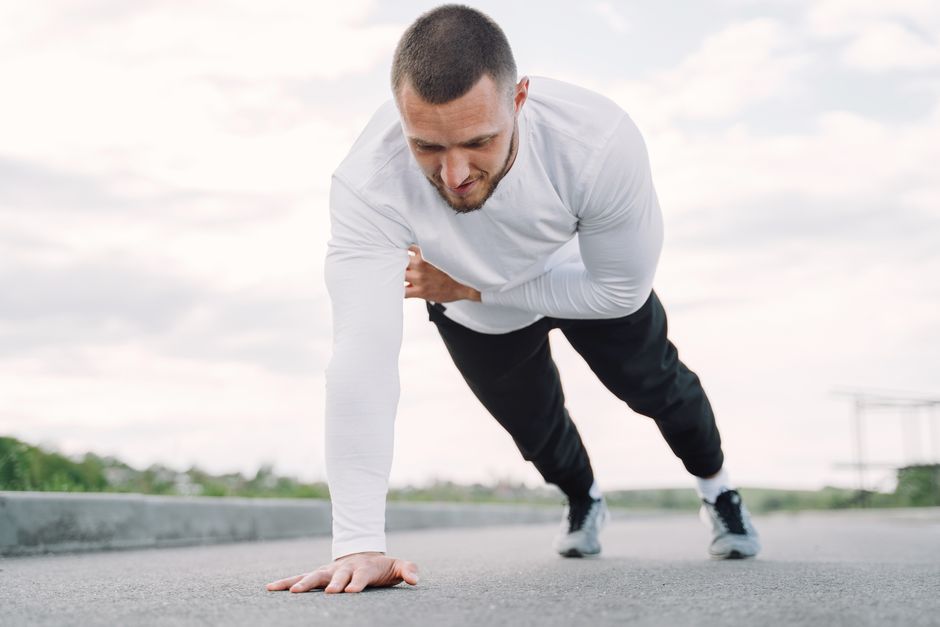
- Mountain Climbers: Start in a high plank. Drive your knees toward your chest as fast as possible while keeping your hips level. This provides a massive cardio boost while forcing your core to stabilize against the rapid leg movement.
- Flutter Kicks: Lie on your back and lift your legs six inches off the floor. Kick them up and down in a small, rapid swimming motion. Press your lower back into the mat to engage the deep transverse abdominis.
- Russian Twists: Sit with your knees bent and feet slightly off the ground. Twist your torso from side to side. To make this effective, ensure your shoulders are rotating, not just your arms.
- Bear Crawls: Hover your knees just an inch off the ground on all fours. Move forward and backward. This “anti-extension” move is incredible for spine protection.
- Plank Jacks: From a forearm or high plank, jump your feet out and in like a jumping jack. This challenges your core to maintain a neutral spine while your lower body creates instability.
- Reverse Crunches: Lie on your back with legs in a tabletop position. Curl your hips just two to three inches off the floor using your lower abs. Avoid using momentum!
- Side Plank Crunches: In a side plank, bring your top elbow and top knee together. This targets the obliques and improves lateral stability.
- Hollow Body Rocks: Lie flat, then lift your arms and legs to create a “banana” shape. Rock slightly back and forth. This is the ultimate test of core tension.
- Sprawls: A “half-burpee.” Drop into a plank, then jump your feet back up into a wide squat. It’s explosive and hits the entire midsection.
- Wood Chops: Imagine you are swinging an axe diagonally from your shoulder to your opposite hip. This rotational power move is essential for functional strength.
For more ideas on using your own weight to get fit, see our bodyweight-exercises-for-home guide.
Beginner Modifications for HIIT for Core Strength
If you’re just starting, don’t feel pressured to match the speed of a pro. The goal is to keep your heart rate up while maintaining perfect form. We recommend a 20/40 work-to-rest ratio. Work for 20 seconds, and rest for 40 seconds. This allows your heart rate to recover enough so you can maintain quality in the next round.
Other modifications include:
- Knee-down options: Perform planks or side planks on your knees rather than your toes.
- Reduced range of motion: In Russian twists, keep your feet on the floor to focus on the torso rotation first.
- Form over speed: It is better to do five slow, perfect mountain climbers than twenty sloppy ones that hurt your back.
Beginners can also benefit from our beginners-upper-body-strength-workout to build the foundational shoulder stability needed for many plank-based core moves.
Advanced Progressions in HIIT for Core Strength
For those who find bodyweight moves too easy, it’s time to turn up the heat. You can move to a 50/10 work-to-rest ratio (50 seconds of work, 10 seconds of rest). This minimal recovery time keeps the metabolic demand sky-high.
You can also incorporate equipment. Adding a dumbbell to your Russian twists or wood chops increases the resistance your core must overcome. If you’re looking for gear-based ideas, our dumbbell-strength-exercises-for-home-workouts is a great resource. Another way to progress is to add isometric holds—pausing for three seconds at the most difficult part of a movement (like the bottom of a hollow body rock) to maximize time under tension.
Maximizing Results: Form, Breathing, and Frequency
The most common mistake in HIIT for core strength is “forgetting” to actually use the core. To maximize results, you must master the art of engagement.
The “Exhale” Secret: Your diaphragm and core are deeply linked. When you perform a difficult movement (like the “up” phase of a crunch or a sprawl), exhale forcefully through your mouth. This contraction helps engage the transverse abdominis, creating a “stiff” core that protects your spine. Research on core muscle activation shows that specific breathing patterns significantly increase the electrical activity in your abdominal muscles. According to scientific research on core muscle activation and breathing, forced exhalation during the concentric phase of an exercise maximizes the recruitment of deep stabilizing muscles.
Neutral Spine: Always aim for a “flat” back. If your lower back arches during flutter kicks or planks, you’ve lost core engagement and are straining your hip flexors and spine. If you feel a “pinch” in your back, stop, reset, and choose a simpler modification.
Frequency and Recovery: How often should you do this? Because HIIT is intense, you don’t need to do it every day. Aim for 2–3 sessions per week, allowing at least 48 hours between core-focused HIIT sessions for muscle repair. Pair this with a balanced ultimate-guide-to-full-body-weight-training-at-home for the best results.
Lastly, don’t forget nutrition and hydration. No amount of HIIT can “undo” a poor diet, especially when it comes to seeing those abdominal muscles. Focus on whole foods and lean proteins to support muscle recovery.
Frequently Asked Questions about HIIT Core Training
Can HIIT core workouts reduce belly fat?
The short answer is yes, but with a caveat. You cannot “spot reduce” fat. Doing a thousand crunches won’t melt fat specifically from your stomach. However, HIIT is incredibly effective at creating a caloric deficit and burning visceral fat (the fat around your organs). Because HIIT raises your metabolic rate via EPOC, it helps lower your overall body fat percentage, which eventually reveals a leaner midsection. Nutrition plays a massive role here—abs are truly built in the gym but revealed in the kitchen!
How long should a HIIT core session last?
One of the best things about HIIT for core strength is the efficiency. A typical session should last between 12 and 30 minutes. If you can go for an hour, you probably aren’t working at a high enough intensity! A 15-minute session consisting of a 3-minute warm-up, 10 minutes of high-intensity intervals, and a 2-minute cool-down is more than enough for most people.
Do I need equipment for HIIT core training?
Absolutely not! Bodyweight exercises like planks, mountain climbers, and bear crawls are some of the most effective moves in existence. While you can add dumbbells or medicine balls to increase the challenge as you get stronger, a simple exercise mat and a timer are all you really need to get started at home.
Conclusion
Building a rock-solid midsection isn’t about spending hours on a floor mat doing endless crunches. By utilizing HIIT for core strength, you can achieve better results in a fraction of the time. Whether your goal is to reduce back pain, improve your athletic performance, or simply feel more confident, these ten moves provide a comprehensive framework for success.
At Casa e Jardim Web, we are dedicated to making fitness accessible. You don’t need an expensive gym membership to see real changes. Start with the beginner modifications, focus on your breathing, and stay consistent. Over time, you can utilize progressive overload to keep challenging yourself.
Ready to explore more? Check out our other home workout guides and tips to continue your fitness journey. Your strongest self is just a few intervals away!
