
The Benefits of Bodyweight Arm Exercises for Strength and Definition
When we think of building “guns,” we often picture heavy dumbbells and complex cable machines. However, we have found that bodyweight arm exercises offer a unique set of benefits that weights simply cannot match. Beyond the obvious convenience of being able to train in your pajamas, these movements build what we call “functional strength”—the kind of power you use to lift a heavy grocery bag, push open a stuck door, or hoist a suitcase into an overhead bin.
One of the most significant advantages is the improvement in bone density. Research shows that weight-bearing exercises, such as push-ups, load the bones in the wrists and forearms. This is crucial for long-term health, as it helps prevent age-related fractures. Furthermore, a 2023 study published in Biology highlights that upper body exercise training significantly enhances aerobic fitness and overall performance, even in healthy individuals Biology, 2023.
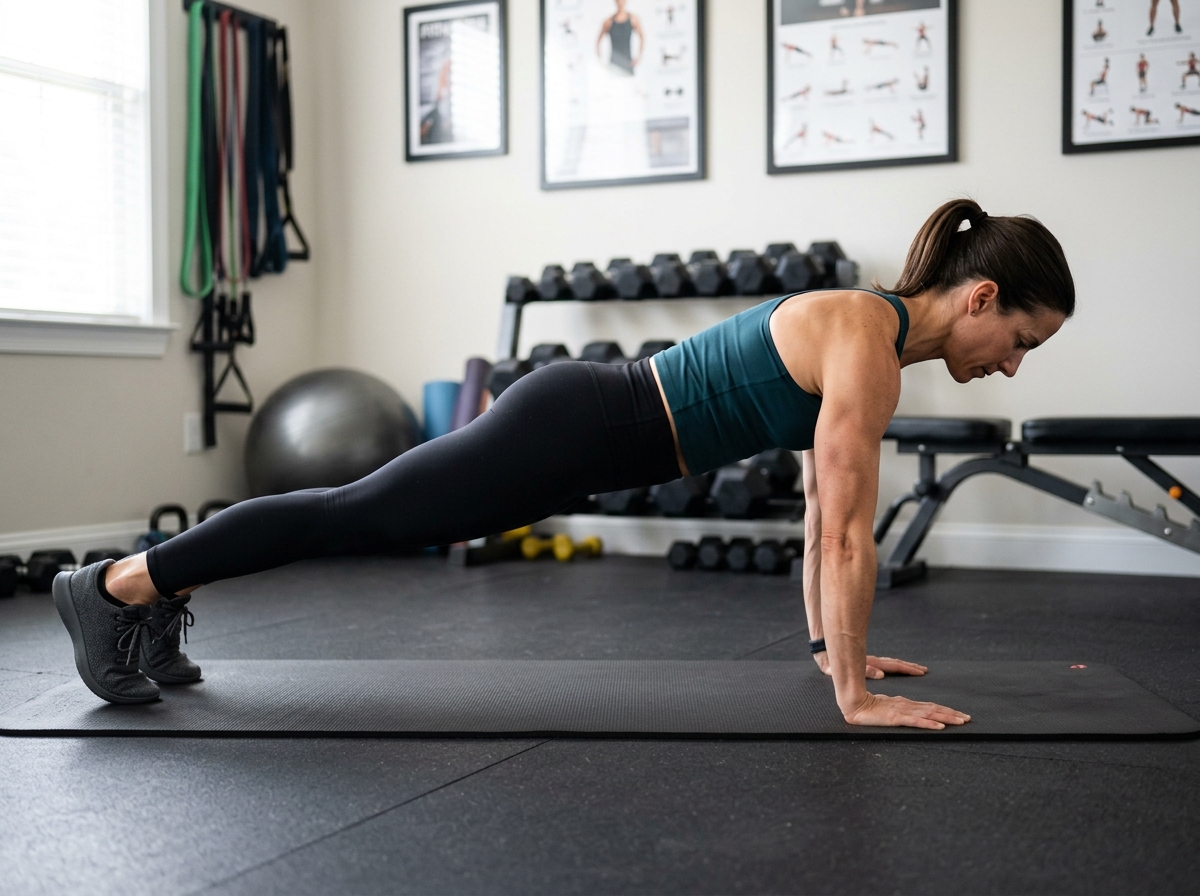
If you have ever held a plank and felt like time literally stopped, you know the power of isometric tension. Planks don’t just “tone” the arms; they improve respiratory capacity and physical fitness. A 2023 study in the Journal of Exercise Rehabilitation found that plank exercises significantly improve immunocytes and physical fitness in older adults J Exerc Rehabil, 2023. By integrating these moves into your routine, you are also working on your posture. Many of these exercises require a neutral spine and engaged core, which naturally counteracts the “slouch” we get from staring at screens all day. For more on how these moves fit into a broader plan, check out our guide on bodyweight-exercises-for-home.
10 Best Bodyweight Arm Exercises for Beginners
Ready to start? We have curated this list to ensure you hit every angle of your arms—the biceps, triceps, and deltoids (shoulders). While bodyweight moves often engage multiple muscle groups at once, we can shift the focus to specific areas by changing our hand placement or body angle.
Before diving in, remember: form is everything. It is better to do five perfect repetitions than twenty sloppy ones that risk a shoulder impingement. If you are brand new to fitness, you might also enjoy our beginners-upper-body-strength-workout for additional foundational tips.
1. Standard Push-Ups
The push-up is the undisputed king of bodyweight arm exercises. While it is famous for building a strong chest, it is also a powerhouse for the triceps and the anterior deltoids (the front of your shoulders).
- How to do it: Start in a high plank position with hands slightly wider than shoulder-width. Lower your body until your chest nearly touches the floor, keeping your elbows at a 45-degree angle to your torso.
- Form Cue: Imagine your body is a straight piece of wood from your head to your heels. Don’t let your hips sag or your “butt” stick up in the air.
- Modification: If a full push-up is too much, drop to your knees or perform them against a sturdy kitchen counter.
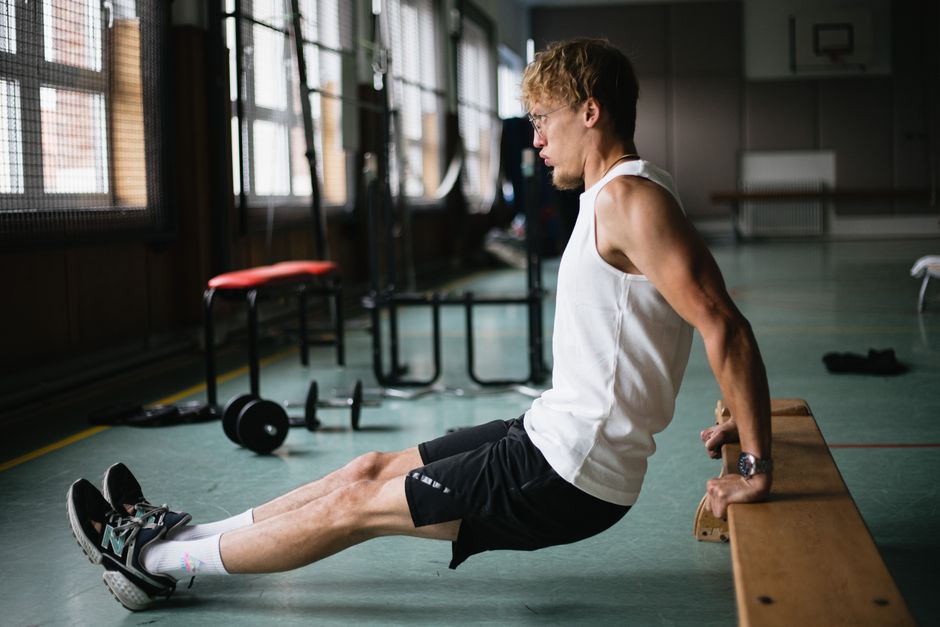
2. Triceps Dips
If you want to target the back of the arm, dips are your best friend. This move isolates the triceps by using your body weight to create elbow extension.
- How to do it: Sit on the edge of a stable chair or bench with your hands next to your hips. Slide off the seat, supporting your weight with your arms. Lower your hips toward the floor by bending your elbows to 90 degrees, then push back up.
- Form Cue: Keep your back close to the chair (about 3 to 6 inches away). If you drift too far forward, you put unnecessary strain on your shoulder joints.
- Expert Tip: For an easy home workout without equipment, you can even do these on the floor in a “crab” position.
3. Plank Up-Downs
This is a dynamic move that challenges your shoulder endurance and core stability simultaneously. It’s a “moving plank” that forces your arms to stabilize your entire weight as you transition.
- How to do it: Start in a high plank (on your hands). Lower your right elbow to the floor, then your left, so you are in a forearm plank. Then, push back up to your hands one at a time.
- Form Cue: Try to keep your hips as still as possible. Imagine you have a glass of water resting on your lower back and you don’t want to spill a drop.
4. Superman with Pulldown
We often forget the back of the shoulders (posterior deltoids), but they are vital for posture. Since your arms weigh about 10-12% of your total body weight, moving them through a full range of motion while prone provides surprisingly effective resistance Biology, 2023.
- How to do it: Lie face down on the floor. Lift your chest and arms off the ground. Reach your arms forward, then pull your elbows back toward your ribs, squeezing your shoulder blades together as if you are pulling a heavy bar down.
- Form Cue: Keep your gaze at the floor to maintain a neutral neck. Don’t look up at the wall in front of you.
5. Inchworms
Inchworms are fantastic for full-body integration. They stretch the hamstrings while putting your shoulders and biceps through a “walking” motion that builds stability.
- How to do it: Stand tall, then fold forward to touch the floor. Walk your hands out until you are in a high plank position. Pause for a second, then walk your hands back toward your feet and stand up.
- Form Cue: Keep your legs as straight as possible to get the added benefit of a stretch, but bend your knees if your hamstrings are tight.
6. Diamond Push-Ups
Once you have mastered the standard push-up, the diamond version is the ultimate triceps isolator. By bringing your hands together, you reduce the involvement of the chest and force the arms to do the heavy lifting.
- How to do it: In a push-up position, place your hands together so your index fingers and thumbs form a diamond shape directly under your chest. Lower yourself down and push back up.
- Form Cue: Keep your elbows tucked close to your sides. If they flare out, you lose the triceps focus and stress the shoulders.
7. Bear Crawls
Bear crawls might look like child’s play, but they are an incredible way to build functional mobility and wrist health. They require constant coordination between your arms and legs.
- How to do it: Get on all fours with your knees hovering just an inch off the ground. “Walk” forward by moving your opposite hand and foot at the same time (right hand/left foot).
- Form Cue: Keep your back flat and your knees low. If your hips rise too high, the weight shifts off your arms.
8. Reverse Plank
While standard planks work the front of the body, the reverse plank targets the posterior chain and keeps the triceps under constant static tension.
- How to do it: Sit with your legs extended. Place your hands behind you, fingers pointing toward your feet. Press into your palms and lift your hips until your body forms a straight line from head to heels.
- Form Cue: Don’t let your head fall back. Keep your chin slightly tucked and look toward your toes.
9. Arm Circles
Don’t let the simplicity fool you. Doing high repetitions of arm circles creates a massive “burn” in the deltoids. It’s an essential move for shoulder mobility and endurance.
- How to do it: Stand with arms extended straight out to the sides at shoulder height. Make small, controlled circles. Do 30 seconds forward, then 30 seconds backward.
- Form Cue: Keep your shoulders depressed (down away from your ears). Don’t let them “shrug” up as you get tired.
10. Wall Angels
Wall angels are a “rehab” style move that is perfect for beginners. They strengthen the rotator cuff and the small muscles around the shoulder blades that are often weak.
- How to do it: Stand with your back flat against a wall. Place your arms against the wall in a “goalpost” position. Slowly slide your arms up toward the ceiling and back down, keeping your elbows and wrists in contact with the wall the entire time.
- Form Cue: If your lower back arches off the wall, you’ve gone too high. Keep your core tight.
How to Structure Your Bodyweight Arm Exercises Routine
To see progress, you need a plan. We recommend choosing 5 to 6 of the exercises above and performing them in a circuit. This keeps your heart rate up while giving specific muscle groups a “break” while others work.
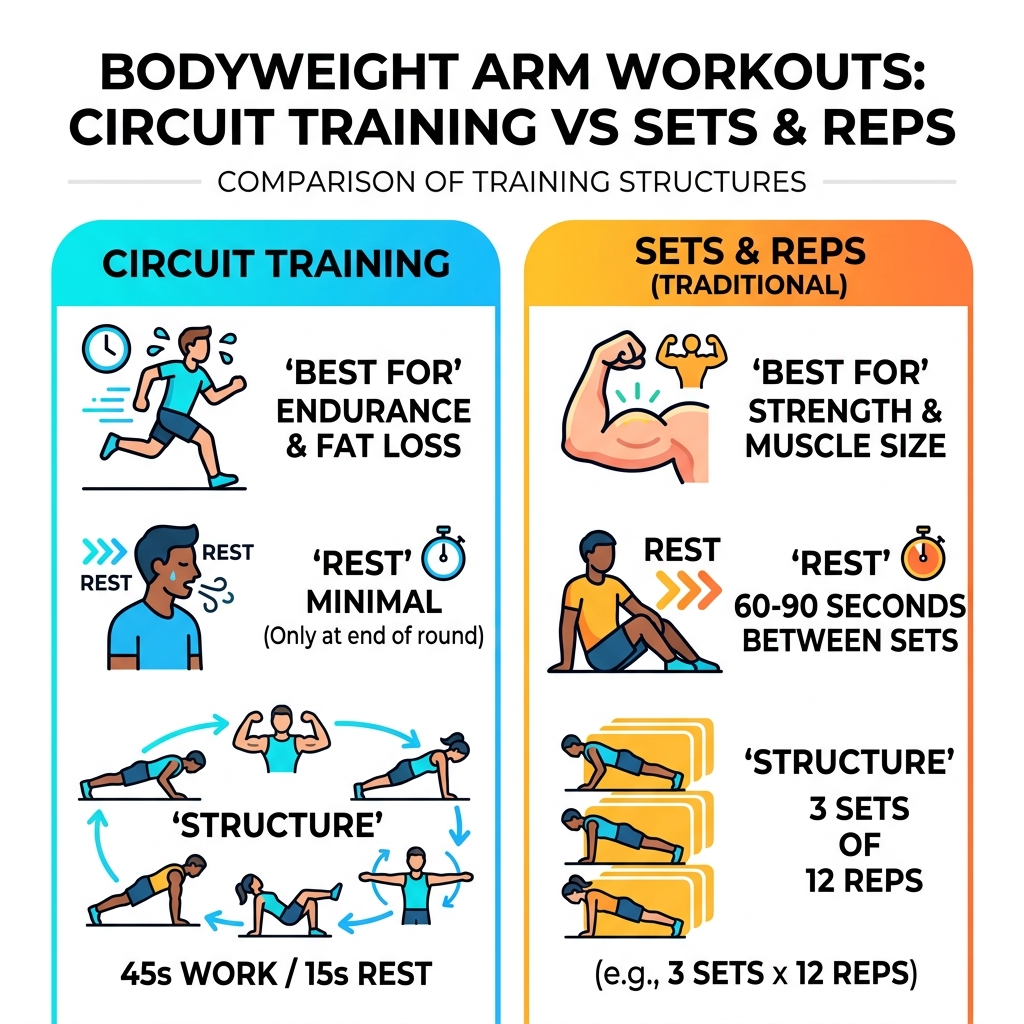
| Feature | Circuit Training | Sets & Reps (Traditional) |
|---|---|---|
| Best For | Endurance & Fat Loss | Strength & Muscle Size |
| Rest | Minimal (only at the end of a round) | 60-90 seconds between sets |
| Structure | 45s work / 15s rest | 3 sets of 12 reps |
| Time | Fast (15-20 mins) | Moderate (30-45 mins) |
For most beginners, we suggest a frequency of 2 to 3 sessions per week on non-consecutive days. Your muscles need at least 48 hours to repair the tiny micro-tears created during exercise—this is actually when the muscle grows! If you want a more comprehensive approach, see our full-body home workout plan.
Maximizing Results with Bodyweight Arm Exercises
Since we aren’t adding heavy plates to a bar, we have to find other ways to make the muscles work harder. This is called Progressive Overload. Here are our favorite tricks:
- Time Under Tension: Instead of rushing through a push-up, take 3 seconds to lower down and 3 seconds to push up. This makes the muscle work for a longer duration.
- Tempo Training: Try a “1-1-3” tempo. One second up, one second hold, three seconds down.
- Increase Repetitions: Aim for 12 to 20 reps. Once 20 feels easy, move to a harder variation (like Diamond Push-ups).
- Reduce Rest: Shorten your rest periods from 60 seconds to 30 seconds to increase the intensity. For more strategies, check out our tips on building-upper-body-strength-easy-home-workouts.
Effective Workout Form and Common Mistakes
We see the same mistakes over and over, and they usually lead to plateauing or injury.
- Elbow Flaring: In push-ups and dips, keep your elbows tucked. Flaring them out to the side puts immense pressure on the rotator cuff.
- Sagging Hips: This usually means your core is “off.” Engage your glutes and abs to keep your body straight.
- Partial Range of Motion: Go all the way down and all the way up. “Half-reps” only give you half the results.
- Holding Your Breath: Exhale on the effort (the “push” or “pull” part of the move).
Check out our at-home-workout-for-upper-body for a deeper dive into form.
Frequently Asked Questions about Bodyweight Arm Exercises
Can you build muscle with bodyweight arm exercises?
Yes, but with a caveat. Beginners will see significant muscle growth (hypertrophy) as their body adapts to the new stimulus. However, bodyweight training eventually reaches a limit for “bulking.” To keep growing, you must use variations that increase mechanical tension—like moving from regular push-ups to decline push-ups (feet elevated). If your goal is “toned” arms, high-volume bodyweight training is exceptionally effective.
How often should I do these exercises?
Consistency is the secret sauce. We recommend 2 to 3 times a week. If you are doing a home-workout-for-muscle-toning, you can alternate arm days with lower body days to ensure you are getting a balanced physique while allowing for recovery.
What are the best modifications for absolute beginners?
If a move feels impossible, don’t quit—modify!
- Push-ups: Use a wall or a kitchen counter to reduce the percentage of body weight you are lifting.
- Plank Up-Downs: Perform them on your knees until your shoulders get stronger.
- Dips: Keep your knees bent and feet close to your body. This allows your legs to “help” push you back up.
Conclusion
At Casa e Jardim Web, we believe that fitness should be accessible to everyone, regardless of whether they have a gym membership or a set of expensive weights. Bodyweight arm exercises prove that your own body is the most powerful tool you own. By mastering these 10 moves, you aren’t just working toward “toned” arms; you are building a foundation of functional strength that will serve you in every aspect of your daily life.
The journey to stronger arms doesn’t happen overnight, but with consistency and the right form, the results will come. Start with one circuit today, even if it’s just for ten minutes. You’ll be surprised at how empowered you feel when you realize you can “conquer the world” using nothing but your own strength. For more inspiration, explore our other bodyweight-exercises-for-home.
