
What Is a Beginner Calisthenics Upper Guide (And Why It Works)
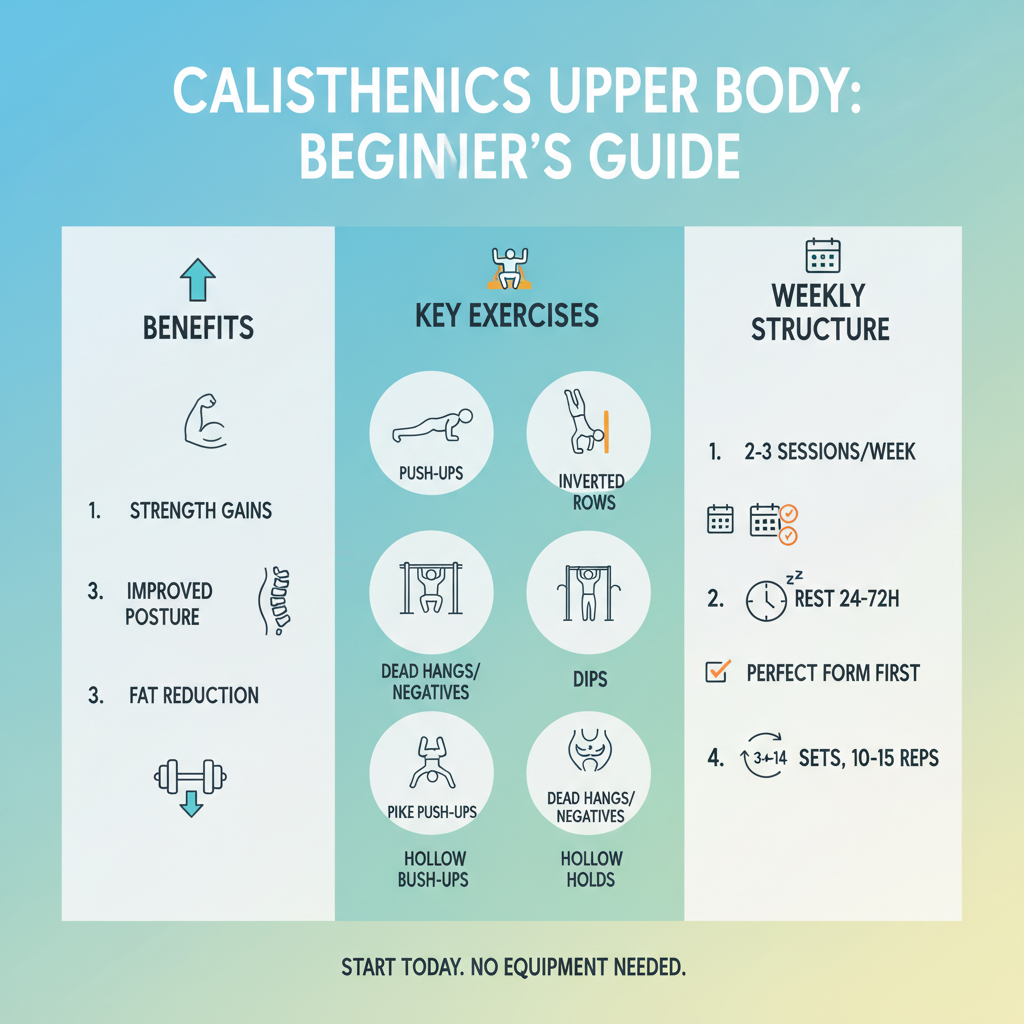
A beginner calisthenics upper guide is a structured plan to build upper body strength using only your bodyweight — no gym, no heavy equipment, no excuses. Here’s what you need to know right away:
The essential beginner upper body calisthenics exercises are:
- Push-ups (and scaled versions like incline or knee push-ups)
- Inverted rows (using a low bar or table)
- Dips (using parallel bars or sturdy chairs)
- Dead hangs and negative pull-ups (building toward full pull-ups)
- Pike push-ups (shoulder strength and stability)
- Hollow body holds (core tension for every movement)
Basic structure for beginners:
- Train 2-3 times per week
- Rest at least 24-72 hours between sessions targeting the same muscles
- Start with the easiest variation you can do with perfect form
- Progress when you can complete 3-4 sets of 10-15 reps at a comfortable effort
The word calisthenics comes from the Greek words kalos (beauty) and stenos (strength). That combination says it all — this style of training builds a body that looks good and functions well.
The best part? You don’t need a gym membership or expensive gear. Your bodyweight and gravity do the work.
Research backs this up. Studies show that just 8 weeks of calisthenics training can increase strength, reduce fat mass, and improve posture. And push-ups — the most basic move in this guide — build comparable muscle size and strength to bench pressing a moderate load.
You don’t need to be fit to start. You just need to start.
Why Start a Beginner Calisthenics Upper Guide Today?
If you have ever felt intimidated by the heavy weights and complex machines at the gym, you are not alone. Many of us want to be stronger but don’t know where to begin. This is exactly where a beginner calisthenics upper guide becomes your best friend.
Scientific research on calisthenics and posture indicates that bodyweight training isn’t just about looking like a gymnast; it is about functional health. Over an eight-week period, participants in calisthenics programs saw significant improvements in their posture and a reduction in fat mass. When we train with our own weight, we are forced to stabilize our entire torso, which naturally corrects the “slouch” many of us develop from sitting at desks.
Furthermore, calisthenics is the king of scalability. Whether you are a total novice or a returning athlete, there is a version of every exercise that fits your current strength. By using bodyweight exercises for home, you can build an impressive strength-to-weight ratio. This means you aren’t just “big”—you are powerful and in control of your own frame.
One of the most underrated benefits we see in our community is the development of the mind-muscle connection. Because you aren’t just pushing a metal bar, you have to focus on every fiber of your chest, back, and arms to keep your body aligned. This focus leads to better muscle hypertrophy (growth) because you are truly engaging the target muscles rather than just going through the motions.
Master the Fundamentals: Essential Upper Body Exercises
Before we dive into the deep end, we need to talk about form. In calisthenics, form isn’t just about safety; it’s about “locking in” the strength. We often see beginners rushing to do 50 messy push-ups, but we promise you that 10 perfect ones will build more muscle.

Two concepts you must master are scapular retraction and the hollow body position.
- Scapular Retraction: This is the act of pulling your shoulder blades back and down (imagine trying to pinch a pencil between them). This protects your shoulders and engages your back muscles during pulling moves.
- Hollow Body: This involves bracing your core, tucking your pelvis, and squeezing your glutes. It turns your body into a solid “plank,” preventing energy leaks.
To get started with a beginners upper body strength workout, you only need a few basic tools. While calisthenics is “equipment-free,” having a few anchors helps you hit the “pulling” muscles that are hard to train on a flat floor.
| Equipment | Why You Need It | Home Alternative |
|---|---|---|
| Pull-up Bar | Essential for vertical pulling and hangs. | A sturdy tree branch or playground bar. |
| Resistance Bands | Helps “lighten” your body for pull-ups/dips. | N/A (Highly recommended investment). |
| Parallel Bars / Dip Station | For tricep and chest dips. | Two sturdy chairs of the same height. |
| Low Bar / Rings | Best for inverted rows. | A sturdy dining table (edge grip). |
Vertical Pulling in Your Beginner Calisthenics Upper Guide
Pulling is often the hardest part of a beginner calisthenics upper guide because most of us don’t use these muscles in daily life. You can’t just jump into a pull-up on day one. We start with the foundations.
- Dead Hangs: Simply hang from the bar. This builds grip strength and shoulder health. Aim for 30–60 seconds.
- Scapular Pulls: While hanging with straight arms, pull your shoulder blades down and back, lifting your chest slightly. This teaches “lat engagement.”
- Negative Pull-ups: Jump to the top of the bar and lower yourself as slowly as possible (aim for 5–10 seconds). Research shows that the “eccentric” (lowering) phase is where the most strength is built.
- Chin-ups: Once you have the strength, use an underhand grip. This recruits the biceps more, making the move slightly easier than a traditional pull-up.
Learning these steps is the secret to building upper body strength easy home workouts that actually yield results.
Horizontal Pushing in Your Beginner Calisthenics Upper Guide
Pushing exercises target your chest, shoulders, and triceps. The push-up is the gold standard here, but if you can’t do one yet, don’t sweat it. We use leverage to make it easier.
- Incline Push-ups: Place your hands on a raised surface like a table or bench. The higher the surface, the easier the move. This is the best way to start for absolute beginners.
- Knee Push-ups: A classic modification, but ensure your body stays in a straight line from your head to your knees. No “piking” your butt in the air!
- Standard Push-up Form: Hands slightly wider than shoulders, elbows tucked at a 45-degree angle (not flared out), and full protraction at the top (pushing your shoulder blades apart).
Using these no equipment home exercises allows you to master the movement pattern before moving on to harder variations like diamond push-ups or dips.
Structuring Your Routine and Progressing Safely
A common mistake is training too much too soon. Calisthenics requires 24–72 hours of recovery between sessions targeting the same muscle groups. Your muscles grow while you rest, not while you work!
To see progress, we use progressive overload. In weightlifting, you add plates. In calisthenics, you change the angle, increase the reps, or slow down the tempo. Interestingly, research on push-ups vs bench press shows that when the difficulty is matched, push-ups can produce the same muscle thickness and strength gains as a bench press at 40% of your one-rep max.
The “Level Up” Strategy:
- Volume: If you can do 3 sets of 8, try for 3 sets of 10 next time.
- Tempo: Spend 3 seconds lowering yourself in every rep. This increases “time under tension.”
- Leverage: Move from incline push-ups to floor push-ups.
For a tailored approach, check out our home workout for men beginners or our home workout for women beginners. Both focus on building that foundational strength safely. The eccentric phase (the lowering part) is your secret weapon. If you can’t do the “up” part of a move, just master the “down” part!
Frequently Asked Questions about Calisthenics
Can I build muscle with only bodyweight exercises?
Absolutely. The myth that you need heavy iron to get “big” has been debunked by science and the physiques of gymnasts everywhere. Your muscles don’t know if you are holding a dumbbell or your own torso; they only know tension.
By manipulating leverage (like leaning forward in a push-up to make it a “pseudo-planche” push-up) and increasing time under tension, you can stimulate significant growth. Nutrition plays a huge role here, too. To build muscle, ensure you are eating enough protein (aim for 1.6g to 2.2g per kg of bodyweight) and staying in a slight caloric surplus.
How often should a beginner train their upper body?
We recommend starting with 2 to 3 sessions per week. This allows for the necessary 48 hours of recovery between workouts. In the beginning, you might experience DOMS (Delayed Onset Muscle Soreness). This is normal! As your body adapts, the soreness will decrease.
Consistency is more important than intensity. It is better to do two “okay” workouts every week for a year than five “killer” workouts for two weeks before quitting. On your off days, you can practice “skills” like the hollow body hold or balancing on your hands, which don’t tax the muscles as heavily but build vital coordination.
What are the most common beginner fitness mistakes to avoid?
Avoiding beginner fitness mistakes to avoid is the fastest way to see results. The biggest culprit is ego lifting. In calisthenics, this looks like trying to do a pull-up by “kipping” or swinging your legs. If you use momentum, you aren’t using your muscles, and you’re likely to hurt your joints.
Other common errors include:
- Poor Form: Not going through the full range of motion (e.g., half-reps).
- Skipping Warm-ups: Your shoulders and wrists need to be “greased” with mobility work before you put weight on them.
- Overtraining: More is not always better. Respect the rest days!
Conclusion
Starting your journey with a beginner calisthenics upper guide is one of the most empowering things you can do for your health. At Casa e Jardim Web, we believe that strength should be accessible to everyone, regardless of whether they have a gym membership.
Calisthenics is a marathon, not a sprint. You might not get your first pull-up this week, but with consistency, you will get it. As you master these upper body movements, consider integrating them into a full body weight training routine at home to ensure your legs and core are just as strong as your chest and back.
Are you ready to stop being weak and start feeling capable? Start your strength journey today and join a community of people who are reclaiming their fitness, one rep at a time. Your future self will thank you for the work you put in today!
