
You Don’t Need a Gym to Build a Powerful Upper Body
A home workout push day is one of the most effective ways to build your chest, shoulders, and triceps — no gym membership required.
Here’s the quick answer:
What is a home workout push day?
- A training session targeting your pushing muscles — chest, shoulders, and triceps
- Done at home using bodyweight, dumbbells, or resistance bands
- Typically performed 1-2 times per week as part of a Push-Pull-Legs (PPL) split
- Effective exercises include push-ups, overhead press, lateral raises, and triceps dips
- Beginners start with 3 sets of 8-12 reps per exercise, resting 60-90 seconds between sets
Most people assume you need a fully loaded gym to make real progress on your upper body. That’s simply not true.
Consider this: push-ups alone have nearly 6 million sets logged by everyday lifters tracking their workouts. Dumbbell bench press has over 8.4 million logged sets — making it one of the most popular exercises in the world, and it requires nothing more than a pair of dumbbells and a flat surface.
The truth is, your living room floor is enough to get started.
Whether you have zero equipment or a pair of adjustable dumbbells in the corner, a well-structured push day delivers real results — stronger chest muscles, broader shoulders, and arms that fill out your sleeves. And it fits into even the busiest schedule.
This guide walks you through everything: the muscles you’re training, the best exercises for each level, how to structure your sets and reps, and how to keep making progress week after week.
What is a Home Workout Push Day and Why Does It Work?
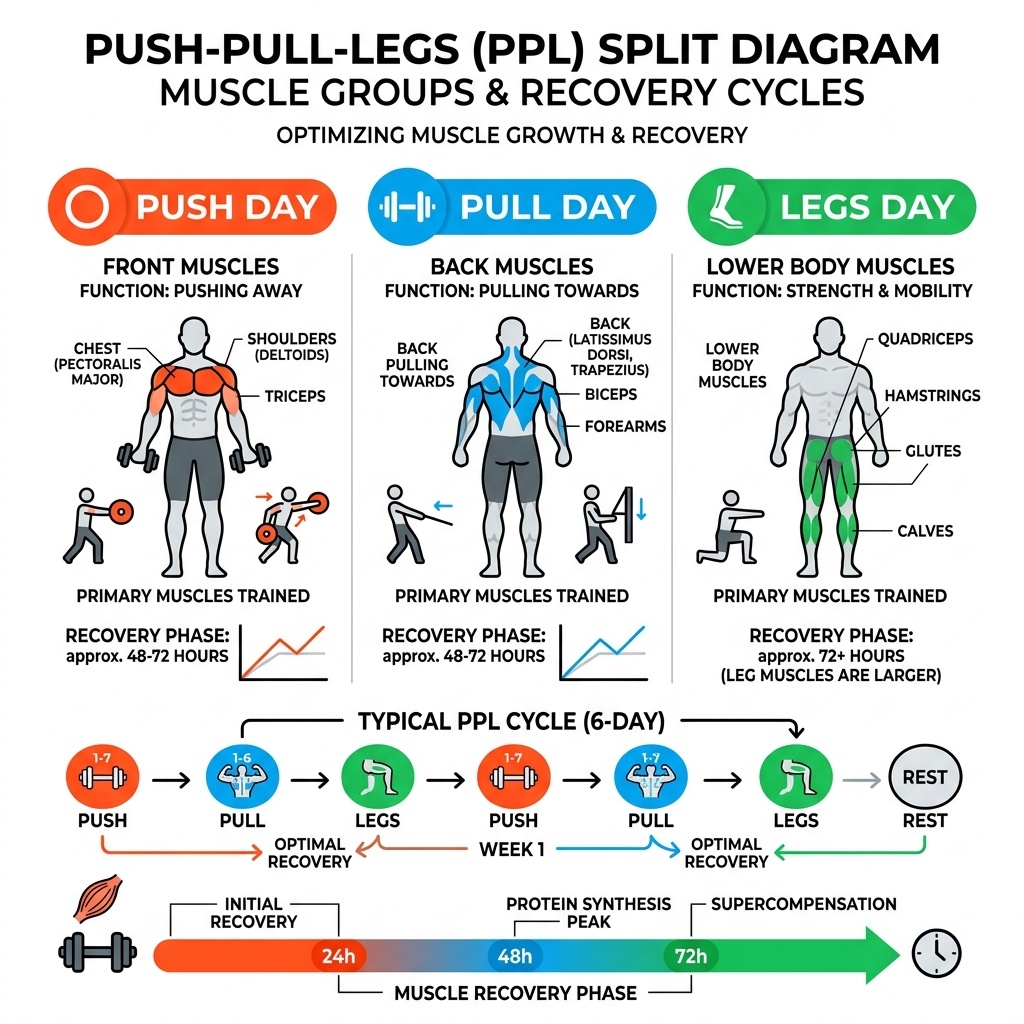
A home workout push day is a targeted training session that focuses on the “anterior muscle chain”—essentially the muscles on the front and sides of your upper body that work together to push weight away from you. This includes your pectoralis major (chest), deltoids (shoulders), and triceps brachii (back of the arms).
In scientific terms, these muscles are agonists in pushing movements. When you perform a push-up or an overhead press, these groups coordinate to produce force. Research from health authorities like the Mayo Clinic consistently shows that resistance training—even when done at home—improves metabolic health, increases lean muscle mass, and enhances functional fitness. Functional fitness is just a fancy way of saying “being better at life.” Whether you are pushing a heavy door or lifting a suitcase into an overhead bin, your pushing muscles are the primary movers.
By dedicating a specific day to these muscles, we allow for “muscle exhaustion.” We work them until they are tired, then give them 48 to 72 hours to recover while we focus on “pull” muscles (back and biceps) or legs on other days. This cycle of stress and rest is the secret sauce for building a stronger physique. For a deeper look at how this fits into a broader routine, check out our guide on at-home-workout-for-upper-body.
The Anatomy of Pushing Muscles
To master your home workout push day, it helps to know what’s happening under the hood.
- Pectoralis Major: This is the “king” of the chest. It has two main parts: the clavicular head (upper chest) and the sternal head (lower/mid chest).
- Pectoralis Minor: A smaller muscle tucked underneath that assists in stabilizing the shoulder blade.
- Deltoids: Your shoulders have three “heads.” The anterior deltoid (front) does most of the heavy lifting in presses, while the lateral deltoid (side) gives your shoulders that capped, wide look. (Note: The rear deltoid is actually a “pull” muscle and is usually saved for pull day!)
- Triceps Brachii: This muscle makes up about two-thirds of your upper arm size. It has three heads: the long head, lateral head, and medial head. They all work together to straighten your arm at the elbow.
Benefits of Training Your home workout push day
Why skip the commute to the gym? Training at home offers several unique advantages:
- Time Efficiency: No waiting for a bench or driving through traffic. You can knock out a high-quality session in 30–45 minutes.
- Minimal Equipment: You don’t need a $2,000 rack. Your body weight and a few basic tools are plenty.
- Bone Density and Joint Stability: Weight-bearing “push” exercises strengthen the bones in your wrists, elbows, and shoulders, reducing the risk of injury as you age.
- Customized Environment: You pick the music, the temperature, and you don’t have to wipe someone else’s sweat off the equipment.
If you’re just starting out, we have a great resource on building-upper-body-strength-easy-home-workouts to help you get the basics down.
Essential Equipment for an Effective Home Push Routine
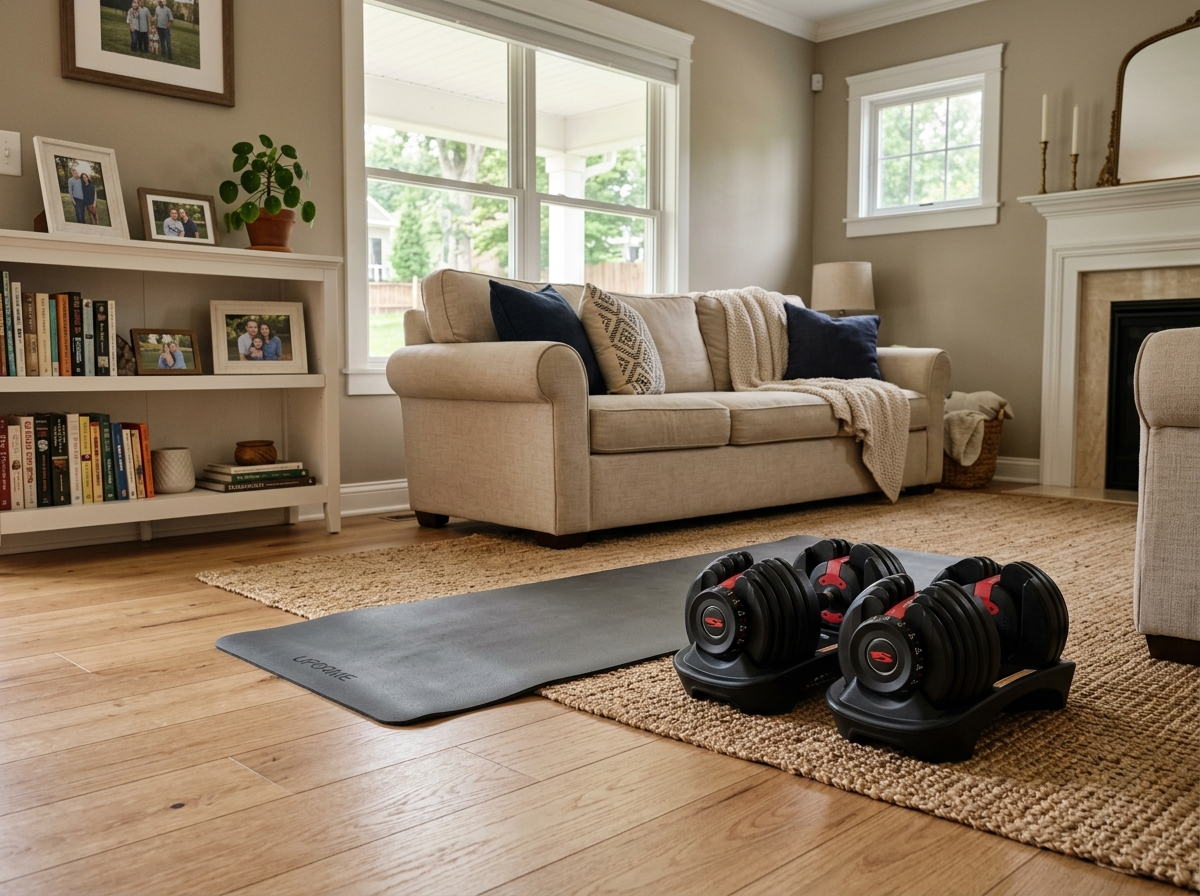
While you can certainly get a great workout with zero equipment, having a few tools can help you target specific muscle heads more effectively.
- Adjustable Dumbbells: These are the gold standard for home gyms. They allow you to increase weight as you get stronger without taking up an entire wall of your house.
- Resistance Bands: Great for “finisher” moves or adding tension to push-ups.
- A Stable Chair or Bench: Essential for triceps dips or incline movements.
- Yoga Mat: Provides grip and cushioning for floor-based exercises.
For those curious about starting their collection, our guide on dumbbells-101-beginner-friendly-home-strength-exercises covers the essentials.
No-Equipment Alternatives for Every Exercise
Don’t have dumbbells yet? No problem. We can use household items or clever body positioning to mimic gym machines:
- Floor Press: If you don’t have a bench, lie on the floor. It actually protects your shoulders by preventing your elbows from dropping too low.
- Glute Bridge Press: Perform a chest press while holding a glute bridge. This creates a “decline” angle, targeting the lower chest.
- Incline Push-ups: Place your hands on a sturdy table or couch. This makes the movement easier for beginners.
- Household Weights: Large water jugs, laundry detergent bottles, or a backpack filled with books can serve as effective weights for overhead presses or lateral raises.
The Best Exercises for Your Home Workout Push Day
To get the most out of your home workout push day, we want to combine compound movements (which use multiple joints and muscles) with isolation exercises (which focus on one specific muscle).
| Exercise Type | Bodyweight Option | Dumbbell Option | Target Muscle |
|---|---|---|---|
| Compound (Primary) | Standard Push-up | Dumbbell Bench Press | Chest, Shoulders, Triceps |
| Compound (Vertical) | Pike Push-up | Overhead Press | Shoulders, Triceps |
| Isolation | Floor Flye (using sliders/socks) | Dumbbell Chest Flye | Chest |
| Isolation | Chair Dips | Skull Crushers | Triceps |
| Isolation | Shoulder Taps | Lateral Raises | Side Deltoids |
For a deep dive into chest-specific moves, see our article on home-chest-workout-pump-up-your-pecs-without-leaving-the-house.
Top Chest Builders: From Push-Ups to Flyes
The chest is usually the star of the show.
- Standard Push-up: The ultimate home exercise. Keep your core tight and elbows at a 45-degree angle from your body (don’t let them flare out like airplane wings!).
- Diamond Push-up: Bring your hands together so your index fingers and thumbs form a diamond. This shifts the focus heavily onto your triceps and inner chest.
- Dumbbell Bench/Floor Press: This allows for a greater range of motion than a push-up. Focus on squeezing the weights together at the top (the “Hex Press” variation) to maximize chest contraction.
- Chest Flyes: Lie on the floor or a bench. Open your arms wide like you’re giving a giant hug, then bring them back together. This provides a deep stretch that pressing movements often miss.
If you are a total newcomer, start with our beginners-upper-body-strength-workout.
Shoulder and Triceps Finishers
Once the chest is tired, we move to the smaller muscles.
- Overhead Press: Stand tall, engage your glutes to protect your lower back, and press the weights toward the ceiling.
- Arnold Press: Start with palms facing you, then rotate them away as you press up. This hits all three heads of the deltoid.
- Lateral Raises: Imagine you are pushing two walls away from you. Lead with your elbows and stop at shoulder height. This is the secret to “broad” shoulders.
- Skull Crushers: Lie on your back, hold dumbbells above your face, and bend only at the elbows to lower them toward your ears. (Please don’t actually crush your skull!)
- Triceps Dips: Use a chair or the edge of your couch. Keep your back close to the chair to avoid straining your shoulders.
Explore more variations in our dumbbell-strength-exercises-for-home-workouts.
Structuring Your Routine: Sets, Reps, and Progression for Your home workout push day
How you organize these exercises depends on your goals:
- For Muscle Growth (Hypertrophy): Aim for 3–4 sets of 8–12 reps.
- For Strength: Use heavier weights (or harder push-up variations) for 3–5 sets of 5–8 reps.
- For Endurance: Use lighter weights for 2–3 sets of 15–20 reps.
The Golden Rule: Progressive Overload. Your muscles won’t grow if they aren’t challenged. Every week, try to do one more rep, add a tiny bit of weight, or decrease your rest time. This is called “double progression.” If you can do 12 reps easily, it’s time to increase the difficulty. For a complete look at how this fits into a week, see our full-body-home-workout-plan.
Sample home workout push day Plan (45 Minutes)
Warm-up (5-7 Minutes):
- Arm Circles: 30 seconds (forward and back)
- Shoulder Taps: 2 sets of 20 taps
- Light Push-ups (on knees or wall): 2 sets of 10
The Workout:
- Dumbbell Floor Press (or Standard Push-ups): 3 sets of 8–12 reps. Rest 90s.
- Overhead Press (or Pike Push-ups): 3 sets of 10 reps. Rest 60s.
- Dumbbell Chest Flyes: 3 sets of 12 reps. Rest 60s.
- Lateral Raises: 3 sets of 15 reps. Rest 45s.
- Skull Crushers (or Chair Dips): 3 sets of 12 reps. Rest 45s.
Cool-down:
- Cross-body shoulder stretch: 30 seconds per side.
- Overhead triceps stretch: 30 seconds per side.
- Chest opener (hands behind back): 30 seconds.
Frequently Asked Questions about Home Push Workouts
How often should I do a push day workout at home?
For most people, 1 to 2 times per week is ideal. If you are doing a Push-Pull-Legs split, you might do Push on Monday, Pull on Tuesday, Legs on Wednesday, and then repeat or take a rest day. Beginners should start with once a week to ensure they don’t overtrain. Muscles grow while you sleep, not while you’re lifting! Check out our strength-training-for-weight-loss-a-beginners-guide for more on frequency.
Can I build muscle with just bodyweight push exercises?
Absolutely. The key is “mechanical tension.” Your muscles don’t know if you’re holding a fancy dumbbell or just your own body weight; they only know how hard they are working. To keep building muscle with bodyweight, you must use harder variations. Once standard push-ups are easy, move to decline push-ups (feet on a chair) or diamond push-ups. Aim to get close to “failure”—the point where you can’t do another rep with good form. Read our ultimate-guide-to-full-body-weight-training-at-home for more tips.
What should I do if I experience shoulder pain during presses?
First, stop immediately. Pushing through sharp pain is a recipe for a long-term injury.
- Check your form: Are your elbows flared out at 90 degrees? Tuck them in slightly (about 45 degrees).
- Warm up your rotator cuffs: Use very light weights or bands to warm up the small stabilizing muscles of the shoulder.
- Switch to neutral grip: If palms-away pressing hurts, try holding dumbbells with palms facing each other. This is often much friendlier on the shoulder joint.
Conclusion
Mastering a home workout push day is about three things: consistency, proper form, and the willingness to challenge yourself. You don’t need a gym full of chrome machines to build a chest and shoulders you can be proud of. By focusing on compound movements like push-ups and presses, and finishing with isolation work for your triceps, you can transform your physique right in your living room.
At Casa e Jardim Web, we believe fitness should be accessible to everyone, regardless of where they train. Start with the basics, track your progress, and don’t be afraid to add that extra rep next week. Your future, stronger self will thank you.
Ready to take the next step in your fitness journey? Explore More info about strength training services and keep pushing toward your goals!
