
You Don’t Need a Gym to Build Serious Upper Body Strength
An upper body strength workout with dumbbells is one of the most effective ways to build muscle, improve posture, and develop functional strength — all from home, with minimal equipment.
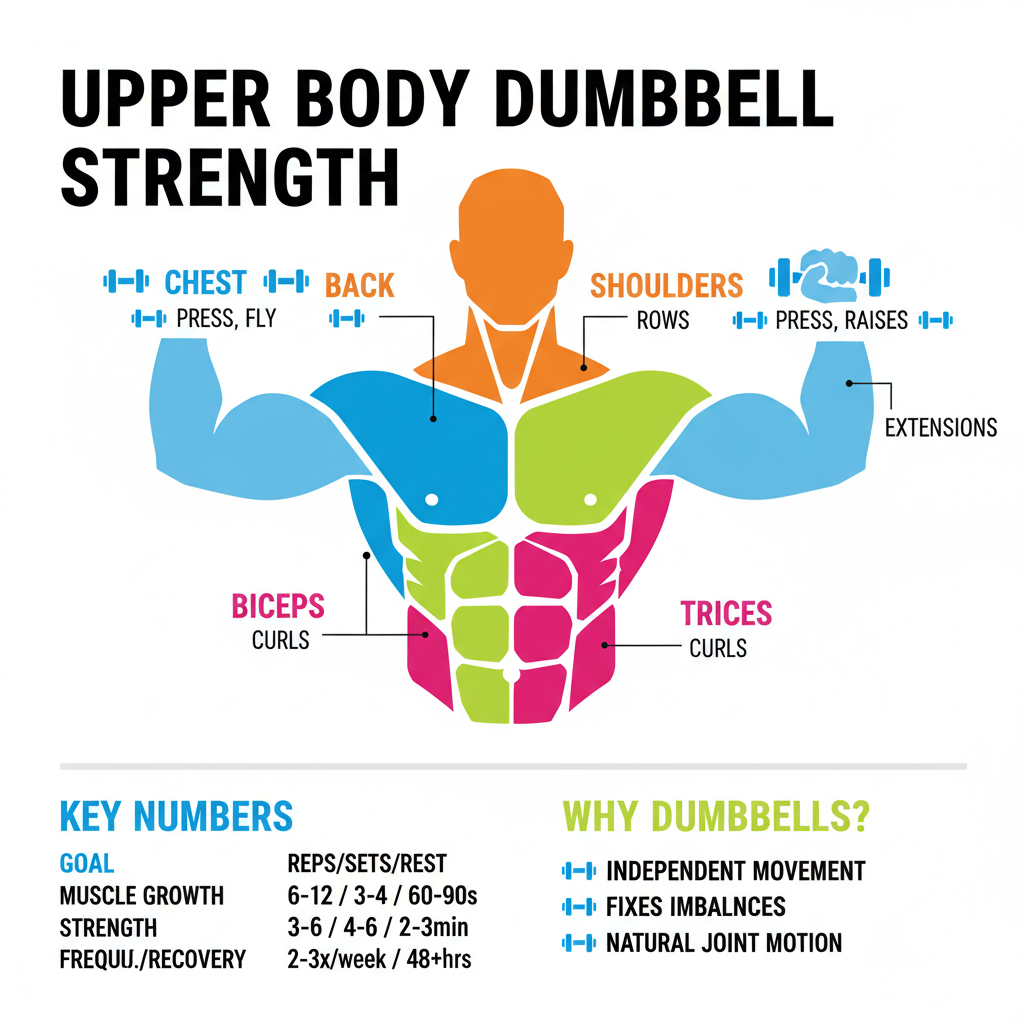
Here’s what an effective upper body dumbbell workout covers:
- Chest – dumbbell bench press, chest fly
- Back – bent-over rows, single-arm rows
- Shoulders – Arnold press, lateral raises
- Biceps – alternating curls, hammer curls
- Triceps – overhead extensions, skull crushers
Key numbers to know:
| Goal | Reps | Sets | Rest |
|---|---|---|---|
| Muscle growth | 6-12 | 3-4 | 60-90 sec |
| Strength | 3-6 | 4-6 | 2-3 min |
| Frequency | 2-3x/week | – | 48+ hrs between sessions |
Most people think building real upper body strength requires a barbell, a rack, and a gym membership. It doesn’t.
Dumbbells actually have a unique advantage over barbells — they force each arm to work independently. That means hidden imbalances get exposed and fixed, stabilizer muscles get activated, and your joints move through a more natural range of motion.
Whether you’re a complete beginner or a seasoned athlete working out at home, a well-structured dumbbell routine can deliver serious results. This guide walks you through exactly how to do it.
Why Dumbbells are Superior for Upper Body Strength
When we think of “heavy lifting,” the image of a massive barbell often comes to mind. However, at Casa e Jardim Web, we’ve seen how dumbbells can actually be the superior tool for developing a symmetrical, injury-resistant physique.
One of the most significant benefits of an upper body strength workout with dumbbells is the requirement for independent movement. Unlike a barbell, where your stronger side can “help” your weaker side, dumbbells force each limb to carry its own weight. This exposes muscle imbalances that barbells and machines often hide. If your left shoulder is weaker than your right, you’ll know it by the third rep, allowing you to correct the issue before it leads to injury.
Furthermore, dumbbells offer a superior range of motion. During a barbell bench press, the bar hits your chest, stopping the movement. With dumbbells, you can lower the weights slightly past the chest line, creating a deeper stretch and greater muscle fiber recruitment. This freedom of movement is also much friendlier on the joints; your wrists and elbows can rotate naturally into the most comfortable path for your specific anatomy.
Scientific research consistently highlights that free weights, particularly dumbbells, recruit more stabilizer muscles. Because the weights aren’t on a fixed track (like a machine) or connected (like a barbell), your body must work harder to keep them steady. This leads to better functional strength—the kind of strength that helps you lift heavy boxes or carry groceries without straining your back. For those just starting out, check out our guide on dumbbells 101: beginner-friendly home strength exercises to get a handle on the basics.
Essential Muscle Groups for a Complete Upper Body Strength Workout with Dumbbells
To build a truly powerful upper half, we need to target all the major players. A well-rounded upper body strength workout with dumbbells isn’t just about the “mirror muscles” (biceps and chest); it’s about creating a balanced structure.
- The Pectorals (Chest): These are your primary “pushing” muscles. Dumbbells allow for variations like the floor press or incline fly to target the upper, middle, and lower regions of the chest.
- The Latissimus Dorsi and Rhomboids (Back): A strong back is the foundation of good posture. Exercises like rows and pullovers help mitigate the “slumped” look many of us get from sitting at desks.
- The Deltoids (Shoulders): The shoulders are made of three heads: anterior (front), medial (side), and posterior (rear). We must target all three to get that rounded, “capped” shoulder look and maintain joint health.
- The Triceps and Biceps (Arms): Did you know triceps make up about two-thirds of your upper arm size? Prioritizing them is the secret to filling out your sleeves. Biceps, meanwhile, are essential for all pulling and carrying tasks.
- Core Stability: Even though this is an upper body focus, your core (abs and obliques) acts as the stabilizer during standing presses and rows.
For a deeper dive into specific movements for these groups, see our breakdown of dumbbell strength exercises for home workouts.
Structuring Your Upper Body Strength Workout with Dumbbells for Beginners
If you’re new to lifting, the sheer number of exercises can feel overwhelming. We recommend sticking to a push-pull pattern. This ensures that for every “pushing” movement (like a shoulder press), you perform a “pulling” movement (like a row). This balance prevents postural issues and ensures even muscle development.
Start with compound movements—exercises that use more than one joint. Examples include the bench press or the overhead press. These should be done at the beginning of your workout when you have the most energy. Finish your session with isolation exercises like bicep curls or tricep kickbacks to “polish” the muscles and drive blood flow for hypertrophy. We’ve designed a specific beginner’s upper body strength workout that follows this exact logic.
Choosing the Right Weight for Your Upper Body Strength Workout with Dumbbells
Choosing the right weight is a bit like Goldilocks—too light and you won’t grow; too heavy and your form will break down. For building muscle (hypertrophy), research suggests using a weight that is roughly 70% to 80% of your one-rep max.
A good rule of thumb is the fatigue threshold: you should choose a weight where the last 2-3 reps of a set are very challenging, but you can still maintain perfect form. If you can breeze through 12 reps without a sweat, it’s time to go heavier.
We also recommend the 4-2-1 tempo method to maximize “time under tension.” This means:
- 4 seconds to lower the weight (the eccentric phase).
- 2 seconds to pause and squeeze at the bottom.
- 1 second to explosively lift the weight.
This controlled pacing forces the muscle to work harder throughout the entire range of motion, leading to faster gains even with slightly lighter weights.
The Ultimate Upper Body Strength Workout with Dumbbells: Step-by-Step
Ready to get to work? This routine is designed to hit every major muscle group in the upper body. Perform this circuit 2-3 times per week, allowing at least one day of rest between sessions.
| Exercise | Targeted Muscle | Reps | Sets | Rest |
|---|---|---|---|---|
| Dumbbell Bench Press | Chest/Triceps | 8-10 | 3 | 90s |
| One-Arm Rows | Back/Biceps | 10 per side | 3 | 60s |
| Arnold Press | Shoulders | 10-12 | 3 | 60s |
| Lateral Raises | Side Delts | 12-15 | 3 | 45s |
| Skull Crushers | Triceps | 10-12 | 3 | 60s |
| Hammer Curls | Biceps/Forearms | 10-12 | 3 | 60s |
1. Dumbbell Bench Press
Lie on a bench (or the floor) with feet planted. Hold dumbbells at chest level with elbows at a 45-degree angle. Press the weights toward the ceiling, squeezing your chest at the top, then lower slowly. This is the king of chest builders.
2. One-Arm Rows
Place one hand on a sturdy surface (like a chair or couch) and hinge forward at the hips. With a flat back, pull the dumbbell toward your hip, squeezing your shoulder blade back. This builds thickness in the mid-back and lats.
3. Arnold Press
Named after the legend himself, this shoulder press starts with palms facing you at shoulder height. As you press up, rotate your palms to face forward. This hits all three heads of the deltoid in one go.
4. Lateral Raises
Stand tall and lift the dumbbells out to your sides until they reach shoulder height. Keep a slight bend in your elbows. This is the best move for widening the shoulders and creating that “V-taper” look.
5. Skull Crushers
Lie on your back and hold dumbbells straight up. Keeping your upper arms stationary, bend your elbows to lower the weights toward your temples (carefully!). Use your triceps to press them back up.
6. Hammer Curls
Hold dumbbells at your sides with palms facing your body (neutral grip). Curl them toward your shoulders. This targets the brachialis, a muscle that sits under the bicep and makes the arm look thicker from the side.
For those who prefer a guided experience, our at-home workout for upper body provides visual cues and further modifications.
Mastering Your Routine: Frequency, Form, and Progression
Consistency is where the magic happens. For a successful upper body strength workout with dumbbells, aim for 2 to 3 sessions per week. This frequency allows you to hit the “sweet spot” of 10 to 20 hard sets per muscle group per week, which research identifies as the optimal volume for hypertrophy.
The Power of 48 Hours Never train the same muscle group two days in a row. Your muscles don’t grow while you’re lifting; they grow while you’re resting. A 48-hour recovery window is essential for repairing the micro-tears in the muscle fibers.
Form Cues and Mind-Muscle Connection Don’t just move the weight from point A to point B. Focus on the muscle you are trying to work. When rowing, imagine your hand is just a hook and you are pulling from the elbow. When pressing, focus on “hugging” your chest together.
Standing vs. Seated If you want to engage your core more, perform your presses and curls while standing. If you want to lift as heavy as possible to maximize muscle size, sitting down provides more stability, allowing you to focus entirely on the target muscle.
Progressive Overload To keep seeing results, you must implement progressive overload. This can mean:
- Increasing the weight of the dumbbells.
- Adding more reps to your sets.
- Adding an extra set to the exercise.
- Decreasing rest time between sets.
No Bench? No Problem! If you don’t have a weight bench, you can use a floor press (lying on the floor) for chest work, or a sturdy ottoman/chair for rows. The floor press is actually a great way to protect your shoulders as it prevents you from over-extending at the bottom of the movement.
Warm-up and Cool-down Never skip the warm-up! Spend 5 minutes doing arm circles, “wall slides,” and light shadow boxing to get the blood flowing to the shoulder joints. Afterward, spend 5 minutes stretching your chest and lats to maintain flexibility.
Frequently Asked Questions about Upper Body Dumbbell Training
What can I use instead of a weight bench for dumbbell exercises?
You don’t need fancy equipment to get a great upper body strength workout with dumbbells. For chest presses, the floor is an excellent substitute—it limits your range of motion in a way that actually protects the shoulder joint. For rows, you can use the back of a sturdy sofa or a kitchen chair for support. For seated presses, any straight-backed chair will work perfectly.
How often should I perform an upper body dumbbell workout per week?
We recommend 2 to 3 times per week. This allows each muscle group to be stimulated at least twice every seven days, which is ideal for steady strength and size gains. Always ensure you have at least one full day of rest between upper body sessions to prevent overtraining.
Which dumbbell exercises are most effective for building arm size?
To maximize arm size, you need to prioritize the triceps, as they make up two-thirds of the upper arm. Skull crushers and overhead tricep extensions are elite choices. For the biceps, hammer curls are essential because they build the thickness of the arm, while alternating bicep curls help develop the “peak” of the muscle.
Conclusion
Building a powerful, defined physique doesn’t require a garage full of heavy machinery. By mastering an upper body strength workout with dumbbells, you are utilizing a tool that corrects imbalances, protects your joints, and builds functional strength that carries over into your daily life.
At Casa e Jardim Web, we believe that fitness should be accessible. Whether you are lifting 5-pound weights or 50-pounders, the key is consistency and progressive overload. Start with the basics, focus on your form, and listen to your body.
Ready to dive deeper into your fitness journey? Explore our guide on building upper body strength: easy home workouts or start your transformation today by checking out our full library of strength training resources. Your strongest self is just a few reps away!
