
You Can Lose Fat at Home — Here’s How to Start Today
A beginner fat loss workout at home is one of the most effective ways to burn fat, build strength, and improve your health — no gym membership required.
Quick answer for beginners starting fat loss at home:
- Work out 2-4 times per week using bodyweight exercises like squats, push-ups, lunges, and planks
- Keep sessions 20-40 minutes — short workouts done consistently beat long workouts done rarely
- Eat in a small calorie deficit — nutrition drives roughly 80% of fat loss results
- Rest 48 hours between sessions targeting the same muscle groups
- Progress gradually by adding reps, reducing rest time, or trying harder exercise variations
Starting a fat loss journey can feel overwhelming. There are endless workout programs, diet plans, and conflicting advice online. But here’s the truth: you don’t need any of that complexity to get results.
Research shows that bodyweight exercises deliver similar fitness benefits to gym-based workouts. And low-intensity exercise can even lower cortisol — the stress hormone linked to stubborn belly fat.
The biggest barrier for most beginners isn’t access to equipment. It’s knowing where to start and building the habit of showing up consistently.
This guide cuts through the noise and gives you everything you need to begin your fat loss journey from home — today.
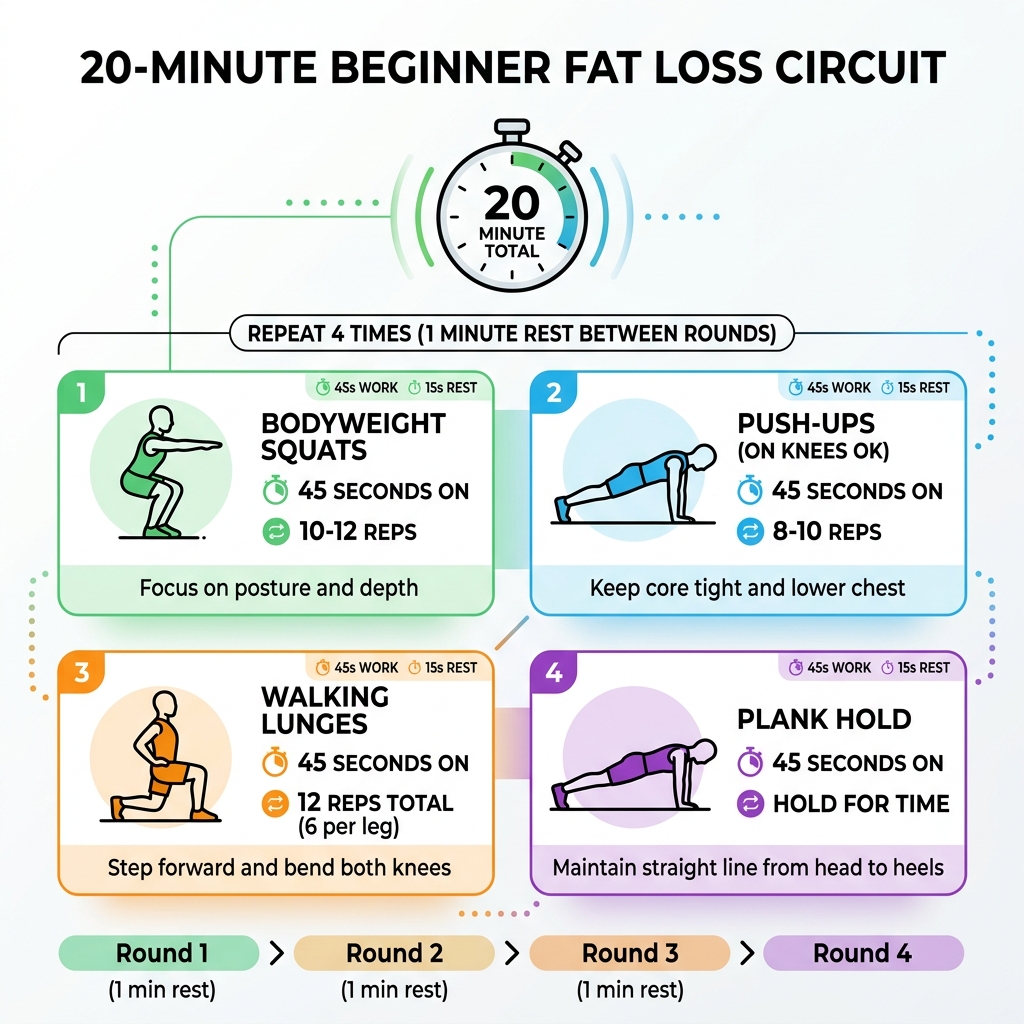
The Science Behind a Beginner Fat Loss Workout at Home
When we talk about a beginner fat loss workout at home, we aren’t just talking about “sweating it out.” There is actual science behind why moving your body in your living room works just as well as hitting a high-end health club. The primary driver of fat loss is a calorie deficit—burning more energy than you consume—but the type of exercise you do determines whether you lose jiggly fat or precious muscle.
Research indicates that bodyweight exercises improve cardiovascular fitness and muscular endurance similarly to equipment-based routines. Furthermore, for beginners, high-intensity training isn’t always the “holy grail.” In fact, low-intensity exercise has been shown to reduce circulating cortisol levels. Since cortisol is a hormone heavily associated with abdominal weight gain, keeping your stress levels low while moving your body is a double win for your waistline.
To get started with a structured approach, we recommend checking out our Beginner Friendly Home Workout Plan to see how these scientific principles translate into daily action.
Benefits of Training Without a Gym
If you’ve ever felt “gym-timidation”—that awkward feeling of walking into a weight room and not knowing where to put your hands—then home workouts are your new best friend. We believe that the best workout is the one you actually do, and the convenience of home training removes almost every excuse.
- Privacy: You can grunt, sweat, and fail at a rep without anyone watching. You can even do it in your pajamas (we won’t tell).
- Cost-Effective: No monthly fees, no gas money, and no need for $100 leggings.
- Habit Formation: When your “gym” is 10 feet from your bed, it’s much easier to build a consistent routine.
- Time-Saving: A 20-minute workout is actually 20 minutes, not 20 minutes plus a 30-minute commute.
For those worried about results, No Equipment Home Exercises are incredibly effective at building the initial strength needed to boost your metabolism.
Understanding Fat Loss vs. Weight Loss
This is a crucial distinction. Weight loss is simply the number on the scale going down. That number includes water, muscle, bone density, and fat. Fat loss, however, is the specific reduction of adipose tissue while preserving lean muscle mass.
Why does muscle matter? Around age 30, we naturally begin to lose 3% to 8% of our muscle mass per decade. Muscle is more metabolically active than fat, meaning it burns more calories even while you’re sitting on the couch watching Netflix. By focusing on a beginner fat loss workout at home that includes strength movements, you protect your resting metabolic rate.
| Metric | Weight Loss | Fat Loss |
|---|---|---|
| Primary Goal | Decrease total body mass | Decrease body fat percentage |
| Method | Calorie restriction (often extreme) | Calorie deficit + Strength training |
| Result | Smaller version of current self | Toned, defined physique |
| Metabolism | Often slows down | Stays elevated or increases |
Essential Exercises for Maximum Results
You don’t need a 50-piece cable machine to get fit. The most effective movements for fat loss are “compound exercises”—moves that use multiple joints and muscle groups at once. Think of these as the “biggest bang for your buck” exercises. They burn more calories per rep and stimulate more muscle growth.
If you’re looking for a deeper dive into the “why” behind these movements, our Strength Training for Weight Loss A Beginners Guide covers the fundamentals of building a leaner body through resistance.
Bodyweight Staples for Your Beginner Fat Loss Workout at Home
Here are the “Big Six” movements every beginner should master. We recommend performing these in a circuit (one after another) to keep your heart rate elevated.
- Air Squats: The king of lower body moves. It targets your glutes, quads, and hamstrings. Pro tip: Imagine you’re sitting back into an invisible chair.
- Knee Push-ups: A fantastic way to build chest and tricep strength. If full push-ups are too hard, drop to your knees but keep your back straight as a board.
- Walking Lunges: Great for balance and toning the legs. Keep your torso upright and don’t let your front knee go past your toes.
- Planks: The ultimate core builder. Hold a straight line from your head to your heels (or knees) and squeeze your glutes.
- Jumping Jacks: A classic cardio burst that gets the blood flowing and burns extra calories.
- Glute Bridges: Lie on your back, knees bent, and lift your hips toward the ceiling. This wakes up the posterior chain, which is often “asleep” from sitting all day.
Adding Resistance to Your Beginner Fat Loss Workout at Home
Once bodyweight moves feel easy, it’s time to add resistance. You don’t need a squat rack; you can use what you have. A gallon of water weighs about 8 pounds—perfect for bicep curls or overhead presses!
If you’re ready to invest a small amount, a set of light dumbbells (5–10 lbs) or resistance bands can drastically increase your options. We’ve put together a guide on Dumbbells 101 Beginner Friendly Home Strength Exercises to help you navigate your first weighted workouts safely.
Structuring Your Weekly Schedule and Progression
Consistency beats intensity every single time. We recommend beginners aim for 2 to 4 sessions per week. The “secret sauce” isn’t working out every day; it’s giving your muscles time to recover. Muscle is actually built during the 48 hours between workouts, not during the workout itself.
A sample schedule might look like this:
- Monday: 20-minute bodyweight circuit
- Tuesday: 30-minute brisk walk (Active Recovery)
- Wednesday: 20-minute bodyweight circuit
- Thursday: Rest or Yoga
- Friday: 20-minute bodyweight circuit
- Saturday/Sunday: Outdoor activity or rest
For a pre-made plan you can follow today, check out this 30 Minute Home Workout Routine.
The Importance of Warm-ups and Cool-downs
Never skip the warm-up! Think of your muscles like a rubber band; if you pull a cold rubber band, it snaps. If you warm it up, it stretches. Spend 5 minutes doing dynamic movements like marching in place, arm circles, and light torso twists.
After your beginner fat loss workout at home, spend 3–5 minutes cooling down. This helps your heart rate return to normal and reduces post-workout soreness. Even a 15 Minute Home Workout for Busy People should include a minute or two of stretching at the end.
How to Use Progressive Overload at Home
If you do the exact same 10 push-ups every day for a year, your body will eventually stop changing. To keep losing fat and building muscle, you must apply “Progressive Overload.” This just means making the workout slightly harder over time.
At home, you can do this by:
- Increasing Reps: Doing 12 squats instead of 10.
- Decreasing Rest: Resting for 30 seconds instead of 60.
- Changing Tempo: Lowering yourself into a squat very slowly (3 seconds down).
- Harder Variations: Moving from knee push-ups to full push-ups.
Ready for a challenge? Try our Jumpstart Your Fitness 30 Day Strength Training Challenge to see how progression works in real-time.
Nutrition and Lifestyle: The 80% Rule
You’ve probably heard that “abs are made in the kitchen.” While we think they’re actually made in the gym and revealed in the kitchen, the sentiment is true: nutrition is responsible for roughly 80% of your fat loss success.
You cannot out-train a poor diet. If you burn 200 calories in a workout but eat a 500-calorie “recovery” muffin, you are moving backward. To lose one pound of fat per week, you generally need a deficit of about 3,500 calories per week—or 500 calories per day.
To help you stay on track, we’ve developed a Healthy Meal Plan for Weight Loss that focuses on whole foods and satiety.
Calculating Your Energy Needs
To lose fat, you need to know your Basal Metabolic Rate (BMR)—the calories you burn just staying alive—and your Total Daily Energy Expenditure (TDEE), which includes your activity.
- BMR: The energy used for breathing, heart rate, and brain function.
- TDEE: BMR + exercise + non-exercise movement (like cleaning or walking the dog).
A safe starting point for fat loss is eating 300 to 500 calories below your TDEE. Focus on high-protein meals; protein has a higher “thermic effect,” meaning your body burns more calories just digesting it compared to fats or carbs. For a deeper dive, read our Daily Workout and Nutrition Guide for Beginners.
Supporting Factors for Fat Loss
If you aren’t sleeping, you aren’t losing fat as effectively as you could. Lack of sleep increases hunger hormones (ghrelin) and decreases “fullness” hormones (leptin). Aim for 7–9 hours of sleep per night.
Additionally, don’t underestimate “NEAT” (Non-Exercise Activity Thermogenesis). This is the energy you burn doing things other than working out—like pacing while on the phone, gardening, or taking the stairs. Increasing your daily step count to 7,000–10,000 can burn more fat over a week than three gym sessions combined!
Check out our Strength Training Nutrition Guide for more tips on fueling your body for success.
Frequently Asked Questions about Home Fat Loss
Can I lose belly fat specifically with home workouts?
We have to be honest here: spot reduction is a myth. You cannot choose where your body burns fat. Doing 1,000 crunches won’t melt belly fat if you have a layer of fat covering the muscle. However, a beginner fat loss workout at home that focuses on full-body movements and a calorie deficit will eventually lead to fat loss everywhere, including your midsection.
How often should a beginner work out for fat loss?
We recommend 2 to 4 times per week. The CDC suggests at least 150 minutes of moderate-intensity activity per week plus two days of strength training. For a beginner, starting with three 20-minute circuits a week is a perfect, sustainable goal. It’s better to do 20 minutes three times a week for a year than 60 minutes five times a week for only twelve days before quitting.
What if I don’t have any equipment at all?
No problem! Bodyweight training is incredibly effective. You can use a sturdy chair for “Chair Squats” or “Tricep Dips.” You can use a countertop for “Incline Push-ups” if the floor is too difficult. The world is your gym! If you’re looking for a completely gear-free routine, our Easy Home Workout Without Equipment is the perfect place to start.
Conclusion
Starting a beginner fat loss workout at home is one of the kindest things you can do for your future self. At Casa e Jardim Web, we believe that fitness should be accessible, gym-free, and sustainable. You don’t need a fancy locker room or expensive machines to transform your body. You just need a small space, a little bit of time, and the willingness to start.
Fat loss is a marathon, not a sprint. Focus on the “non-scale victories”—like having more energy to play with your kids, your clothes fitting better, or finally being able to do five “real” push-ups. Those are the markers of true progress.
Ready to take the next step? Start your journey with our complete home workout guides and join a community of people reclaiming their health from the comfort of their own homes. You’ve got this!
