
Why Your Upper Body Feels Stiff (And What to Do About It)
Upper body mobility stretches are targeted movements that help your shoulders, neck, chest, and thoracic spine move through their full, pain-free range of motion.
Here are the most effective ones to start with:
- Cross-arm stretch – targets the posterior shoulder
- Doorway chest stretch – opens tight pectorals
- Child’s pose – releases the lats and thoracic spine
- Thoracic rotation – improves mid-back rotation
- Shoulder pass-throughs – warms up the shoulder girdle
- Cat-cow – mobilizes the entire spine
- Wall slides – activates scapular control
- Sleeper stretch – improves internal shoulder rotation
- Neck side pull – releases the upper trapezius
- Puppy pose – opens the chest and shoulders
You probably don’t think much about your upper body mobility — until reaching for something on a high shelf suddenly hurts.
Modern life is hard on your shoulders and upper back. Sitting at a desk, hunching over a phone, and doing the same repetitive movements every day quietly chips away at how freely your joints move. Over time, that stiffness becomes pain.
The numbers back this up. Research published in BMC Musculoskeletal Disorders found that 50% of people who reported shoulder pain still had it six months later. And up to 80% of adults will experience a painful episode of low back pain at some point — often linked to poor posture and limited mobility in the upper body.
The good news? You don’t need a gym or fancy equipment to fix it. A few targeted mobility stretches, done consistently, can make a real difference in how you feel and move every day.
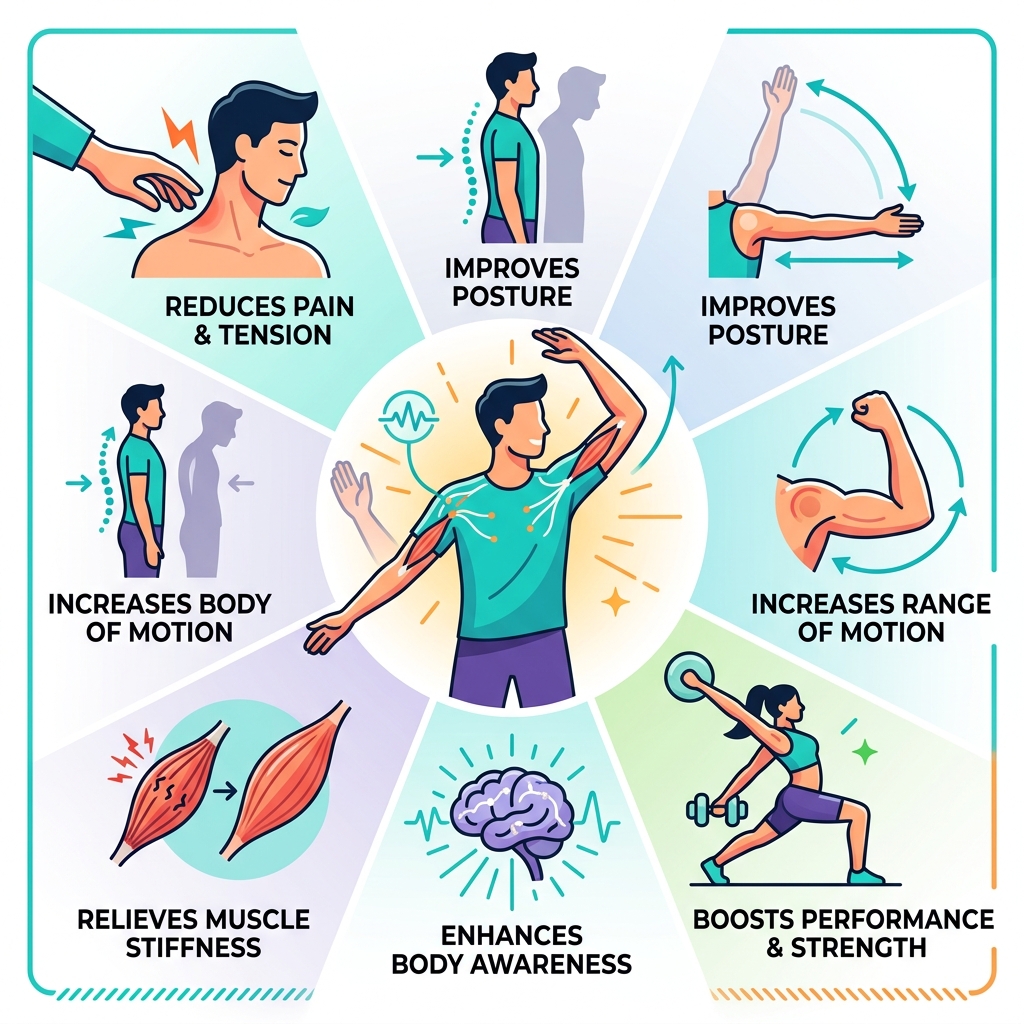
The Science Behind Upper Body Mobility Stretches
When we talk about moving better, we often use words like “flexible” or “limber” interchangeably. However, in sports science and physical therapy, these terms mean very different things. Understanding the distinction is the first step toward building a body that doesn’t just “stretch,” but actually performs.
Mobility is the “active” version of flexibility. While flexibility is about how far a muscle can be pulled, mobility is about how well you can control your joints through their full range of motion. Think of it as the difference between being able to pull your arm across your chest with your other hand (flexibility) and being able to rotate your arm in a full, controlled circle using only its own strength (mobility).
| Feature | Mobility | Flexibility | Stability |
|---|---|---|---|
| Definition | Active joint range of motion | Passive muscle lengthening | Ability to maintain position |
| Component | Strength + Flexibility | Muscle elasticity | Motor control + Strength |
| Action | Moving through a range | Being moved into a range | Resisting unwanted movement |
Defining Mobility vs. Flexibility vs. Stability
To move your upper body effectively, you need a harmony of three things:
- Flexibility: Your muscles must be long enough to allow movement.
- Stability: Your joints (especially the shoulder blades or “scapula”) must be strong enough to support that movement.
- Mobility: Your nervous system must be able to coordinate that movement safely.
If you have plenty of flexibility but no stability, you are at a high risk for injury. Conversely, if you are stable but “stiff as a board,” your movement becomes restricted and labored. This is why we emphasize Home Exercise for Flexibility as a foundation, but insist on adding active mobility drills to complete the picture.
Scientific research supports this integrated approach. A 2021 study published in PeerJ found that individuals who scored higher on mobility screening tests were six times less likely to get injured. By training your joints to move actively, you teach your brain that these ranges of motion are “safe,” which reduces the protective tension (stiffness) your body often creates.
The Best Upper Body mobility stretches for Beginners
If you are just starting out, your goal isn’t to turn into a contortionist overnight. It’s about gently reintroducing movement to joints that have been “locked” by hours of desk work. We recommend starting with a mix of dynamic warm-ups and short static holds.
A great starting point is our Beginners Upper Body Strength Workout, which incorporates basic movements to wake up the muscles. For mobility specifically, beginners should focus on:
- Shoulder Rolls: Simple but effective for breaking up tension in the traps.
- Arm Swings: Dynamic movements that increase blood flow to the shoulder capsule.
- Neck Tilts: Gentle side-to-side movements to release the scalenes and upper trapezius.
The key for beginners is to avoid “bouncing” or forcing a stretch. If it feels like a sharp pinch, back off. We want a “comfortable discomfort”—that deep, satisfying pull that tells you the tissue is actually responding.
Why Mobility Matters: From Desk Jobs to Peak Performance
Why should you care about upper body mobility stretches if you aren’t a professional athlete? Because “stiffness” is rarely just about feeling tight; it’s a precursor to chronic pain.
When your thoracic spine (the middle of your back) becomes stiff from hunching, your body looks for movement elsewhere. Usually, it steals that movement from your neck or your lower back. This is why a stiff mid-back often manifests as a pounding tension headache or a “tweaked” lower back.
Furthermore, poor mobility can lead to shoulder impingement. This happens when the space in your shoulder joint narrows, causing tendons to rub against bone. As mentioned in the research on shoulder pain persistence, these issues don’t just go away on their own. They require proactive movement.
Improving your range of motion also unlocks better results in your workouts. If you can’t fully extend your arms overhead due to tight lats, you’ll never be able to perform a proper overhead press or pull-up. By Building Upper Body Strength: Easy Home Workouts, you ensure that your muscles are working through their full length, which leads to better muscle growth and functional power.
Common Causes of Poor Upper Body Mobility
Most of us aren’t born stiff; we “earn” it through our daily habits.
- The “Sedentary Lifestyle” Trap: Sitting for eight hours a day causes the chest muscles to shorten and the upper back muscles to become overstretched and weak.
- Muscle Imbalances: If you love “Mirror Muscles” (chest and biceps) but ignore your back, you create a “Force Coupling” issue. Your tight chest pulls your shoulders forward, making it physically impossible for the joint to rotate correctly.
- Repetitive Strain: Even “non-active” tasks like scrolling on a phone or typing create micro-tension in the wrists and forearms that travels up the kinetic chain to the shoulders.
Many of these issues can be mitigated by incorporating No Equipment Home Exercises that focus on “opening” the front of the body and “activating” the back.
Advanced Upper Body mobility stretches for Athletes
For those who are already active, mobility is the “secret sauce” for peak performance. Athletes need more than just general looseness; they need scapular stability and thoracic extension.
If you are following an At-Home Workout for Upper Body, adding advanced drills like “Shoulder Flossing” or “Thoracic Extensions” on a foam roller can drastically improve your overhead reach. This allows for better “stacking” of the joints during heavy lifts, which protects the rotator cuff from unnecessary wear and tear.
10 Essential Exercises to Unlock Your Range of Motion
Ready to get moving? We have curated these ten moves to target the most common “sticking points” in the human body. These require no equipment and can be done in a small living room.

- Doorway Chest Stretch: Stand in a doorway, place your forearms on the frame with elbows at shoulder height, and lean forward. This is the ultimate “desk job” antidote.
- Shoulder Pass-Throughs: Using a broomstick or a long towel, keep your arms straight and move the stick from your hips, over your head, to your lower back.
- Thoracic Rotations: On all fours, place one hand behind your head. Rotate your elbow toward the ceiling, then tuck it under your body. This “unwraps” a stiff spine.
- Cat-Cow: On all fours, alternate between arching your back (Cow) and rounding it toward the ceiling (Cat). This lubricates the vertebrae.
- Child’s Pose: Sit back on your heels and reach your arms forward on the floor. This releases the lats and lower back.
- Wall Slides: Stand with your back against a wall. Try to keep your elbows and wrists in contact with the wall as you slide your arms up and down in a “Y” shape.
- Sleeper Stretch: Lying on your side, keep your bottom arm at a 90-degree angle. Gently push your wrist toward the floor to improve internal rotation.
- Cross-Arm Stretch: Pull one arm across your chest. Focus on keeping your shoulder “down” away from your ear.
- Puppy Pose: Similar to Child’s Pose, but keep your hips high over your knees. This provides a deeper stretch for the chest and shoulders.
- Thread the Needle: From all fours, reach one arm under your chest as far as possible, resting your shoulder on the floor.
For more targeted chest work, check out our Home Chest Workout: Pump Up Your Pecs Without Leaving the House.
Shoulder and Neck Specific Drills
The shoulder is the most mobile joint in the body, which also makes it the most unstable. To keep it healthy, we need to address the surrounding tissues.
The Sleeper Stretch is particularly vital for anyone who plays racquet sports or throws a ball. Scientific research on sleeper stretches shows that it has acute positive effects on shoulder range of motion, specifically for internal rotation.
Additionally, don’t ignore the neck. Tight “traps” (the muscles between your neck and shoulders) can actually pull your shoulder blades out of alignment. Simple Neck Pulls—gently tilting your head to the side while reaching the opposite arm toward the floor—can provide instant relief. These Bodyweight Exercises for Home are easy to slip into a five-minute work break.
Thoracic Spine and Chest Openers
The “T-Spine” is the engine room of upper body mobility. If it doesn’t move, nothing else will.
- Puppy Pose: This is a “gravity-assisted” opener. By letting your chest sink toward the floor, you use your own body weight to stretch the pectorals and the front of the shoulder capsule.
- Cobra Stretch: Lying on your stomach, push your chest up while keeping your hips on the floor. This encourages thoracic extension, which is the direct opposite of the “slumped” posture we adopt at computers.
Using a foam roller for thoracic extension is one of our favorite “hacks.” By placing the roller horizontally across your mid-back and gently leaning over it, you can “segmentally” mobilize each vertebra.
How to Safely Build Your Upper Body Mobility Routine
The biggest mistake people make with upper body mobility stretches is doing them once and expecting a miracle. Mobility is a “use it or lose it” skill.
To see real change, aim for consistency over intensity. Five minutes every day is infinitely better than an hour once a week. We recommend integrating these moves into your daily flow—perhaps a few rotations when you wake up and a few chest openers after lunch.
Safety is paramount. You should never stretch into “sharp” pain. A dull ache or a “stretching” sensation is normal, but anything that feels like an electric shock or a pinch is a signal from your nervous system to stop.
Breathing is your best tool for deeper mobility. When you hold a stretch, try to exhale longer than you inhale. This activates the parasympathetic nervous system, which signals your muscles to stop “guarding” and allow for more length. For more on timing your movements, see our Pre-Workout and Post-Workout Tips.
Tools and Equipment for Enhanced Mobility
While your own body weight is enough to get started, a few simple tools can accelerate your progress:
- Resistance Bands: Great for “Shoulder Flossing” and adding a gentle pull to your stretches.
- Foam Rollers: Essential for “smashing” tight fascia and mobilizing the spine.
- PVC Pipes or Broomsticks: Provide a fixed lever to help you rotate your shoulders evenly.
- Massage Balls (or Lacrosse Balls): Perfect for pinpointing “trigger points” in the pec minor or the rhomboids (between the shoulder blades).
- Yoga Blocks: Can bring the floor “closer” to you in poses like Child’s Pose or Puppy Pose if you are very tight.
Tracking Your Progress Over Time
How do you know if it’s working? Unlike weightlifting, where the numbers on the bar go up, mobility progress can be subtle.
- Video Analysis: Film yourself doing a “Wall Slide” or a “Thoracic Rotation.” Do it again in four weeks. You’ll be surprised at how much further you can reach.
- Workout Journals: Note how your shoulders feel during your regular workouts. Are you able to get deeper into your squats? Does your overhead press feel “smoother”?
- Range of Motion Testing: Use simple “check-ins,” like trying to touch your hands behind your back (the “Back Scratch Test”).
Frequently Asked Questions about Upper Body Mobility
How often should I perform upper body mobility stretches?
For most people, 3 to 5 times a week is the “sweet spot” for seeing lasting improvements. However, “movement snacks”—doing 60 seconds of stretching every hour you spend at a desk—can be done daily and are highly effective for pain management.
Can mobility exercises help with chronic shoulder pain?
In many cases, yes. Most chronic shoulder pain is caused by “mechanical” issues—muscles pulling on joints in ways they shouldn’t. By restoring proper movement, you take the pressure off the tendons. However, if you have a known tear or severe injury, always consult a physical therapist before starting a new routine.
What is the difference between a dynamic warm-up and a static stretch?
A dynamic warm-up involves moving through a range of motion (like arm circles) to increase blood flow and “wake up” the nervous system. A static stretch involves holding a position for 30–60 seconds to physically lengthen the tissue. Generally, do dynamic moves before a workout and static holds after or as a standalone session.
Conclusion
At Casa e Jardim Web, we believe that fitness should be accessible to everyone, regardless of whether they have a gym membership or fancy equipment. Our mission is to provide effective, gym-free training that helps you move better, feel stronger, and live without the nagging “stiffness” that so often accompanies modern life.
Improving your upper body mobility stretches isn’t just about being able to reach the top shelf; it’s about long-term joint health and functional freedom. By spending just a few minutes a day on these routines, you are investing in a body that will serve you well for decades to come.
Ready to take the next step in your fitness journey? Check out our comprehensive At-Home Workout for Upper Body to start building the strength that supports your newfound mobility. Stay mobile, stay strong, and stop settling for “stiff as a board.”
