
Why a Core Strength Home Workout Deserves a Spot in Your Routine
A core strength home workout is one of the most effective ways to build lasting strength, improve posture, and protect your body from injury — all without a gym membership or expensive equipment.
Here are the best no-equipment core exercises you can start today:
- Glute Bridge – Lie on your back, bend your knees, squeeze your glutes and lift your hips. Hold 10-30 seconds, repeat 3-5 times.
- Bird Dog – From all fours, extend opposite arm and leg. Hold briefly, switch sides. Do 8-12 reps per side.
- Dead Bug – Lie on your back, arms up, lower opposite arm and leg slowly. 8-12 reps per side.
- Plank – Hold a forearm or high plank with a straight body line. Start with 15-30 seconds, build up.
- Bicycle Crunch – Alternate elbow to opposite knee in a slow, controlled motion. 3 sets of 12 reps.
- Supine Toe Taps – From a tabletop position, slowly tap alternating feet to the floor. 8-12 reps per side.
Think about the last time you bent down to tie your shoes, carried groceries, or stood up from a chair. Every one of those movements relied on your core. It’s not just about abs — your core is working almost every waking moment of your day.
Yet most people either skip core training entirely or reduce it to a few rushed crunches at the end of a workout.
This guide changes that. Whether you’re a complete beginner or a seasoned athlete, you’ll find a clear, practical path to building real core strength at home — no gym required.
Understanding the Anatomy of Your Core
When most people hear the word “core,” they immediately picture a six-pack. However, the anatomy of your midsection is far more complex and interesting than just one muscle group. Think of your core as a natural corset that wraps around your entire trunk, providing a stable foundation for every limb movement.
To master a core strength home workout, we first need to know what we are actually training. The core is composed of several layers:
- Rectus Abdominis: These are the “six-pack” muscles located on the front of your abdomen. Their primary job is flexing the spine (bringing your chest toward your hips).
- Transverse Abdominis (TVA): This is the deepest layer of abdominal muscle. It wraps around your waist like a weight belt. It doesn’t move your bones much, but it creates internal pressure to protect your spine.
- Internal and External Obliques: Located on the sides of your trunk, these allow you to rotate and bend sideways. They are also crucial for “anti-rotation”—resisting a force that tries to twist your body.
- Erector Spinae and Multifidus: These are the powerhouses of your back. The erector spinae helps you stand up straight, while the multifidus provides tiny, essential adjustments to keep your vertebrae aligned.
- Pelvic Floor and Diaphragm: The “floor” and “ceiling” of your core. The diaphragm helps you breathe, and the pelvic floor supports your internal organs.
- Glutes and Hip Flexors: Yes, your butt is part of your core! The glutes stabilize the pelvis, which is the base upon which your spine sits.
Scientific research on core muscle function shows that these muscles rarely work in isolation. Instead, they function as a coordinated unit to transfer force from your legs to your upper body.
Why a Core Strength Home Workout is Essential for Longevity
Building a strong midsection isn’t just about looking good at the beach; it’s a fundamental requirement for healthy aging. As we age, our balance and spinal stability naturally begin to decline. A dedicated core strength home workout acts as an insurance policy for your body.
One of the most significant benefits is lower back pain reduction. Many cases of chronic back pain stem from a “lazy” core that forces the lower spine to take on weight it wasn’t meant to carry. By strengthening the multifidus and TVA, you provide the support your spine needs.
Furthermore, core strength is the “secret sauce” for functional fitness. Whether you are following a full-body weight training routine at home or using strength training for weight loss, your core is the anchor. Without it, your form breaks down, and your risk of injury skyrockets.
For those navigating unstable terrain—like trail runners or even just people walking on a cracked sidewalk—core activation is the difference between staying upright and a nasty fall. It keeps you aligned, stable, and powerful.
How to Properly Engage and Activate Your Midsection
Before you drop down for 50 crunches, you need to learn how to “turn on” the right muscles. Many people accidentally use their hip flexors or neck muscles because they haven’t mastered abdominal bracing.
The “Blueberry” Technique
One of the best ways to find your deep core (the transverse abdominis) is to imagine there is a blueberry sitting in your belly button. Now, try to “squeeze” that blueberry by pulling your belly button toward your spine without holding your breath.
360 Breathing
Most people are “chest breathers,” but core stability requires “diaphragmatic breathing.” Inhale and feel your entire midsection expand like a balloon—front, sides, and back. As you exhale, perform the abdominal brace. This creates internal pressure that stabilizes the spine from the inside out.
Neutral Spine and Pelvic Tilt
A common mistake in a core strength home workout is arching the back. To find a neutral spine, lie on your back and notice the small gap between your lower back and the floor. A “posterior pelvic tilt” involves tucking your tailbone to flatten that gap against the floor. This is often the safest position for beginners to prevent back strain.
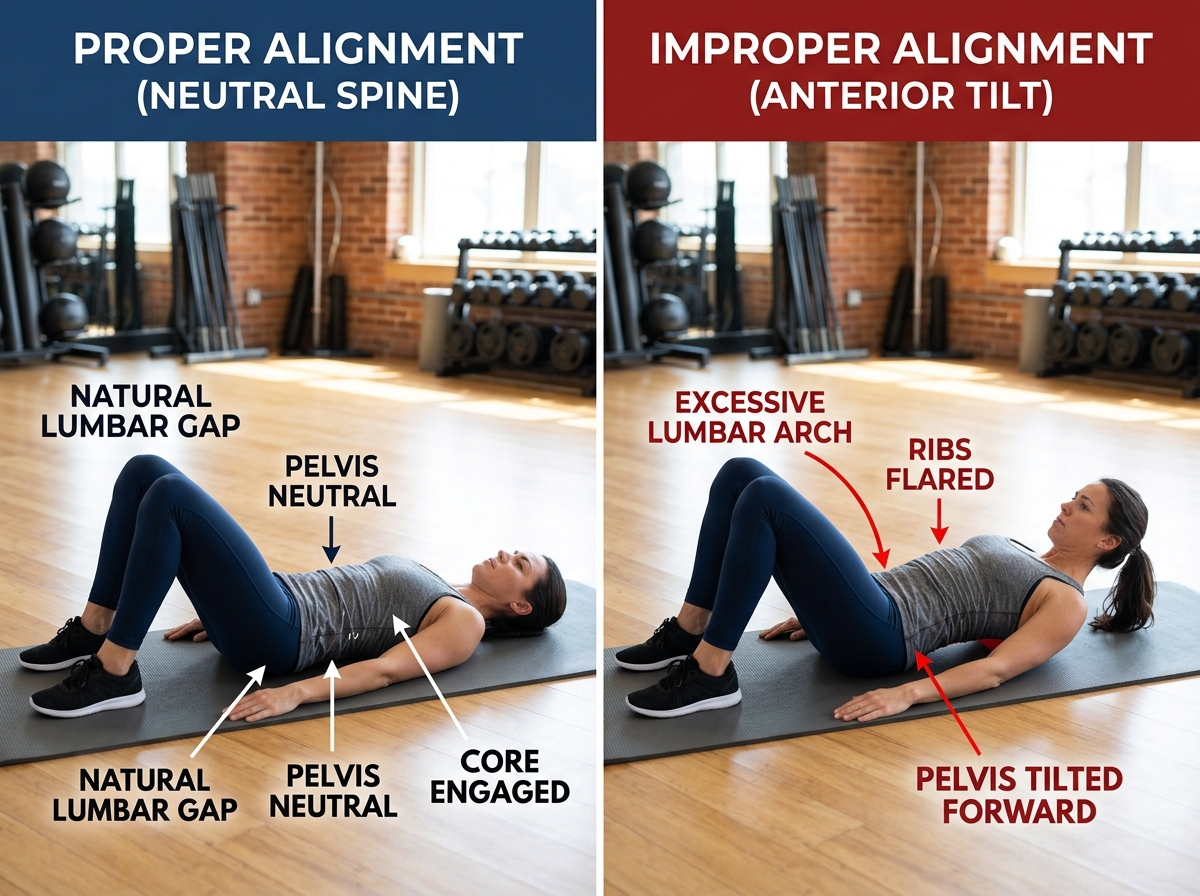
According to research on abdominal bracing techniques, bracing is generally more effective for spinal stability than “hollowing” (just sucking the stomach in).
Best Exercises for Your Core Strength Home Workout
To build a truly functional core, we need to move beyond the crunch. We focus on three types of movements:
- Isometric Holds: Holding a position (like a plank) to build endurance.
- Anti-Rotation/Extension: Resisting a force that wants to move your spine.
- Controlled Rotation: Moving with intention through a full range of motion.
If you are already building upper body strength with easy home workouts, adding these core moves will significantly improve your lifting form.
Beginner Core Strength Home Workout Moves
If you’re just starting, focus on stability and form. These moves require zero equipment.
- Glute Bridge: Excellent for the posterior chain. Focus on squeezing your glutes at the top rather than just arching your back. This is a staple in any lower body weight training plan for beginners.
- Bird Dog: From all fours, extend your right arm and left leg. The goal is to keep your back perfectly flat—imagine a hot cup of coffee sitting on your lower back that you can’t spill.
- Dead Bug: The “gold standard” for beginners. Lie on your back with arms and legs in the air (knees bent at 90 degrees). Slowly lower the opposite arm and leg while keeping your lower back pressed into the floor.
- Supine Toe Taps: Lower one foot at a time from a tabletop position. If your back arches, don’t tap all the way down.
Intermediate and Advanced Core Strength Home Workout Progressions
Once the basics feel easy, it’s time to increase the “time under tension” or add complexity.
- Forearm Plank: Move from a high plank to a forearm plank. Ensure your hips don’t sag or hike up toward the ceiling.
- Bicycle Crunch: The key here is slow and controlled. Don’t just tug on your neck; focus on bringing your shoulder toward the opposite knee.
- Mountain Climbers: These add a cardiovascular element. Keep your weight over your wrists and your core tight to prevent your hips from bouncing.
- Side Plank with Rotation: From a side plank, reach your top arm under your body and then back up. This targets the obliques and improves shoulder stability.
- Turkish Get-Up (Bodyweight): A complex move that involves moving from a lying position to standing while keeping one arm extended overhead. It’s a masterclass in core control.
- Hollow Body Hold: Lie on your back and lift your head, shoulders, and legs a few inches off the floor. Your body should look like a banana. This is an elite-level isometric hold.
For those looking to add a bit of challenge, resistance band exercises to boost strength can be integrated into planks or side steps to fire up the hips even more.
Designing Your 20-Minute Routine and Tracking Progress
Consistency is the bridge between wanting a strong core and actually having one. We recommend training your core 2 to 4 times per week. Because core muscles are postural muscles, they recover relatively quickly, but they still need rest to grow.
| Workout Level | Exercise Selection | Structure | Rest |
|---|---|---|---|
| Beginner | Glute Bridge, Dead Bug, Bird Dog | 2 Sets of 10-12 reps | 60 Seconds |
| Intermediate | Plank, Bicycle Crunch, Toe Taps | 3 Sets of 45 seconds | 45 Seconds |
| Advanced | Hollow Body, Side Plank, Mountain Climbers | 4 Sets / Circuit Style | 30 Seconds |
To track progress, don’t just look at the scale. Instead, track your time under tension. If you could hold a plank for 20 seconds last week and 30 seconds this week, you are getting stronger!
Whether you are looking for at-home strength training for women or a strength exercises guide for men, the principles of progressive overload remain the same: do a little more than you did last time.
Common Mistakes, Safety, and Equipment Needs
One of the most frequent errors we see in a core strength home workout is hip flexor dominance. If you feel your hip creases or your lower back burning more than your abs during a leg raise, your hip flexors are doing the work. To fix this, shorten your range of motion and focus on that “posterior pelvic tilt” we discussed earlier.
Other common mistakes include:
- Arching the back: This puts dangerous pressure on the spinal discs.
- Neck strain: In crunches, imagine you have an orange tucked under your chin. Don’t pull on your head with your hands.
- Holding your breath: This increases blood pressure and prevents proper muscle engagement. Use the “exhale on the exertion” rule.
While you can do these exercises on a bare floor, a yoga mat provides much-needed cushioning for your spine and elbows. As you get stronger, you might consider incorporating dumbbell strength exercises for home workouts to add resistance to moves like the Russian twist or weighted crunch.
Nutrition, Body Fat, and Visible Results
We have to be honest with you: you can have the strongest core in the world, but if it’s covered by a layer of body fat, you won’t see “abs.” You cannot “spot reduce” fat from your stomach by doing more crunches.
Visible results come from a combination of:
- Muscle Hypertrophy: Building the muscle size through your core strength home workout.
- Caloric Deficit: Eating slightly fewer calories than you burn to reduce overall body fat.
- Protein Intake: Ensuring you have enough protein to repair the muscle fibers you’ve challenged.
Check out our beginner’s guide to strength training for weight loss for a deeper dive into how nutrition and exercise work together to reveal that hard-earned definition.
Frequently Asked Questions about Core Training
How often should I train my core each week?
For most people, 2 to 3 dedicated sessions per week are optimal. If you are doing a lot of compound movements (like squats or push-ups), your core is already getting “sneaky” work, so you might only need 1 or 2 targeted sessions.
How long does it take to see improvements in core strength?
You will likely feel stronger and more stable within 2 to 4 weeks. Visible muscle definition usually takes 8 to 12 weeks, depending on your starting body fat percentage and consistency with nutrition.
Do I need weights or equipment for an effective core workout?
Absolutely not! Your body weight is a significant lever. By changing the angle of your body or increasing the duration of a hold, you can challenge even the most advanced athletes. However, dumbbells or resistance bands can be fun ways to add variety once you’ve mastered the basics.
Conclusion
Building a stronger core is one of the kindest things you can do for your future self. It’s about more than just a flat stomach; it’s about moving through the world with confidence, balance, and freedom from pain.
At Casa e Jardim Web, we believe that fitness should be accessible to everyone, regardless of whether they have a gym membership. By starting this core strength home workout today, you are taking a massive step toward a healthier, more resilient version of yourself.
Ready to take the next step? Join our jumpstart your fitness 30-day strength training challenge and let’s build that foundation together!
