
Why Deltoid Muscle Exercises at Home Deserve a Spot in Your Routine
Deltoid muscle exercises at home are one of the most effective ways to build stronger, more stable shoulders — no gym membership required.
Here are the best at-home deltoid exercises you can start today:
- Pike pushups – targets all three deltoid heads using bodyweight
- Lateral raises – isolates the middle deltoid (use dumbbells or water bottles)
- Front raises – works the anterior (front) deltoid
- Prone snow angels – activates rear (posterior) deltoids lying face down
- Plank shoulder taps – challenges the deltoids with stability work
- Resistance band lateral raises – constant tension, joint-friendly option
- Overhead press – compound move hitting anterior and lateral delts
- Reverse fly – targets the often-neglected posterior deltoid
Your shoulders power almost every arm movement you make — reaching overhead, lifting groceries, pushing a door, carrying a child. The deltoid muscle sits on top of each shoulder like a cap, and it has three distinct parts, each doing a different job.
Most people unknowingly overtrain the front of the shoulder while ignoring the sides and rear. That imbalance leads to poor posture, reduced mobility, and a higher risk of injury over time.
The good news? You don’t need a gym — or even weights — to fix it. Research from McMaster University found that training with lighter loads produced virtually identical muscle and strength gains compared to heavy lifting, as long as you train with enough effort. That means water bottles, resistance bands, or just your own bodyweight can genuinely get the job done.
Whether you’re a complete beginner or a seasoned athlete training from home, this guide covers everything you need to build well-rounded, strong deltoids — safely and effectively.
Anatomy and Benefits of Strong Deltoids
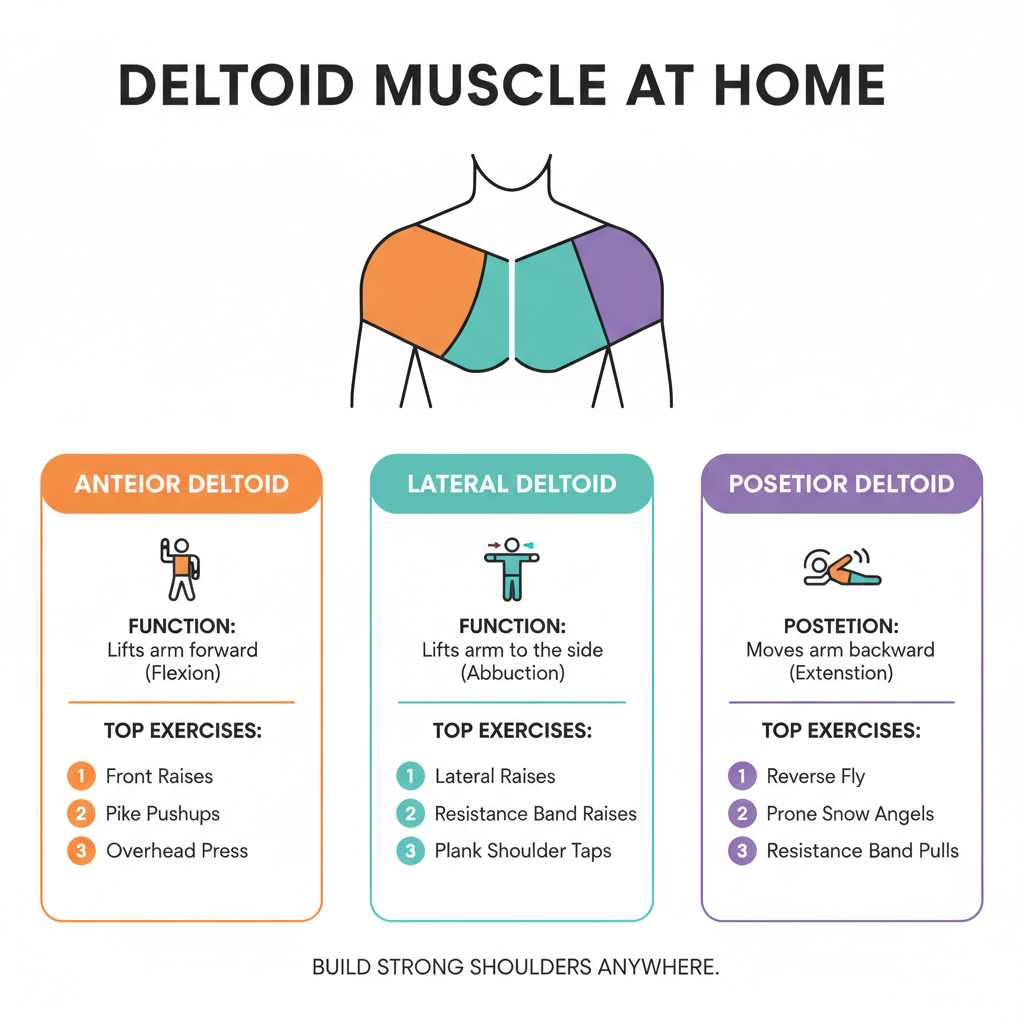
To master deltoid muscle exercises at home, we first need to understand the “three-headed” nature of the shoulder. The word “deltoid” comes from the Greek letter delta, which is triangular. This large muscle caps the shoulder joint and is divided into three distinct sections, or “heads”:
- Anterior Deltoid (Front): This part sits at the front of your shoulder. It’s responsible for flexion—lifting your arm forward (like reaching for a high shelf) and internal rotation.
- Medial/Lateral Deltoid (Side): This is the middle section. Its primary job is abduction—lifting your arm out to the side. This is the muscle that gives shoulders that broad, “capped” look.
- Posterior Deltoid (Rear): Located at the back of the shoulder, this head handles extension—pulling your arm backward (like pulling a lawn mower cord)—and external rotation.
Why Strengthening Your Delts Matters
We often focus on “mirror muscles” like biceps, but the deltoids are the true workhorses of the upper body. Strengthening them isn’t just about aesthetics; it’s about survival for your joints.
- Shoulder Stability: The shoulder is the most mobile joint in the body, but that mobility makes it inherently unstable. Strong delts help center the humerus (arm bone) in the socket, supporting the rotator cuff and preventing painful “impingement.”
- Posture Correction: Many of us spend hours hunched over laptops. This overworks the front delts and neglects the rear delts, leading to rounded shoulders. Targeted building-upper-body-strength-easy-home-workouts can pull those shoulders back where they belong.
- Injury Prevention: Statistics show that programs focusing on shoulder health can lead to massive improvements. For instance, participants in specialized shoulder programs have seen up to a 68% reduction in pain within 12 weeks.
- Functional Strength: From carrying heavy grocery bags to lifting a child, your delts are involved in almost every “push” and “pull” motion. For women looking to improve daily ease, simple-and-effective-strength-training-for-women-at-home provides a great foundation for these functional moves.
Best Bodyweight Deltoid Exercises for Beginners
If you don’t have a single dumbbell in your house, don’t panic. You carry around a significant amount of weight every day—your own body! We can use gravity and clever angles to turn your bodyweight into a high-intensity shoulder workout.
1. Pike Pushups
This is the “king” of bodyweight deltoid muscle exercises at home.
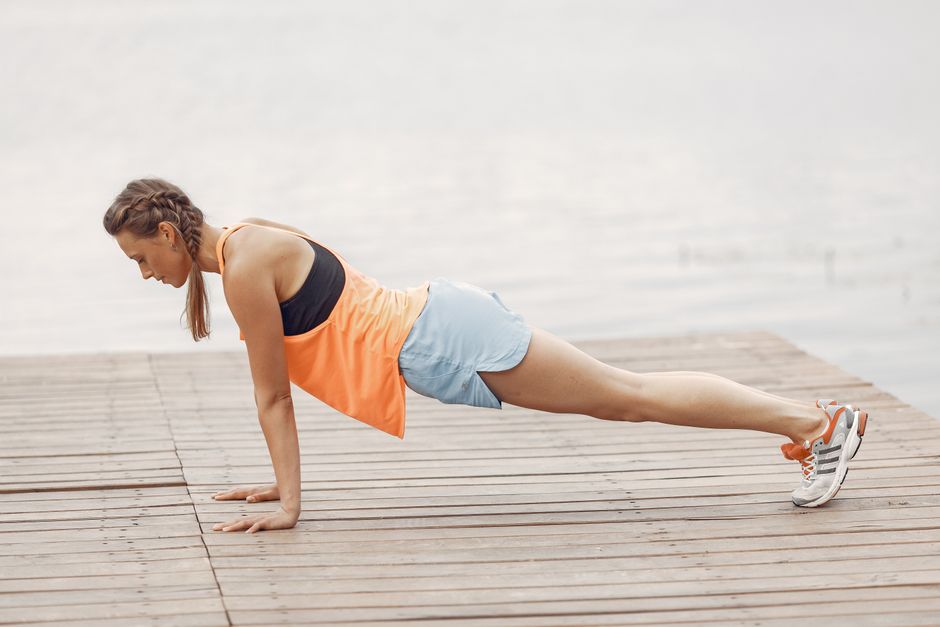
- How to do it: Start in a standard pushup position, then walk your feet toward your hands until your body forms an inverted “V” shape (the pike position). Keep your legs straight and your hips high. Lower the top of your head toward the floor by bending your elbows, then push back up.
- Why it works: By shifting your weight forward, you move the load from your chest to your shoulders.
2. Plank Shoulder Taps
This move is fantastic for stability and hits the delts while torching your core.
- How to do it: Get into a high plank position. While keeping your hips as still as possible (no wiggling!), lift your right hand and tap your left shoulder. Return it to the floor and repeat with the other hand.
- Pro Tip: Check out our guide on no-equipment-home-exercises for more ways to use the plank for upper body strength.
3. Prone Snow Angels
This exercise specifically targets the posterior delts and the muscles between your shoulder blades.
- How to do it: Lie face down on the floor with arms at your sides, palms down. Lift your chest and arms slightly off the ground. Slowly sweep your arms out to the sides and overhead (like making a snow angel), then return. Keep your arms straight and hovering the whole time.
4. Wall Slides
This looks easy, but it’s a killer for shoulder mobility and the medial delts.
- How to do it: Stand with your back against a wall. Raise your arms so your elbows and the backs of your hands are touching the wall at 90-degree angles (like a “goalpost”). Slowly slide your hands up the wall as high as you can without losing contact, then slide back down.
- Further Reading: For more floor-based movements, see our list of bodyweight-exercises-for-home.
Beginner-Friendly deltoid muscle exercises at home
If you are just starting out, we recommend these low-impact variations to build a baseline of strength. You can find more easy-home-workout-without-equipment options on our site, but these three are shoulder essentials:
- Incline Pushups: Use a sturdy table or the back of a sofa. By elevating your hands, you reduce the total weight you have to push, making it easier to focus on shoulder engagement.
- Arm Circles: It sounds like middle school gym class, but doing large and small circles for 60 seconds straight creates a massive “burn” in the medial delts.
- Shoulder W-s: Lie on your stomach and lift your arms into a ‘W’ shape, squeezing your shoulder blades together. This activates the rear delts and improves posture instantly.
Effective Dumbbell and Resistance Band deltoid muscle exercises at home
When you’re ready to add resistance, you don’t need a 50-pound rack of iron. As mentioned in the intro, a 2016 study from McMaster University proved that lifting lighter weights (30–50% of your max) for higher reps (20–25) can build just as much muscle as heavy lifting. This is great news for home trainers!
1. Military Press (Overhead Press)
This is the foundational movement for shoulder mass.
- The Move: Stand with feet hip-width apart. Hold your dumbbells (or resistance band) at shoulder height, palms facing forward. Press the weight toward the ceiling until your arms are straight, but don’t lock your elbows. Lower slowly.
- Home Hack: If you’re new to weights, read dumbbells-101-beginner-friendly-home-strength-exercises to ensure your grip and stance are correct.
2. Lateral raises
This is the best way to isolate the medial deltoid for that “wide” shoulder look.
- The Move: Hold weights at your sides. With a very slight bend in your elbows, raise your arms out to the sides until they are level with your shoulders. Lower them with control—don’t let them drop!
- Mistake to avoid: Don’t shrug your shoulders up to your ears. Keep your neck relaxed.
3. Front Raises
This targets the anterior deltoid.
- The Move: Hold weights in front of your thighs. Lift one arm (or both) straight out in front of you to shoulder height. Keep your core tight so you don’t lean back to “swing” the weight up.
4. Reverse Fly
Essential for the rear delts.
- The Move: Hinge forward at the hips with a flat back. Let the weights hang down. Raise your arms out to the sides like wings, squeezing your shoulder blades at the top.
- Band Version: Use a resistance band for “pull-aparts” to get a similar effect. Learn more about resistance-band-exercises-to-boost-strength.
5. Arnold Press
Named after the legend himself, this move hits all three heads.
- The Move: Start with dumbbells in front of your face, palms facing toward you. As you press up, rotate your palms so they face away from you at the top. Reverse the rotation on the way down.
Advanced Progressions and Creative Equipment Hacks
Once the basics feel easy, it’s time to ramp up the intensity. We can do this by changing the angle of the exercise or using household items to add “odd” weight that challenges your stabilizers.
1. Handstand Pushups
This is the ultimate goal for bodyweight shoulder training.
- How to do it: Kick up into a handstand against a wall for balance. Slowly lower yourself until your head nearly touches the floor, then press back up.
- Warning: This requires significant existing strength. If you’re not there yet, stick to pike pushups or check out our at-home-workout-for-upper-body for intermediate steps.
2. Decline Pike Pushups
A middle ground between the pike and the handstand. Place your feet on a chair or the sofa while keeping your hands on the floor in a pike position. This puts even more of your bodyweight onto your deltoids.
3. Tempo Training and Isometrics
You don’t always need more weight; you can just use “time under tension.”
- Tempo: Take 3 seconds to lift the weight and 5 seconds to lower it. This makes even a light weight feel like a ton of bricks.
- Isometric Holds: Hold the “top” of a lateral raise for 10–20 seconds. This forces the deltoid fibers to fire constantly to maintain the position.
Advanced deltoid muscle exercises at home Using Household Items
Don’t let a lack of equipment stop you. We’ve seen incredible results from people using these “hacks”:
- Water Bottles or Milk Jugs: A standard 16oz water bottle is about 1lb. A gallon of water is roughly 8.3lbs. These are perfect for lateral and front raises.
- Backpack Weights: Fill a backpack with books or canned goods. You can wear it while doing pushups or hold the top handle for overhead presses and upright rows. For more ideas on using weights effectively, see dumbbell-strength-exercises-for-home-workouts.
- Towel Face Pulls: Wrap a towel around a sturdy door handle or pole. Lean back and pull your face toward the towel, flaring your elbows out. This is a fantastic substitute for a gym cable machine to hit the rear delts.
How to Structure Your At-Home Shoulder Workout
Consistency is key, but so is a plan. We recommend training your deltoids 2 to 3 times per week, allowing at least 48 hours of rest between sessions for muscle repair.
| Level | Sets | Reps | Rest | Focus |
|---|---|---|---|---|
| Beginner | 2 | 12-15 | 60 sec | Form & Mobility |
| Intermediate | 3 | 10-12 | 45 sec | Hypertrophy (Growth) |
| Advanced | 4 | 8-10 (or failure) | 30-90 sec | Strength & Endurance |
Key Principles for Success:
- Progressive Overload: To keep seeing results, you must make the workout harder over time. This could mean adding one extra rep each week, reducing your rest time, or using a slightly heavier water bottle!
- Train to “Near Failure”: Especially when using light weights at home, you need to reach a point where you feel you could only do 1 or 2 more reps with perfect form. This is what triggers muscle growth.
- Frequency: For those just starting, our beginners-upper-body-strength-workout provides a balanced schedule that includes shoulders without overtraining.
Safety Tips, Warm-Ups, and Common Mistakes
The shoulder joint is delicate. Before diving into deltoid muscle exercises at home, we must ensure we aren’t setting ourselves up for a trip to the doctor.
The Warm-Up
Never train “cold” shoulders. Spend 5 minutes doing:
- Arm Circles: 30 seconds forward, 30 seconds backward.
- Cat-Cow Stretch: To loosen the upper back and neck.
- Dynamic Band Pulls: If you have a band, do light “face pulls” to wake up the rotator cuff. For more band ideas, see resistance-band-exercises-to-boost-strength-2.
Common Mistakes to Avoid
- Using Momentum: If you have to swing your hips to get the weight up during a lateral raise, the weight is too heavy. You’re using your lower back, not your delts.
- Ignoring the Rear Delts: Most people do 10 sets of front-focused moves and 0 for the rear. This creates an imbalance that leads to shoulder impingement. Aim for a 1:1 ratio of “push” to “pull” exercises.
- Shrugging: When you lift weights overhead or to the side, keep your shoulder blades tucked down and back. If your traps (the muscles next to your neck) are doing all the work, your delts won’t grow.
Frequently Asked Questions about Shoulder Training
How long does it take to see results from at-home deltoid training?
Most people will feel “tightness” and improved posture within 2 weeks. Visible muscle definition usually takes 6 to 8 weeks of consistent training (2-3 times per week) combined with a healthy diet.
Can I build big shoulders without heavy weights?
Absolutely. As the McMaster University study showed, volume (reps x sets) and intensity (effort) are more important than the literal number on the dumbbell. By using techniques like tempo training and high-rep sets to failure, you can build impressive deltoids with minimal equipment.
What should I do if I feel sharp pain during shoulder exercises?
“Burn” is good; “Sharp” is bad. If you feel a pinching or stabbing sensation, stop immediately. This often indicates shoulder impingement or a rotator cuff strain. Rest the area, apply ice, and focus on gentle mobility drills. If pain persists, consult a professional.
Conclusion
Building strong, healthy shoulders doesn’t require a commercial gym or expensive machines. By mastering deltoid muscle exercises at home, you are investing in your long-term mobility, posture, and functional strength.
At Casa e Jardim Web, we believe that fitness should be accessible to everyone, regardless of their setup. Start with the bodyweight basics like pike pushups and prone snow angels, then progress to household “hacks” or resistance bands as you get stronger. The best workout is the one you actually do—so keep it simple, stay consistent, and watch those shoulders transform.
Ready to expand your fitness journey? Check out more home workout guides for everything from core stability to full-body transformations!
