
Why a 30 Day Home Chest Workout Can Transform Your Upper Body
A 30 day home chest workout is one of the most effective ways to build a stronger, more defined chest — no gym required. Here’s what you need to know to get started:
Quick-start overview:
- Train 2-4 days per week depending on your fitness level
- Use push-up variations (standard, incline, decline, diamond) as your core exercises
- Keep sessions short — most workouts take less than 10 minutes per day
- Progress gradually — increase reps, sets, or difficulty every few days
- Rest 45-75 seconds between sets and at least one full day between sessions
- Support with nutrition — aim for 0.8-1g of protein per pound of body weight daily
You don’t need a bench, barbells, or a gym membership to build a stronger chest. Push-ups and their many variations can create real mechanical tension on your pectoral muscles — and that’s the main driver of muscle growth.
The challenge most people face isn’t access to equipment. It’s structure. Without a clear plan, it’s easy to do random reps and wonder why nothing changes.
That’s exactly what a focused 30-day plan solves. It gives you a progression system, a schedule, and a clear finish line to work toward.
One important thing to set expectations early: visible chest changes take consistency over time. You can feel stronger and notice early toning within 30 days, but significant size changes often require several months of consistent effort. Think of this month as a profound foundation — not an overnight fix.
The Science of a 30 Day Home Chest Workout
To build a “Superman chest” at home, we need to understand how muscles actually grow. Your chest is primarily composed of the pectoralis major and the pectoralis minor. The pectoralis major is that large, fan-shaped muscle that gives the chest its thickness and depth, while the smaller pectoralis minor sits underneath and helps with shoulder stability.
Scientific research shows that muscle hypertrophy (growth) is driven by two main factors: mechanical tension and metabolic stress. When you perform a push-up, you are placing mechanical tension on the muscle fibers. By increasing the volume—the total number of reps and sets you do over time—you create metabolic stress that signals your body to repair and grow those fibers stronger.
The pectoralis major is further divided into the clavicular head (the upper chest) and the sternal head (the lower, larger portion). A well-rounded Home Chest Workout: Pump Up Your Pecs Without Leaving the House must target both heads to ensure balanced development.
Targeting the Upper, Lower, and Inner Pecs
One of the biggest myths is that you need a gym’s worth of machines to hit different angles of your chest. In reality, you can manipulate your body position to change which muscle fibers are recruited:
- Upper Pecs (Clavicular Head): Use decline push-ups (feet elevated on a chair or couch). This shifts the tension upward toward your collarbone.
- Lower Pecs (Sternal Head): Use incline push-ups (hands on a table or bench). This focuses the effort on the bottom portion of the chest.
- Inner Pecs: While you can’t truly “isolate” the inner part of a muscle fiber, diamond push-ups (hands close together) maximize the horizontal adduction of the arm, providing a peak contraction that emphasizes that “inner” look.
By varying these angles, we ensure that every fiber is being challenged during your Building Upper Body Strength: Easy Home Workouts.
Functional Benefits Beyond Aesthetics
While looking “ripped” is a common goal, the benefits of a 30 day home chest workout go way beyond the mirror. Strong pecs are essential for functional daily tasks—think of pushing open a heavy door, lifting a child, or even pushing a stalled car.
Training these large muscle groups also provides a significant metabolic boost. Because the chest, shoulders, and triceps are large muscle groups, working them burns a considerable amount of energy both during and after the session. Additionally, strengthening the chest and the supporting muscles helps with posture correction and shoulder stability, reducing the risk of injury in your daily life. You can learn more about starting this journey in our Jumpstart Your Fitness: 30-Day Strength Training Challenge.
Essential Exercises for Your Home Chest Challenge
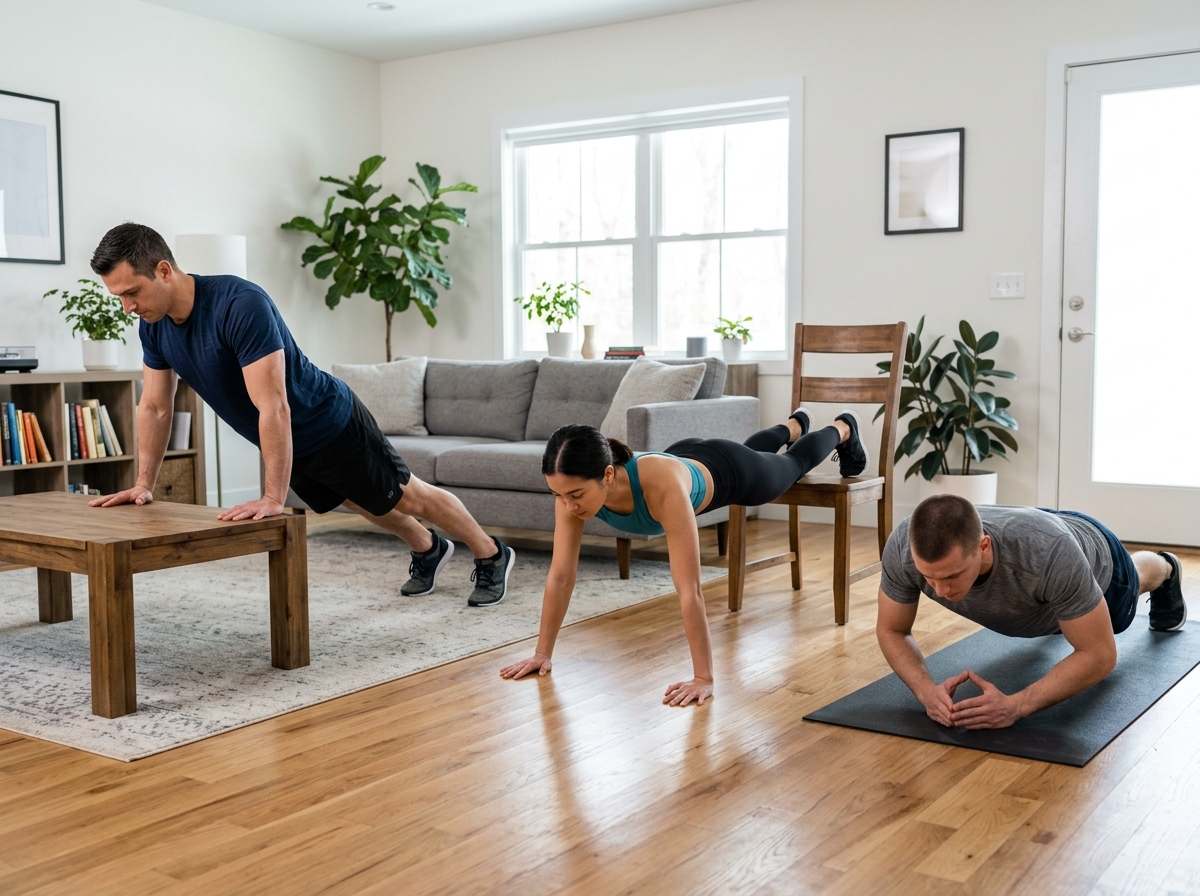
To succeed in this challenge, we will rely on a “toolbelt” of highly effective moves. You don’t need fancy gear, but you do need to master these forms:
- Standard Push-Ups: The gold standard. Keep your back flat and core tight.
- Explosive (Plyometric) Push-Ups: Pushing off the ground with enough force that your hands leave the floor. This builds power and recruits fast-twitch muscle fibers.
- Chest Dips: Using two sturdy chairs or a low corner of a kitchen counter. These are often called the “squat of the upper body” because of how effectively they build mass.
- Floor Press: If you have dumbbells, great! If not, use water bottle weights or gallon jugs. Lie on the floor and press upward; the floor acts as a safety stop for your elbows.
For those just starting, check out our guide on No-Equipment Home Exercises or see how to incorporate Dumbbell Strength Exercises for Home Workouts if you have a pair of weights lying around.
Bodyweight Mastery for All Levels
At Casa e Jardim Web, we believe fitness should be accessible to everyone. If a standard push-up feels impossible right now, don’t sweat it!
- Beginner: Start with knee push-ups or incline push-ups against a wall or kitchen island.
- Intermediate: Incorporate plank walkups and mountain climbers to build the core stability needed for longer sets.
- Advanced: Focus on time under tension. Instead of rushing through reps, take 3-4 seconds to lower your body to the floor.
For more foundational movements, explore our Bodyweight Exercises for Home and our Beginners Upper Body Strength Workout.
Advanced Variations and Equipment Substitutions
Once the basics become easy, it’s time to turn up the heat. We can use “intensity multipliers” to keep the muscles guessing:
- 1.5 Rep Technique: Go all the way down, come halfway up, go back down, and then push all the way up. That’s one rep. It effectively doubles the time your muscles spend under stress.
- Isometric Holds: Pause at the bottom of a push-up (just an inch off the floor) for 3-5 seconds.
- Tempo Push-Ups: Use a specific count (e.g., 4 seconds down, 1 second pause, 1 second up).
- Chair Dips: A fantastic way to target the lower chest and triceps using just a piece of furniture.
These methods are perfect for Muscle Building Home Workouts for Beginners who want to progress to an intermediate level quickly.
Structuring Your 30-Day Home Chest Workout Plan
Success in a 30 day home chest workout comes down to progressive overload. This means you must gradually increase the difficulty of your workouts so your muscles don’t plateau.
| Feature | Beginner Schedule | Advanced Schedule |
|---|---|---|
| Frequency | 2-3 times per week | 3-4 times per week |
| Sets per Exercise | 2-3 sets | 3-5 sets |
| Repetitions | 8-12 reps | 12-20+ reps |
| Rest Intervals | 60-90 seconds | 30-60 seconds |
| Focus | Form & Consistency | Muscle Failure & Intensity |
For a broader look at organizing your week, see our Beginner-Friendly Home Workout Plan.
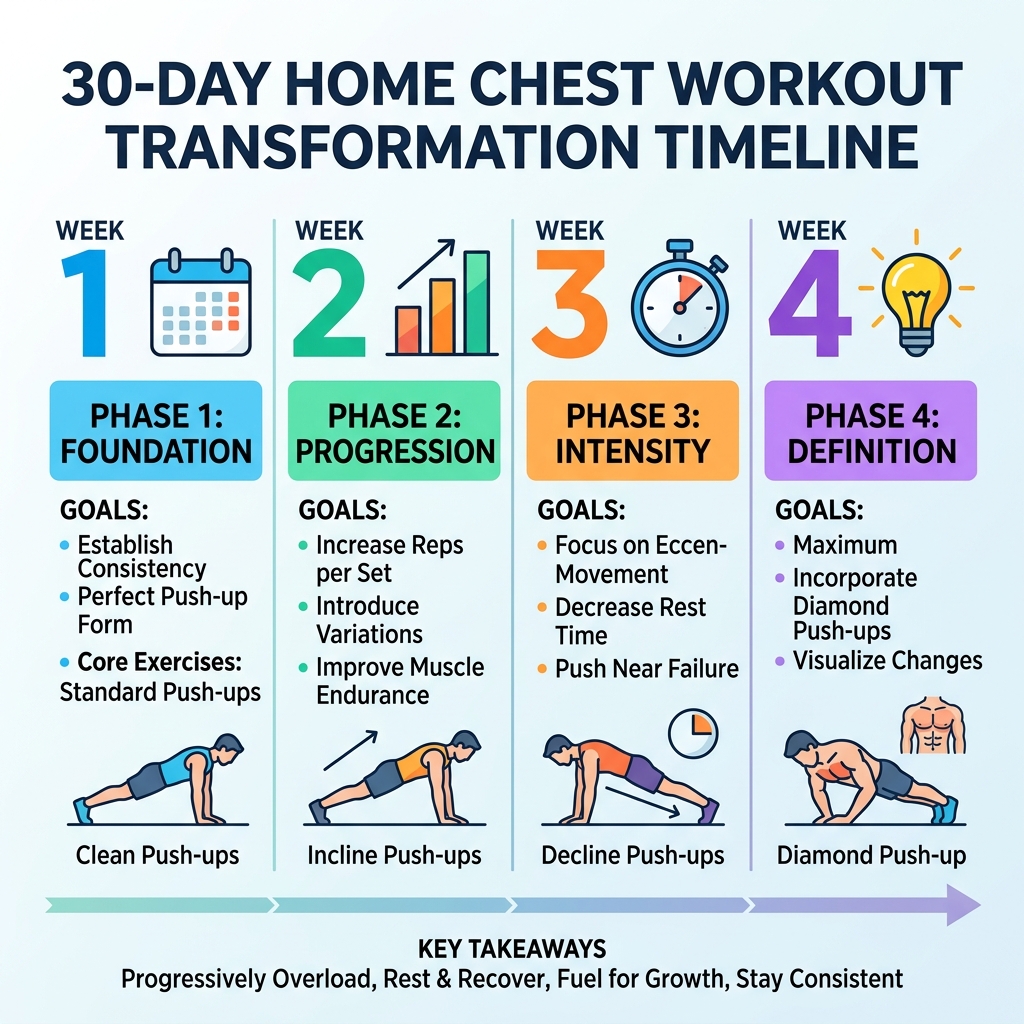
Phase 1: Building the Foundation (Days 1-15)
In the first two weeks, your goal is to establish your baseline. On Day 1, perform a “max rep assessment”—do as many standard push-ups as you can with perfect form. This number will be your benchmark.
During this phase, we focus on 2-3 sessions per week. Focus entirely on your form: keep your elbows tucked at a 45-degree angle (don’t flare them out like a “T”) and ensure your chest touches the floor. Allow 45-75 seconds of rest between sets to ensure your muscles recover enough for the next round.
Phase 2: Increasing Intensity (Days 16-30)
Now that your joints and muscles are used to the movement, we push for growth. We increase frequency to 3-4 sessions per week.
We also introduce “Grinder Style” reps. When you reach muscle failure (you can’t do another full rep), don’t stop! Rest in a “pike” position (butt in the air) for 3 seconds, then try to squeeze out 1 or 2 more reps. We also suggest using a triset format—performing three different chest exercises back-to-back with no rest—to maximize the “pump” and metabolic stress.
Maximizing Results: Nutrition, Recovery, and Form
You don’t build muscle in the “gym” (or your living room); you build it while you sleep and eat. To see a transformation in 30 days, your kitchen habits must match your workout intensity.
Protein synthesis is the process of repairing muscle tissue. To support this, we recommend consuming 0.8-1g of protein per pound of body weight daily. Think lean meats, eggs, beans, or protein shakes. Pair this with complex carbohydrates (sweet potatoes, oats, brown rice) for energy and healthy fats (avocados, nuts) for hormone health. Check out our Nutrition Tips for Muscle Building for a deeper dive.
The Role of Warm-ups and Cool-downs
Skipping a warm-up is the fastest way to end your 30-day challenge early with an injury. Spend 5-10 minutes on dynamic stretching:
- Shoulder Rolls: 15 reps forward and back.
- Arm Circles: Small to large circles to lubricate the joints.
- Trunk Rotations: To engage the core.
After your session, spend 5-8 minutes on static chest stretches (holding a stretch against a doorframe) to aid recovery and reduce muscle tightness. Proper Pre-Workout and Post-Workout Tips can make the difference between a successful month and a painful one.
Tracking Progress and Staying Motivated
Motivation is what gets you started; habit is what keeps you going. To stay on track:
- Visual Evaluations: Take “Before” photos on Day 1 in good lighting.
- Body Measurements: Measure the circumference of your chest.
- Workout Logs: Write down how many reps you did. Seeing that “20” become a “25” is a huge mental win.
- Accountability Partners: Tell a friend about your 30 day home chest workout or post your progress online.
Frequently Asked Questions about Home Chest Training
Can I really see a chest transformation in just 30 days?
Yes and no. In 30 days, you will definitely see increased strength and visible toning, especially if you are a beginner. However, for a massive, “bodybuilder” style transformation, most experts suggest a 90-day commitment. Consistency and intensity are the keys to making these short-term gains permanent.
What equipment is absolutely necessary for this challenge?
Technically, zero equipment is necessary. You can build a great chest using bodyweight alone. However, using household items like heavy chairs for dips or water bottles for floor presses can add variety and help you target muscles more effectively.
How often should I rest during the 30-day program?
Muscle recovery is vital. We recommend a 48-hour window between intense chest sessions. On your “off” days, you can do active recovery like walking or light stretching. Never underestimate sleep quality; aim for 7-9 hours to allow your hormones to maximize muscle repair.
Conclusion
At Casa e Jardim Web, our mission is to make gym-free fitness accessible to everyone. Whether you are a total beginner or an advanced athlete, a 30 day home chest workout is a powerful tool to take control of your physique and your health.
By combining the science of mechanical tension with a structured plan and proper nutrition, you can achieve sustainable Strength right from your living room. Are you ready to accept the challenge? Start today, stay consistent, and watch your body transform one push-up at a time!
