
Why the Pistol Pushup Upper Body Challenge Is the Ultimate Test of Bodyweight Strength
The pistol pushup upper body challenge is one of the most demanding tests of raw, equipment-free pressing strength you can attempt at home. It combines single-arm stability, core tension, and total-body control into one movement — no gym required.
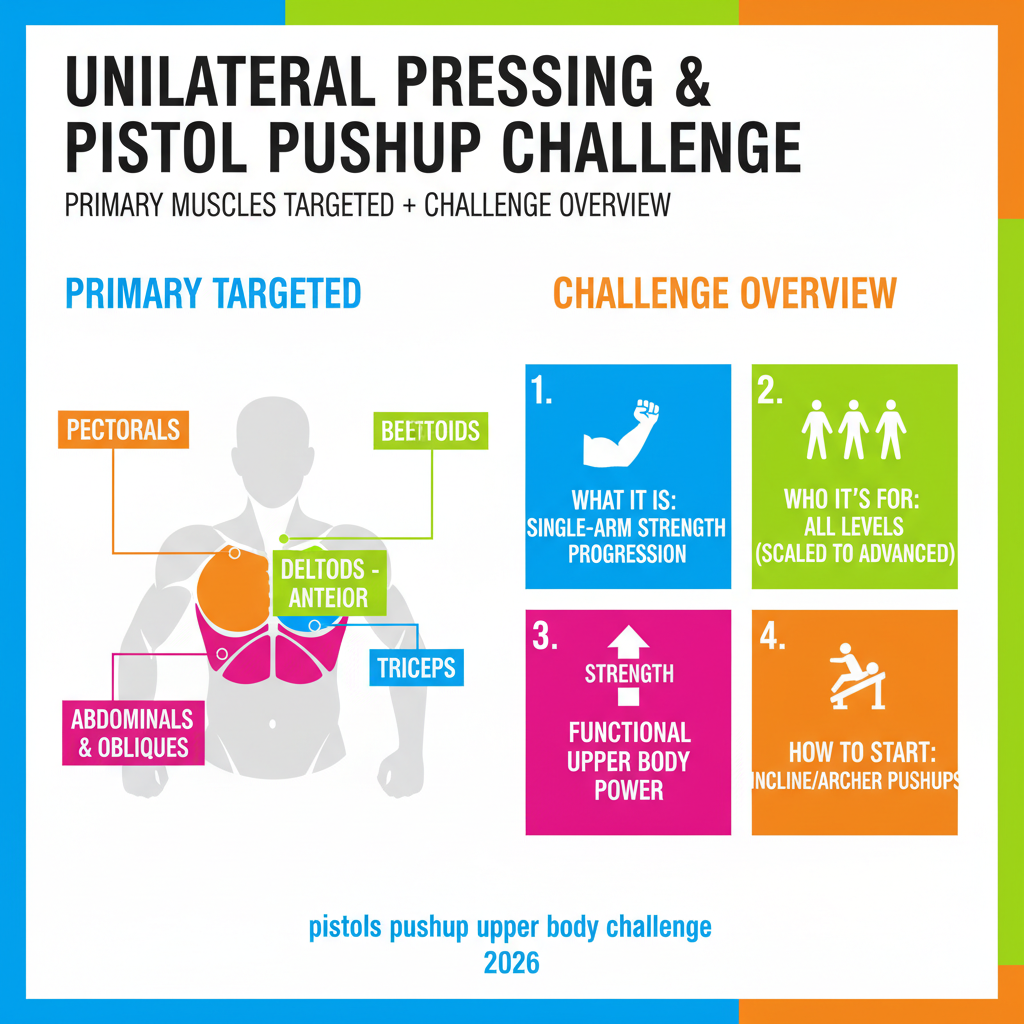
Here’s what you need to know at a glance:
- What it is – A structured challenge built around the one-arm (pistol) pushup, progressed over multiple weeks
- Who it’s for – Anyone from beginners (using scaled versions) to advanced athletes chasing unilateral strength
- Key benefit – Builds pressing strength that carries over to dips, overhead press, and athletic performance
- How to start – Begin with incline or archer pushup progressions, then work toward a full one-arm rep
- How to structure it – Use Grease the Groove (GTG) or ladder sets, training 3-5 times per week
Most people can bench press or do standard pushups. Far fewer can control their entire bodyweight on a single arm. That gap is exactly what this challenge targets.
The good news? You don’t need to nail a perfect one-arm pushup on day one. With the right progressions and a smart training plan, almost anyone can build toward it — and get significantly stronger in the process.
Below, we’ll walk you through everything: form, mobility prep, beginner scaling, advanced loading, and a full 30-day plan.
What is the Pistol Pushup Upper Body Challenge?
When we talk about the pistol pushup upper body challenge, we are diving into unilateral (one-sided) resistance training. While a standard pushup distributes your weight across four points of contact (two hands, two feet), the pistol pushup—often referred to as the one-arm pushup—slashes that support system in half.
This challenge isn’t just about “doing pushups.” It is a structured journey designed to take you from bilateral movements to the pinnacle of calisthenics mastery. By focusing on one side of the body at a time, we eliminate the “hidden” imbalances where a stronger dominant side carries the load for a weaker one.
The science supports this approach. Scientific research on the benefits of unilateral resistance training suggests that training one side can actually improve strength in the opposite limb through a phenomenon called “cross-education.” Furthermore, because you are fighting to stay upright with only one arm, your core has to work double-time to prevent your torso from collapsing. If you are looking for a comprehensive at-home-workout-for-upper-body, this challenge is the “gold standard” for testing your grit.
Defining the Pistol Pushup Upper Body Challenge vs. Standard Pushups
The primary difference lies in the physics of the movement. In a standard pushup, your center of gravity is centered between your hands. In a pistol pushup, your center of gravity must shift. You aren’t just pushing up; you are resisting rotation (anti-rotation).
- Standard Pushup: Balanced load, moderate core engagement, focuses on chest/triceps volume.
- Pistol Pushup: Unbalanced load, extreme core tension, requires high-level shoulder stability and “irradiation”—the ability to tense every muscle in the body to create a rigid structure.
For those just starting, we recommend checking out our beginners-upper-body-strength-workout to build the foundational “push” strength required before narrowing your base of support.
Benefits of the Pistol Pushup Upper Body Challenge for Athleticism
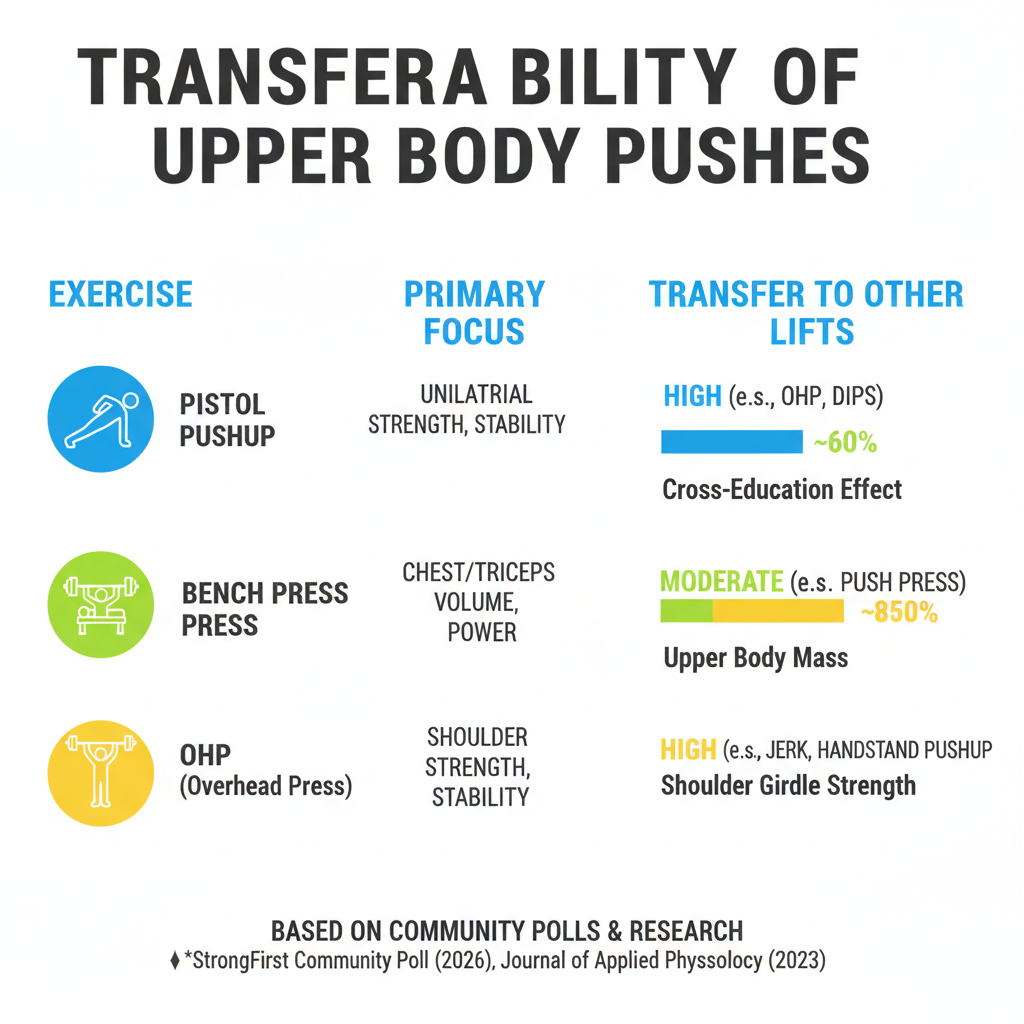
Why put yourself through this? Because the strength gained here is “transferable.” In strength training, we often look at how one exercise helps another. Research and community polls (such as those from StrongFirst) show that unilateral pressing movements have a high carryover to other heavy lifts.
For example, mastering the one-arm pushup improves your “pressing groove,” which directly benefits your Overhead Press (OHP) and Weighted Dips. In a poll of 66 strength enthusiasts, exercises like Weighted Dips (22.7%) and OHP (21.2%) were voted as the most versatile upper-body pushes. The pistol pushup sits right in that sweet spot of high-tension, high-reward training.
Mastering Form and Essential Mobility
Before you drop to the floor, we need to talk about the “setup.” A pistol pushup is a full-body contraction. If your legs are limp or your core is soft, your arm will fail.
Key Form Cues:
- Shoulder Packing: Pull your shoulder blade down and back into its socket. Never let the shoulder “shrug” toward your ear.
- Feet Positioning: Unlike a standard pushup, your feet should be wider than shoulder-width. This creates a “tripod” of stability between your two feet and your single hand.
- Glute Engagement: Squeeze your glutes like you’re trying to crack a walnut. This stabilizes the pelvis and prevents the common “hip sag.”
According to Scientific research on core activation during pushup variations, unilateral variations significantly increase the demand on the obliques and transverse abdominis. This makes the pistol pushup an incredible “secret” abs workout. If you’re looking for an easy-home-workout-without-equipment, mastering this form is your first step.
Mobility Drills for the Pistol Pushup Upper Body Challenge
You cannot perform a high-level pushup with “stiff” joints. We need to prepare the “chassis” before we rev the engine.
- Wrist Flexibility: Since one wrist is taking 60-70% of your total body weight, perform wrist circles and “finger-pulses” on the floor to warm up the joint.
- Thoracic Extension: Use a foam roller or a chair to open up your mid-back. If your upper back is rounded, your shoulder cannot stay “packed” safely.
- Shoulder Health: Perform “Scapular Pushups” (moving only the shoulder blades) to ensure you have control over your serratus anterior.
For more ideas on prepping your joints, see our guide on no-equipment-home-exercises.
Proper Technique and Common Mistakes
The most common error in the pistol pushup upper body challenge is “elbow flaring.” If your elbow points straight out to the side (90 degrees), you are placing immense stress on the rotator cuff. Instead, keep your elbow tucked closer to your ribs (about 45 degrees).
Another mistake is “the twist.” As people struggle to get back up, they often rotate their hips toward the floor. To fix this, imagine there are headlights on your hip bones; keep those lights pointed straight at the ground throughout the entire rep.
Progressions for the Pistol Pushup Upper Body Challenge
Don’t worry if you can’t do a full one-arm pushup yet. Most people can’t! The secret is in the “ladder of difficulty.” We use bodyweight-exercises-for-home to bridge the gap.
Beginner to Intermediate Scaling
- Wall or Incline Pushups: Perform the one-arm movement against a wall or a high kitchen counter. This reduces the percentage of body weight you have to lift.
- Archer Pushups: Keep both hands on the floor, but extend one arm out to the side like a kickstand. Shift 80% of your weight to the “working” arm.
- Eccentric-Only Reps: This is a game-changer. Start at the top of a one-arm pushup and lower yourself as slowly as possible (3-5 seconds). When you hit the bottom, use both hands to push back up.
- Knee-Supported Unilateral: Shortening the lever by dropping to your knees makes the balance much easier to manage.
For those focusing on building-upper-body-strength-easy-home-workouts, these progressions ensure you never hit a plateau.
Advanced Loading and Tools
Once you can do 5+ clean pistol pushups per side, you might want more.
- Resistance Bands: Loop a band around your chest and anchor it above you to “lighten” the load at the bottom.
- Weighted Vests: The ultimate way to increase the challenge without changing the mechanics.
- Kettlebell Counterweights: Holding a light weight in the “non-working” hand can actually help balance your center of gravity, though it adds to the total load.
If you have equipment at home, you can integrate dumbbell-strength-exercises-for-home-workouts to build the accessory muscles (like the triceps and rear delts) that support your pistol pushup progress.
Structuring Your 30-Day Challenge Routine
To see real results in the pistol pushup upper body challenge, you need a plan. We recommend two specific methods: Grease the Groove (GTG) and Ladders.
Sample Workout Plans: Ladders and GTG
The GTG Method (Best for Skill Mastery): The goal here is to train your nervous system without getting tired.
- Perform 1-2 reps of your hardest “attainable” progression (e.g., Archer Pushups).
- Do this 4-6 times throughout the day, spread out by at least an hour.
- Never go to failure. Stay at roughly 50% of your max effort.
The Ladder Method (Best for Volume): This is inspired by classic press-up challenges that total 210 reps (20+19+1…). For our unilateral challenge, try a “1 to 5” ladder:
- 1 rep left, 1 rep right.
- 2 reps left, 2 reps right.
- …up to 5, then back down to 1.
Tracking Progress and Measuring Success
Don’t just count reps; count “perfect” reps. In our challenge, a rep only counts if:
- The chest gets within 2 inches of the floor.
- The hips stay level (no twisting).
- The elbow doesn’t flare.
Consistency is the only metric that matters. If you train 3-5 times per week, you will see your “sticking point” (the bottom of the pushup) get stronger every week.
Frequently Asked Questions about Pistol Pushups
Who should avoid attempting this challenge?
If you have existing shoulder impingements, wrist tendonitis, or lower back issues (specifically flexion intolerance), proceed with caution. The high tension required can aggravate these areas if your form isn’t perfect. Always consult a professional if you feel sharp pain.
How do I fix my balance during the descent?
Widen your feet! The wider your base, the easier the balance. Also, squeeze the hand that is not working into a tight fist and press it against your thigh or lower back. This creates “irradiation” and makes your whole body feel like one solid piece of wood.
Can I pair this with pull-ups and dips?
Absolutely. In fact, we encourage it. The pistol pushup is a “horizontal push.” Pairing it with a “vertical pull” (pull-ups) creates a balanced physique and healthy shoulders. Many advanced athletes use a GTG approach where they alternate one-arm pushups with pull-ups throughout the day.
Conclusion
The pistol pushup upper body challenge is more than just a workout; it’s a path to mastering your own body. At Casa e Jardim Web, we believe that you don’t need a room full of expensive machines to build elite-level strength. By focusing on unilateral movements, core stability, and consistent progressions, you can transform your upper body from the comfort of your living room.
Whether you are starting with wall pushups or aiming for 100 consecutive reps, the journey is the same: stay tight, stay consistent, and never sacrifice form for ego. Ready to take your training to the next level? Explore more info about strength training services and join our community of gym-free athletes today.
