
You Don’t Need a Gym to Build a Stronger Core
A 6 week ab workout no equipment plan is one of the most accessible ways to build real core strength and work toward visible abs — no gym membership, no dumbbells, no excuses.
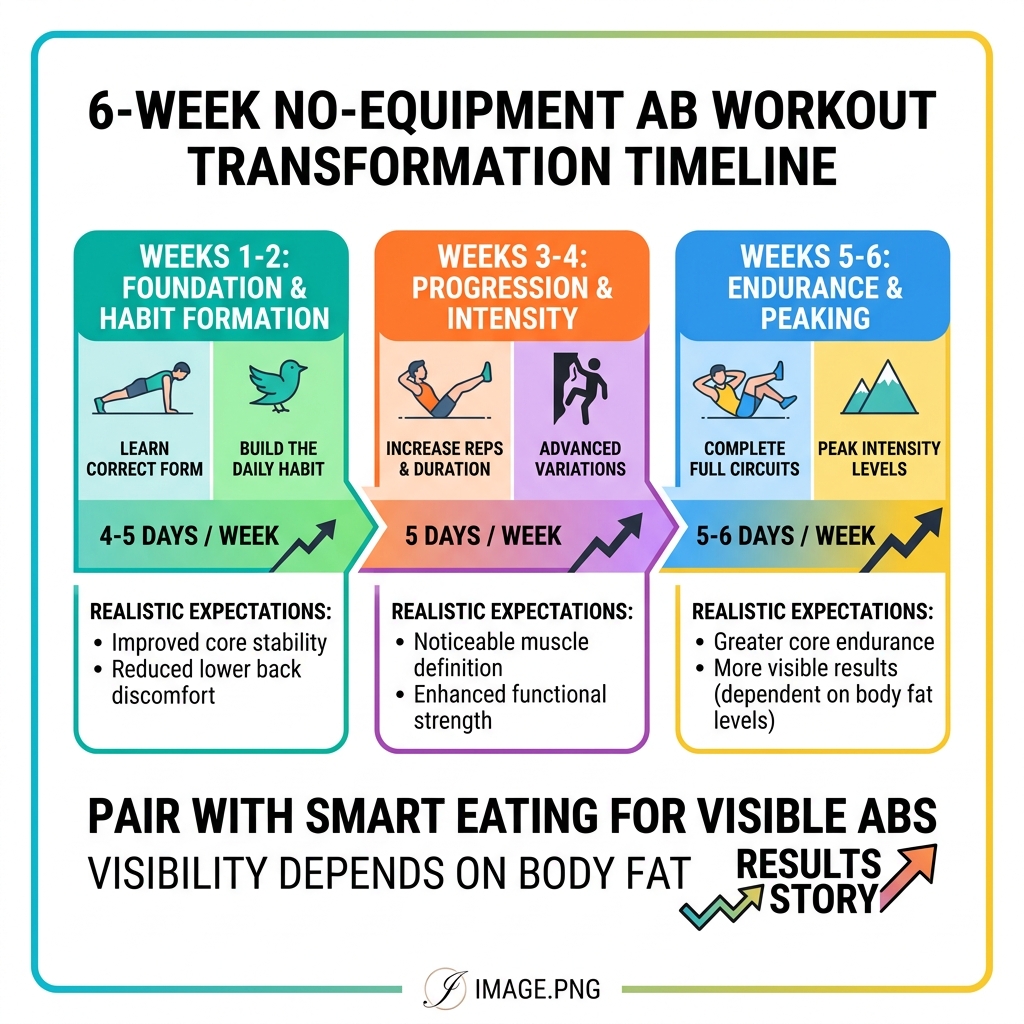
Here’s what a solid 6-week no-equipment ab plan looks like at a glance:
| Week | Focus | Frequency |
|---|---|---|
| 1-2 | Foundation — learn form, build the habit | 4-5 days/week |
| 3-4 | Progression — increase reps and intensity | 5 days/week |
| 5-6 | Endurance — advanced variations, full circuits | 5-6 days/week |
What you can realistically expect in 6 weeks:
- Noticeable improvements in core strength and stability
- Better posture and reduced lower back discomfort
- Increased muscle definition (visibility depends on body fat levels)
Most people searching for a no-equipment ab plan want results they can actually see. The good news? Research shows you can expect measurable improvements in core strength and definition within just 4-6 weeks — if you stay consistent and pair your training with smart eating habits.
The less popular truth is that visible abs are mostly a body fat story, not just a workout story. But that doesn’t mean the training doesn’t matter. It absolutely does — and a structured 6-week plan gives you both the muscle development and the habit foundation to get there.
What to Expect from a 6 Week Ab Workout No Equipment Plan
When we embark on a journey to redefine our midsection, it is vital to set the stage with honesty. We often see “shredded in seconds” clickbait, but the biological reality of muscle growth and fat loss follows a more measured pace. Over a six-week horizon, your body undergoes significant physiological shifts.
Initially, the changes are neurological. Your brain becomes more efficient at “firing” the muscles in your core. You’ll find that a plank that felt impossible on day one becomes a steady hold by day fourteen. Beyond these “newbie gains,” actual muscle hypertrophy—the physical growth of the muscle fibers—begins to take shape. According to Scientific research on abdominal muscle activation, even the humble crunch, when performed with perfect technique, shows immense muscle activation compared to expensive gym gadgets.
By the time you reach the 4-to-6-week mark, your core will feel “tighter.” This isn’t just a feeling; it’s the result of increased muscle tone and improved resting tension in the transverse abdominis (your internal “weight belt”). If you are also incorporating bodyweight exercises for home, you’ll notice these core gains translating into better balance and strength in your other movements.
The Reality of Visible Results
Let’s address the “six-pack” in the room. Can you see your abs in six weeks? The answer depends largely on where you start. Research suggests that for many, the outline of a complete set of abs can begin to emerge at body fat levels in the mid-teens. For men, this is typically between 9-15%, and for women, 14-21%.
If you are starting at a higher body fat percentage, six weeks of a 6 week ab workout no equipment routine will build a powerful, thick wall of muscle, but it might still be tucked under a layer of subcutaneous fat. However, don’t let that discourage you. Building the muscle first ensures that when the fat does come off, there is something impressive to show. You can find more tips on starting simply with an easy home workout without equipment to complement your ab-specific goals.
The Science of Visible Abs: Diet and Body Fat
We have all heard the phrase “abs are made in the kitchen.” While we believe they are built through sweat and floor work, they are certainly revealed in the kitchen. To see the fruits of your labor, a calorie deficit is usually required. This means consuming slightly fewer calories than your body burns, encouraging it to use stored fat for energy.
Nutrition is the lever that moves the needle on visibility. Prioritizing high protein intake (around 0.7 to 1.0 grams per pound of body weight) helps preserve the muscle you’re working so hard to build while you lose fat. We also recommend focusing on “high-volume” foods—veggies and leafy greens—that keep you full without packing on excess calories.
When it comes to the exercises themselves, science offers a clear path. While isometric holds like planks are great for stability, dynamic spinal flexion (where your spine actually moves, like in a crunch or leg raise) has been found superior for abdominal hypertrophy.
| Exercise Type | Benefit | Best For |
|---|---|---|
| Dynamic Flexion | Muscle Growth (Hypertrophy) | “Pop” and definition of the six-pack |
| Isometric Holds | Stability & Endurance | Core strength and injury prevention |
Why You Can’t Out-Train a Bad Diet
It is a mathematical heartbreak, but a 10-minute ab circuit might burn 50 to 100 calories, while a single sugary coffee drink can easily exceed 400. This is why you cannot “out-train” a diet that isn’t aligned with your goals.
Consistent fat loss requires a sustainable approach. Aim for a loss of about 0.5% to 1% of your body weight per week. This slow and steady pace ensures you aren’t just losing water or muscle. For a holistic approach to your fitness, consider integrating your ab work into a full body home workout plan, which boosts your overall metabolic rate. The goal of our 6 week ab workout no equipment plan is to build a habit that lasts far longer than forty-two days. You can also check out no-equipment home exercises for more ways to keep your heart rate up.
Essential Exercises for Your 6 Week Ab Workout No Equipment
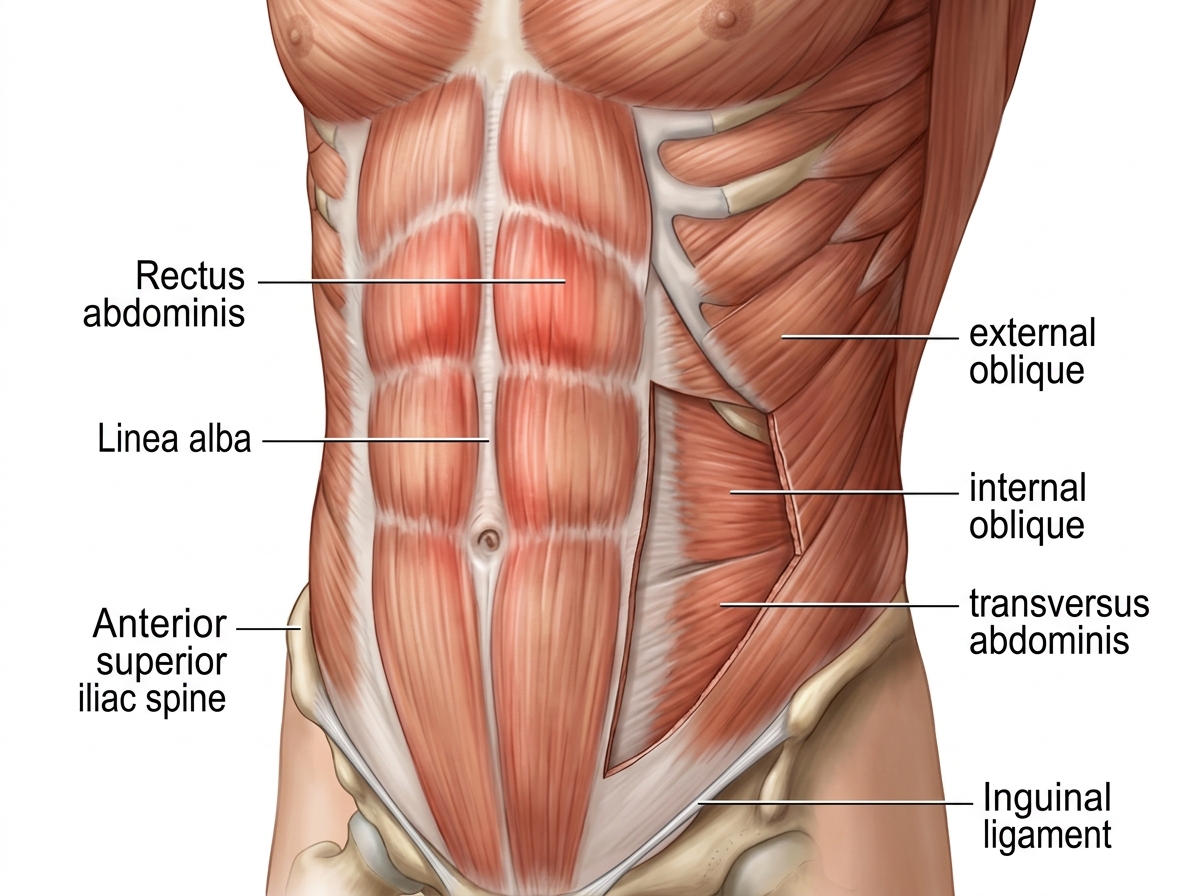
To target every “zone” of the core—the upper and lower rectus abdominis, the internal and external obliques, and the deep transverse abdominis—you need variety. We have selected a handful of “power moves” that require zero equipment but offer maximum tension.
One of our favorites is the W-Raise. Lying on your back, you bring your legs up and out in a “W” shape, engaging the lower abs and hip stabilizers. Another heavy hitter is the Black Widow Knee Slide. Starting in a plank position, you draw your knee toward your elbow and then slide it up toward your shoulder, creating a massive contraction in the obliques.
For those just starting, a beginner-friendly home workout plan can help you build the necessary baseline strength to perform these moves with control.
Targeting the Upper and Lower Abs
The “upper” and “lower” abs are actually part of the same muscle (the rectus abdominis), but we can emphasize different ends by moving either our torso or our legs.
- Levitation Crunch: This isn’t your grandma’s crunch. Lie on your back with legs in the air, knees bent. Reach for the ceiling, lifting only your shoulder blades. The goal is “vertical” movement, which places immense stress on the upper portion of the abs.
- Reverse Crunch: By curling your hips off the floor toward your chest, you engage the lower fibers of the abs. This is a staple for anyone following a home workout for beginners because it is safer for the lower back than traditional leg lifts.
- Butterfly Sit-up: By placing the soles of your feet together, you take the hip flexors out of the equation, forcing your abs to do the heavy lifting.
Strengthening the Obliques and Deep Core
The obliques are the muscles on the sides of your waist that create that “V-taper” look and allow for rotational power.
- Russian Twists: Seated with your feet off the floor, rotate your torso from side to side.
- Side Planks: These are essential for lateral stability.
- Deadbug: This is the gold standard for deep core health. By moving opposite limbs while keeping your lower back glued to the floor, you train the transverse abdominis. Scientific research on core strength and back pain has shown that those with stronger core stabilizers suffer significantly less from lower back issues.
For men looking to build that rugged core look, we recommend a home workout for men beginners to see how these moves fit into a larger strength routine.
Structuring Your Routine for Maximum Progression
A 6 week ab workout no equipment plan only works if it gets harder over time. This is called “progressive overload.” Since we aren’t adding weight, we must add difficulty through other means: more reps, shorter rest periods, or more challenging exercise variations.
We recommend a technique called Extinction Training. This involves performing an exercise until you can no longer maintain perfect form, resting for just 10 seconds, and then trying to squeeze out a few more reps. This creates “metabolic stress,” which is a key driver for muscle growth.
You can organize these exercises into a circuit. For example, perform five exercises back-to-back, rest for 60 seconds, and repeat for three to four rounds. This keeps the heart rate elevated and maximizes the work done in a short window. For more ideas on how to structure your week, see our full body weight training routine at home.
Frequency and Rest in a 6 Week Ab Workout No Equipment
Unlike larger muscle groups like your legs, the abs are made of endurance-based fibers that recover relatively quickly. This means you can—and should—train them frequently. Aim for 5-6 days per week for short, intense sessions (10-15 minutes).
It takes approximately 22 days to solidify a new habit. If you can make it through the first three weeks of this 6 week ab workout no equipment challenge, your brain will stop fighting the process, and it will become a natural part of your day. However, “rest” doesn’t always mean sitting on the couch. Active recovery, like walking or light stretching, helps blood flow and muscle repair. Our ultimate guide to full body weight training at home goes deeper into how to balance intensity with recovery.
Mastering Form to Prevent Injury
The most common mistake in ab training is using the hip flexors or the lower back instead of the core. To avoid this, master the posterior pelvic tilt.
Imagine you have a tail and you are trying to tuck it between your legs. This motion flattens your lower back against the floor and “turns on” your abs. If you feel a “twinge” in your lower back during a leg raise, your back is likely arching. Stop, reset your tilt, and continue. Mind-muscle connection—actually thinking about the muscle you are squeezing—is not just “gym talk”; it’s a proven way to increase muscle fiber recruitment.
Lifestyle Factors for Six-Pack Success
You can do a thousand crunches a day, but if you aren’t sleeping, your muscles won’t grow. Sleep is when your body undergoes protein synthesis and releases growth hormones. Aim for at least 7 to 8 hours of quality shut-eye.
Hydration is another unsung hero. Water is necessary for every metabolic process, including fat burning. Furthermore, staying hydrated helps prevent the bloating that can hide abdominal definition. Finally, manage your stress. High levels of cortisol (the stress hormone) are scientifically linked to increased abdominal fat storage. Consistency is the “secret sauce”—doing a “good” workout six days a week is vastly superior to doing one “perfect” workout once a month.
Frequently Asked Questions about No-Equipment Ab Training
Can I get a six-pack in just 6 weeks?
As we’ve discussed, you can definitely see improvement. If you start with a low body fat percentage, six weeks is enough time to see significant definition. If you are starting at a higher body fat level, you will build the muscle and strength, but the “six-pack” look may take longer as you continue your fat loss journey.
Are 10-minute ab workouts actually effective?
Yes! Because the abs recover quickly and are relatively small muscles, 10 minutes of high-intensity, “no-rest” circuit training is plenty of time to stimulate growth, provided you are doing it 5-6 times a week.
Is it safe to train my abs every single day?
For a short-term challenge like this, yes. However, if you start feeling excessive soreness or a loss of strength, take a day off. Most people find that 5-6 days a week is the “sweet spot” for core development.
Conclusion
Embarking on a 6 week ab workout no equipment journey is about more than just the mirror. It’s about building a core that supports your spine, improves your athletic performance, and gives you the confidence of knowing you are physically capable. At Casa e Jardim Web, we believe that fitness should be accessible to everyone, regardless of whether they have a home gym or a single dumbbell.
By combining these targeted exercises with a disciplined approach to nutrition and a commitment to habit formation, you aren’t just working toward a six-pack—you’re working toward a healthier, stronger version of yourself. For more tips on staying active without the gym, explore our more home workout guides and routines. Now, clear a space on the floor and let’s get to work!
