
You Don’t Need a Gym to Build Real Muscle — Here’s the Truth
Can you build muscle at home without equipment? Yes, absolutely. Science confirms it, and millions of people do it every day.
Here’s the quick answer:
- Muscle grows when it’s challenged — not just when you lift iron
- Bodyweight exercises create mechanical tension and metabolic stress, the same triggers that cause muscle growth in the gym
- Research published in Physiology & Behaviour found that muscle growth can occur independent of an external load, as long as exercises are performed through their full range of motion
- An 8-week study found push-ups as effective as bench press for muscle hypertrophy and strength gains
- Progressive overload — gradually making your workouts harder — is the real key, not the equipment you use
So if you’ve been putting off getting stronger because you don’t own a dumbbell, this guide is for you.
The truth is, your body is already a resistance machine. Push-ups, squats, lunges, and planks all force your muscles to work against gravity. Done consistently and with increasing difficulty, they build real size and strength.
You just need a plan.
The Science: Can You Build Muscle at Home Without Equipment?
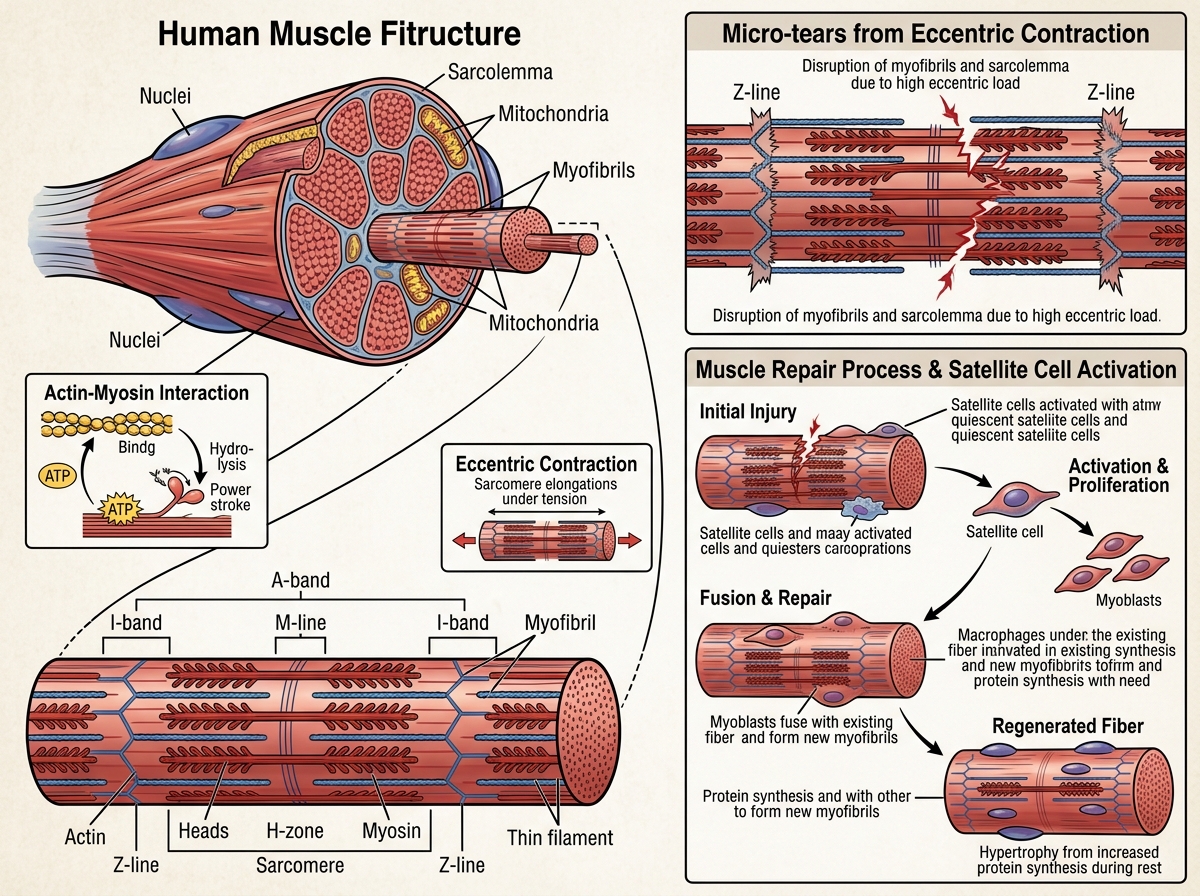
To understand how we can grow without iron, we have to look at how muscle hypertrophy (the scientific name for muscle growth) actually happens. Your muscles don’t have eyes; they don’t know if you are holding a $500 gold-plated dumbbell or simply pushing your own torso off the bedroom floor. They only respond to mechanical tension and metabolic stress.
When we perform bodyweight exercises, we create tension by stretching and contracting muscle fibers against gravity. Research has shown that muscle growth can occur independent of an external load. A key study in the Journal of Exercise Science & Fitness found that 18 male participants who did push-ups with a load similar to 40% of their bench press max saw comparable muscle thickness gains to those using traditional weights over eight weeks.
The secret lies in recruiting Type II muscle fibers. These are your “power” fibers, which have a larger cross-sectional area and more potential for growth than Type I fibers. To hit these without heavy weights, we must focus on a full range of motion and explosive movements. If you only go halfway down on a squat, you’re only getting half the gains.
For those just starting, check out our guide on muscle-building home workouts for beginners to lay the groundwork.
| Feature | Bodyweight Training | Traditional Weightlifting |
|---|---|---|
| Accessibility | High (Anywhere, anytime) | Low (Requires gym/gear) |
| Joint Impact | Generally Lower/Natural | Can be High |
| Functional Strength | Excellent (Moving your own mass) | Good (Isolation focused) |
| Progressive Overload | Via leverage & tempo | Via adding plates |
Mastering Progressive Overload Without External Weights
The biggest mistake people make when trying to build muscle at home without equipment is doing the same 20 push-ups every morning for three years. If the challenge stays the same, your muscles stay the same. In the gym, you add a 5lb plate. At home, we use “biological hacking” to increase the difficulty.
- Time Under Tension (TUT): Instead of banging out reps like a piston, slow down. Take 3 seconds to lower yourself and 1 second to explode up. This forces the muscle to work harder for longer.
- Tempo Manipulation: Add pauses. Holding the bottom of a squat for two seconds removes momentum and forces your fibers to fire more intensely.
- Decreased Rest Intervals: If you usually rest for 60 seconds, try 30. This increases metabolic stress—that “burning” feeling that signals your body to grow.
- Unilateral Training: This is a game-changer. If two-legged squats are easy, try a pistol squat (one leg). You’ve just doubled the load on that working muscle.
- Plyometrics: Adding an explosive jump to your lunges or a clap to your push-ups recruits those high-growth Type II fibers.
For more strategies on setting up your space, see our tips on bodyweight exercises for home and no-equipment home exercises.
Essential Exercises to Build Muscle at Home Without Equipment
Upper Body: Pushing and Pulling Power
Your chest, shoulders, and triceps are the easiest to target. Standard push-ups are the “bench press” of the home. To target the upper chest and shoulders specifically, try decline push-ups by placing your feet on your bed or a sturdy chair. Research shows these recruit more fibers from the shoulders and serratus muscles.
For the triceps, chair dips are unbeatable. Just ensure your elbows stay tucked close to your ribs. Pulling is trickier without a bar, but table rows (lying under a sturdy table and pulling your chest toward the underside) work your lats and biceps beautifully.
Want to focus on the mirror muscles? Read our guide on a home chest workout to pump up your pecs or explore a general at-home workout for upper body.
Building Muscle at Home Without Equipment for Legs
Legs are the largest muscle group in the body, so they need high intensity. Walking lunges and step-ups onto a sturdy crate or chair mimic the leg press. If you want a real challenge, the Pistol Squat is the king of bodyweight leg moves, requiring massive balance and quad strength.
Don’t forget the “posterior chain” (your glutes and hamstrings). Glute bridges—especially the single-leg version—are essential for posture and power. For a structured approach, follow our lower-body weight training plan for beginners or our kickstart-your-fitness lower body plan.
Core Stability and Full-Body Conditioning
A strong core isn’t just about six-pack abs; it’s the foundation for every other lift. The RKC Plank is superior to the standard plank because it involves active tension—squeezing your glutes and pulling your elbows toward your toes to “shorten” the muscle.
Dead bugs are fantastic for deep abdominal stability, while burpees and mountain climbers provide the “greater training stimulus” mentioned in CrossFit research, often outperforming steady-state treadmill running for calorie burn and hormonal response. Finally, Superman holds ensure your lower back stays strong to prevent injury.
Check out these easy home workouts without equipment for more core-focused moves, or try our home workout for muscle toning.
Structuring Your Routine for Maximum Hypertrophy
How often should you train? NHS guidelines and a 2016 research review suggest that strength training at least two days a week is the minimum for growth. However, for “buff” results, we recommend 3–4 sessions.
We generally recommend a Full-Body Circuit for beginners, where you hit every muscle group in one session. This allows for high frequency. As you get more advanced, you might move to a Split Routine (e.g., Upper Body on Monday, Lower Body on Tuesday).
The most important rule is the 48-hour recovery rule. Muscles don’t grow while you’re working out; they grow while you’re sleeping. Never hit the same muscle group two days in a row. For a complete template, visit our full-body home workout plan or the ultimate guide to full-body weight training at home.
Nutrition and Recovery: The Hidden Pillars of Growth
You can do 1,000 push-ups a day, but if you aren’t eating enough, your body won’t have the bricks it needs to build the house. To build muscle at home without equipment, you generally need a caloric surplus (eating more than you burn) and high protein intake.
Research suggests aiming for 1.6 to 2.2 grams of protein per kilogram of body weight daily. This supports muscle protein synthesis, the process where your body repairs those micro-tears caused by your workout.
- Hydration: Aim for 8-10 cups of water. Dehydration can lead to measurable strength loss.
- Sleep: Most muscle recovery happens during deep sleep when growth hormones are released. Aim for 7–9 hours.
- Protein Timing: While total daily intake is most important, having protein after a workout can help jumpstart repair.
For a deeper dive into fueling your gains, read our nutrition tips for muscle building and our strength training nutrition guide.
Frequently Asked Questions about Building Muscle at Home Without Equipment
Is bodyweight training effective for advanced athletes?
Yes, but it requires more creativity. Once you can do 50 push-ups, doing more won’t build much muscle; it builds endurance. Advanced athletes must move to harder variations like one-arm push-ups, handstand wall walks, or using blood flow restriction (BFR) techniques (like using a light band as a cuff) to increase metabolic stress. The goal is to always stay within the 5–30 rep range for failure.
How long does it take to see results without weights?
Beginners often experience “newbie gains” within the first 4 weeks as the nervous system learns to recruit more muscle. Visible muscle size usually takes 8 to 12 weeks of consistent effort. Be warned: just two weeks of complete inactivity can lead to measurable muscle loss, so consistency is your best friend!
What are the best safety tips for home workouts?
- Proper Form: Quality always beats quantity. If your hips sag during a plank, stop.
- Breathing: Never hold your breath. Breathe out on the “effort” (e.g., as you push up from the floor).
- Joint Alignment: Keep your wrists under your shoulders and your knees behind your toes during squats.
- Warm-up: Spend 5 minutes doing dynamic stretches like “groiners” to open up your hips and increase your range of motion.
Conclusion
Building a powerful, muscular physique doesn’t require a monthly subscription to a big-box gym or a garage full of expensive iron. By understanding the science of hypertrophy and applying the principles of progressive overload, you can transform your body using nothing but your own weight and a bit of floor space.
The “secret sauce” is simple: Consistency + Challenge + Recovery. Start with the basics, focus on your mind-muscle connection, and never stop looking for ways to make the next rep harder than the last.
Ready to start? Casa Jardim Web is here to support you every step of the way. Start your fitness journey today and see what your body is truly capable of!
