
The Best Free Printable 30-Day Workout Charts (Quick Answer)
A 30 day workout chart is a pre-planned, day-by-day fitness schedule that maps out your exercises for an entire month — making it easy to stay consistent and build a lasting workout habit.
Top free sources to find or create printable 30-day workout charts:
- Pinterest — Search “free printable 30 day workout challenge” for hundreds of PDF calendars sorted by goal (abs, full body, legs, beginners)
- Canva — 492+ customizable workout planner templates you can edit and print for free
- Fitness blogs — Many specialized fitness sites offer free downloadable PDF calendars with video links for each day
- Health publications — Look for structured 30-day challenges with daily workouts and clear progression
Sometimes the hardest part of working out isn’t the exercise itself — it’s knowing what to do. You open your notes app, stare at a blank page, and 20 minutes later you’ve watched YouTube instead of working out.
That’s exactly why a 30-day workout chart works so well. It removes the guesswork entirely.
Whether you’re a complete beginner or getting back into a routine after a long break, a simple printed calendar with each day’s workout already planned can be the difference between results and giving up by week two.
The best part? You don’t need a gym, a personal trainer, or expensive equipment. Most of the best 30-day plans are completely free, printable from home, and built around bodyweight moves or a basic set of dumbbells.
Below, you’ll find the best free printable 30-day workout charts available — plus everything you need to pick the right one for your goals and actually finish it.
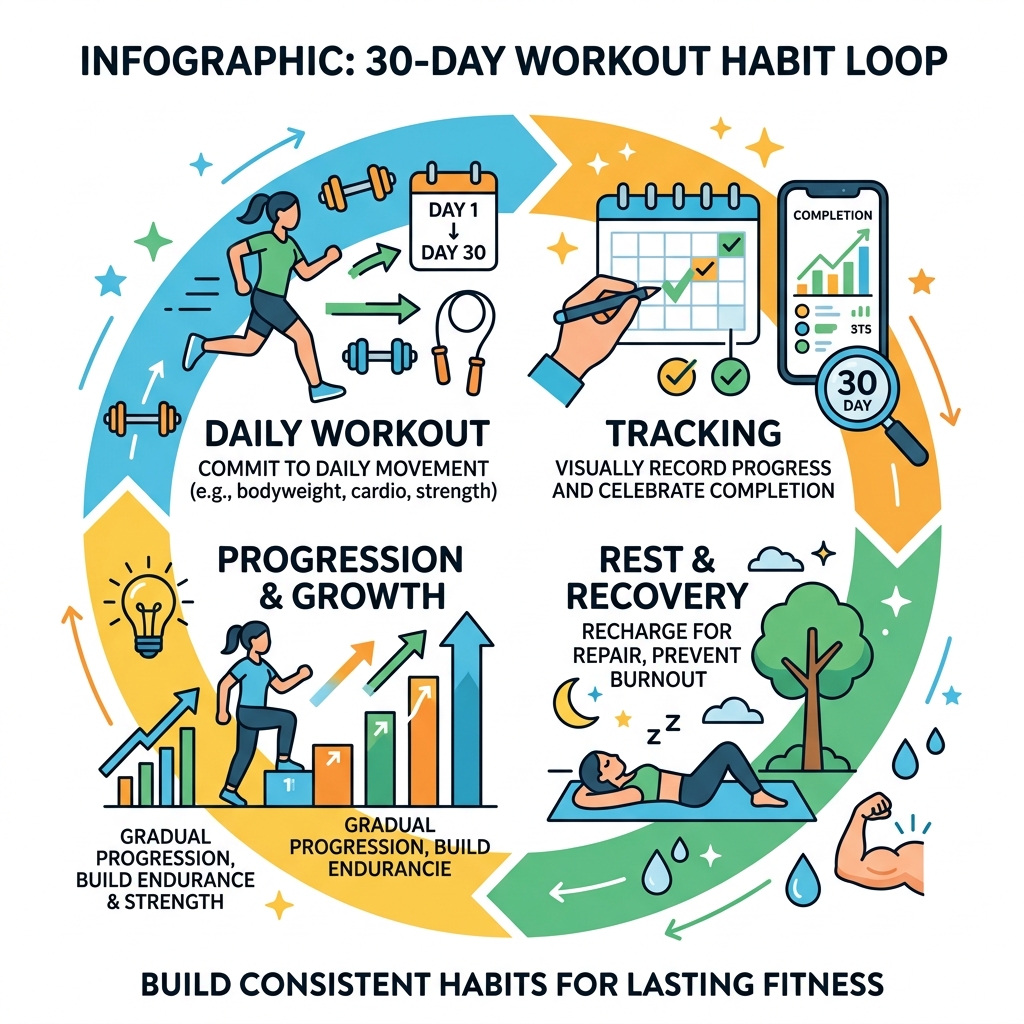
Why a 30-Day Workout Plan is the Ultimate Beginner Tool
Starting a fitness journey can feel like standing at the base of a mountain. We often overcomplicate things, thinking we need a complex split or a high-priced gym membership to see results. However, a 30 day workout chart simplifies the process by providing visual tracking and a clear roadmap.
When we can see our progress—literally crossing off a day with a red pen—it triggers a sense of accomplishment. This visual feedback is a powerful motivator. Research on scientific research on exercise habit formation suggests that consistency is the primary driver of long-term success. By committing to just 30 days, we aren’t just “working out”; we are training our brains to accept exercise as a daily non-negotiable.
One of the biggest hurdles for beginners is “decision fatigue.” If you have to decide what to do every single morning, you are more likely to skip the session. A chart removes that friction. If you’re ready to start, we recommend checking out our Jumpstart Your Fitness: 30-Day Strength Training Challenge to get moving immediately.
Key Benefits for Beginners:
- Foundational Strength: Most 30-day charts focus on compound movements like squats and pushups, which build a base for all future fitness goals.
- Time Management: Knowing exactly how long a workout takes (usually 20-30 minutes) helps us fit it into a busy schedule.
- Confidence Building: Mastering a few basic moves over four weeks builds the confidence to try more advanced routines later.
- Low Barrier to Entry: You can start today with our Beginner-Friendly Home Workout Plan without spending a dime on equipment.
Essential Components of an Effective 30-Day Routine
Not all workout charts are created equal. A truly effective 30 day workout chart should be balanced, progressive, and sustainable. If a plan asks you to do 500 burpees on Day 1, it’s probably not a good plan. Instead, we look for routines that mix strength, mobility, and recovery.

The Equipment You (Might) Need
While many challenges are “bodyweight only,” adding a few tools can accelerate your results.
- Bodyweight: Your own weight is the most versatile tool you have. Exercises like planks, lunges, and glute bridges are staples in any No-Equipment Home Exercises list.
- Dumbbells: If you want to focus on muscle definition, a set of dumbbells is a game-changer. Aim for a weight where the last two reps are challenging but don’t break your form.
- Resistance Bands: These are great for adding tension to lower body moves or assisting with upper body exercises.
- Yoga Mat: Essential for floor work and protecting your joints during core sessions.
For those looking to maximize their time at home, a Full Body Home Workout Plan often provides the best “bang for your buck” by engaging multiple muscle groups in a single session. This is particularly effective if your goal is fat loss, as we discuss in our Strength Training for Weight Loss: A Beginner’s Guide.
Understanding Workout Structures in Your 30 day workout chart
To keep things interesting and effective, many charts use specific “protocols.” These aren’t just fancy acronyms; they are ways to structure your effort to get the most out of every minute.
- Interval Training: This involves alternating between periods of high-intensity work and short rest. For example, 40 seconds of mountain climbers followed by 20 seconds of rest. This is a staple for those looking to Sweat and Burn: Intensive Cardio Workouts at Home.
- AMRAP (As Many Rounds As Possible): You set a timer (e.g., 8 minutes) and complete a circuit of exercises as many times as you can with good form. It’s a great way to track progress—did you do 4 rounds in Week 1 and 6 rounds in Week 4?
- EMOM (Every Minute On the Minute): At the start of every minute, you perform a specific number of reps. You rest for whatever time is left in that minute. This teaches you to work efficiently.
- EMOM+1: A more advanced version where you add one rep to the requirement every single minute. It gets tough fast!
Weekly Splits and Muscle Group Rotation
A common mistake in 30-day challenges is doing the same thing every day. If you do 100 squats every day for 30 days, your legs will eventually give out. We need to rotate muscle groups to allow for repair. A typical Daily Home Exercise Schedule might look like this:
- Monday: Upper Body (Push/Pull)
- Tuesday: Lower Body (Quads/Glutes)
- Wednesday: Core & Mobility
- Thursday: Full Body HIIT
- Friday: Active Recovery (Walking or Yoga)
- Saturday: Full Body Strength
- Sunday: Full Rest
By alternating between our Strength Training Category and cardio-focused days, we ensure the body has time to recover while still staying active.
How to Progress Through Your 30 day workout chart
The “magic” of a 30-day program isn’t just in the first week; it’s in how you grow. We use a principle called Progressive Overload. This means gradually increasing the difficulty of your workouts so your body continues to adapt and get stronger.
In Week 1, your goal is simply to establish a baseline. By Week 4, you should be aiming for your “Personal Best.”
| Feature | Week 1: Baseline | Week 4: Intensity |
|---|---|---|
| Focus | Learning Form | Increasing Load/Reps |
| Weight | Light/Bodyweight | Challenging Weight |
| Rest Time | 60-90 Seconds | 30-45 Seconds |
| AMRAP Rounds | 3-4 Rounds | 5-7 Rounds |
| Effort Level | 6/10 | 9/10 |
To see real changes, especially if you are focusing on Muscle Building Home Workouts for Beginners, you must track your stats. Use the margins of your 30 day workout chart to write down how many reps you did or what weight you used. Even for those using our Fitness Tips for Busy People, taking 30 seconds to log a workout is vital for long-term motivation.
Customizing Your 30 day workout chart for Specific Goals
One size doesn’t always fit all. Depending on your body and your goals, you might need to tweak your printable chart.
- For Fat Loss: Focus on charts that include more HIIT and full-body circuits. These keep the heart rate elevated and burn more calories during and after the workout. See our Home Workout for Weight Loss guide for specific exercise swaps.
- For Strength: Prioritize the days labeled “Upper” or “Lower” and try to use dumbbells. Move slower and focus on the “squeeze” of the muscle.
- Scaling Difficulty: If an exercise is too hard (like a full pushup), modify it (do pushups on your knees). If it’s too easy, make it harder (try a diamond pushup).
- Pregnancy Modifications: Many 30-day plans can be modified. Avoid lying flat on your back after the first trimester and swap high-impact jumping for low-impact stepping. Always consult a physician before starting a new routine during pregnancy.
- Cardio Lovers: If you prefer running or cycling, use our Cardio Workouts Category to find ways to integrate your favorite cardio into a strength-based 30-day chart.
Maximizing Results with Nutrition and Recovery
You can have the best 30 day workout chart in the world, but if you’re fueling your body with junk and sleeping four hours a night, your progress will stall. We like to say that fitness happens in the gym (or living room), but results happen in the kitchen and the bedroom.
The Role of Protein and Hydration
When we work out, we create tiny tears in our muscle fibers. Protein is the building block that repairs these tears, making the muscle stronger. Aim for a serving of protein with every meal. If you’re stuck for ideas, check out our Healthy Snack Ideas for Workouts.
Hydration is equally critical. Even mild dehydration can make a workout feel twice as hard and slow down your recovery. Follow our Hydration Tips for Home Workouts to stay on top of your water intake.
The 48-Hour Recovery Rule
Scientific research suggests that muscle groups typically need about 48 hours to fully recover after an intense strength session. This is why our charts don’t hit the same muscle group two days in a row. On “off” days, prioritize active recovery like light walking or stretching. For a complete look at how to balance your plate and your plate-lifts, our Daily Workout and Nutrition Guide is a must-read.
Don’t forget the importance of what happens immediately before and after your sweat session. Proper fueling can prevent dizziness during HIIT and reduce soreness the next day. We’ve compiled our best advice in these Pre-Workout and Post-Workout Tips.
Frequently Asked Questions about 30-Day Challenges
Where can I find a free printable 30 day workout chart?
There are several fantastic resources online where we find our favorite templates:
- Pinterest: This is the gold standard for “aesthetic” and functional charts. You can find everything from “30 Days of Abs” to “Full Body Toning.”
- Canva: If you want to make your own, Canva offers nearly 500 free templates. You can type in your own exercises, change the colors, and print a custom PDF.
- Fitness resource sites: Many reputable fitness platforms host massive databases of professional plans that have been downloaded millions of times.
- Interactive fitness guides: Some sites offer interactive PDF calendars where you can click the day’s date and be taken directly to a follow-along video.
If you find yourself losing steam halfway through, our Home Exercise Motivation Tips can help you get back on track.
What equipment do I need for a 30-day challenge?
As we’ve mentioned, many challenges are “gym-free.” However, for the best results, we suggest:
- A set of dumbbells (light and medium).
- A comfortable exercise mat.
- A sturdy chair or bench for step-ups or dips.
- A water bottle to stay hydrated.
Combining the right gear with a solid Home Workout and Diet Plan is the fastest way to see a transformation in 30 days.
How do I stay motivated for the full 30 days?
Motivation is a feeling, but discipline is a habit. To stay the course:
- Print the Chart: Don’t leave it on your phone. Tape it to your fridge or bathroom mirror.
- Find a Partner: 30-day challenges are more fun with a friend. Select someone slightly more fit than you to keep you pushed!
- Set a Specific Time: Whether it’s 6:00 AM or 6:00 PM, treat your workout like an appointment you can’t cancel.
- Focus on Small Wins: Don’t worry about Day 30 on Day 3. Just focus on winning today.
For more deep-dives into keeping your “why” strong, revisit our Home Exercise Motivation Tips.
Conclusion
At Casa e Jardim Web, we believe that fitness should be accessible to everyone, regardless of their schedule or budget. A 30 day workout chart is more than just a piece of paper; it’s a commitment to yourself. It’s the first step in moving from “I want to get fit” to “I am someone who works out.”
By choosing a structured plan, focusing on progressive overload, and supporting your body with proper nutrition, you can achieve incredible things in just one month. The goal of these 30 days isn’t just to finish the chart—it’s to build the momentum needed for a lifetime of health.
Once you’ve crushed your first 30 days, keep the momentum going by exploring our Home Workout Category for your next challenge. Whether you want to focus on strength, cardio, or flexibility, we have the guides to help you get there. Now, go print that chart and get started today!
