
You Don’t Need a Gym to Build Strong, Defined Arms
A no equipment arm workout upper body routine can be just as effective as lifting weights — if you know how to do it right.
Here’s a quick answer for what actually works:
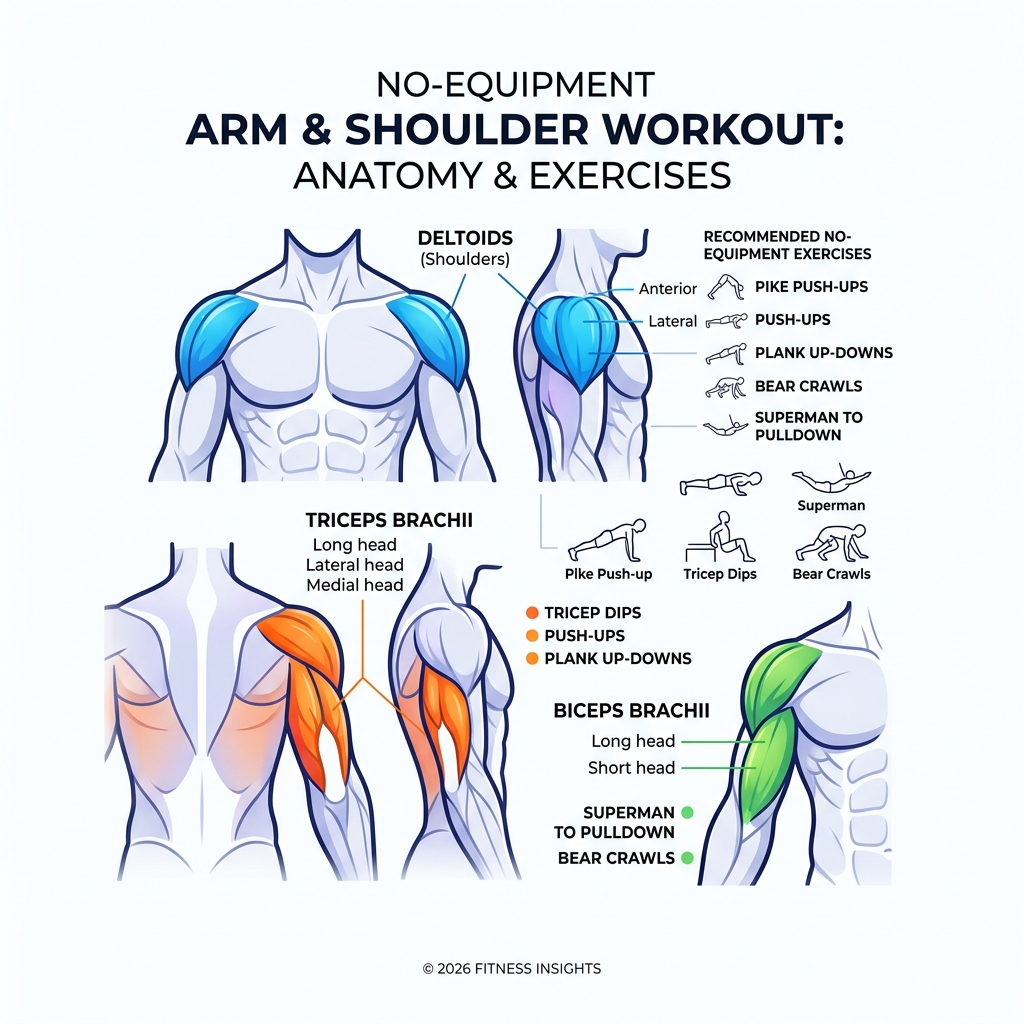
Best no-equipment exercises for your upper arms:
- Push-ups – targets chest, triceps, and shoulders
- Tricep dips – isolates the back of the arm using a chair or the floor
- Plank up-downs – works shoulders, triceps, and core together
- Pike push-ups – shifts load onto the shoulders and upper arms
- Superman to pulldown – activates the back, rear delts, and biceps
- Bear crawls – engages arms, shoulders, and core simultaneously
Key strategies to make these moves actually build muscle:
- Slow down each rep (3-5 seconds on the way down)
- Increase reps instead of adding weight
- Keep rest short between sets
- Aim for 2-3 sessions per week
Your arms make up roughly 10 to 12 percent of your total body weight. That means every push-up, dip, and plank is already loading your muscles with real resistance.
The challenge isn’t having no equipment. The challenge is using what you have with enough intention.
As fitness coach Tatiana Lampa, CPT, puts it: “The best way to build arm definition with just bodyweight is repetition, consistency, and adding time under tension.”
This guide walks you through the exact exercises, strategies, and workout structures to build stronger, more defined arms — no gym, no dumbbells, no excuses.
The Science of Building Muscle with a No Equipment Arm Workout Upper
When we think about building muscle, we often picture heavy iron plates and clanking machines. However, our muscles don’t actually know the difference between a 20-pound dumbbell and the weight of our own limbs. They only respond to tension, metabolic stress, and microscopic damage that triggers repair. This is where the no equipment arm workout upper body strategy becomes a powerhouse for transformation.
Understanding Time Under Tension (TUT)
To trigger muscle hypertrophy (growth) without external weights, we must master “Time Under Tension.” This refers to how long a muscle is under strain during a set. If you breeze through ten push-ups in ten seconds, your muscles aren’t working nearly as hard as they would if those same ten reps took sixty seconds.
We recommend a slow tempo. For example, during a push-up, try lowering your chest to the floor over a count of three to five seconds, holding for one second at the bottom, and then pressing back up. This controlled movement maximizes muscle fiber recruitment.
The Power of High Repetitions
In traditional weightlifting, you might stop at 8 or 12 reps because the weight is too heavy to continue. With bodyweight training, we often need to push into the 15 to 25 rep range to reach that same level of fatigue. High-volume training is incredibly effective for “toning” and building endurance. It forces the blood into the muscle (the “pump”), delivering nutrients and stretching the muscle fascia.
Weight-Bearing Exercises and Bone Health
Beyond aesthetics, using your body weight as resistance is vital for long-term health. According to research on bone health and weight-bearing exercises, strength training helps build bone density. This is especially important for the wrists and forearms, which are prone to fractures as we age. Exercises like planks and push-ups put healthy stress on these bones, keeping them strong and resilient.
At Casa e Jardim Web, we believe that fitness should be accessible to everyone, regardless of their access to a gym. Learning to manipulate your own body weight is the ultimate form of functional strength. For more insights on starting your journey, check out our guide on At-Home Workout for Upper Body.
Top Bodyweight Exercises for Upper Body Definition
To see real results, we need to balance our routine with compound movements and isolation exercises. Compound moves, like push-ups, work multiple joints and muscle groups at once (chest, shoulders, triceps). Isolation moves, like certain plank variations or arm pulses, focus more specifically on one area.
When performing a no equipment arm workout upper body circuit, the goal is to create a balanced physique. This means we can’t just work the “mirror muscles” (biceps and chest); we must also target the triceps (which make up two-thirds of your arm mass) and the muscles of the upper back and shoulders. For a broader look at home fitness, explore our No Equipment Home Exercises.
Difficulty Levels: Finding Your Starting Point
Not everyone is ready for a full floor push-up on day one, and that is perfectly okay! Progression is the key to success. Use the table below to determine which variation fits your current strength level.
| Exercise Level | Push-Up Variation | Focus Area |
|---|---|---|
| Beginner | Wall Push-Ups | Chest & Front Delts (Low Impact) |
| Beginner+ | Incline Push-Ups (Hands on a sofa/table) | Lower Chest & Triceps |
| Intermediate | Knee Push-Ups | Full Chest & Core Stability |
| Intermediate+ | Standard Floor Push-Ups | Chest, Triceps, Shoulders, Core |
| Advanced | Pike Push-Ups | Shoulders & Upper Triceps |
| Advanced+ | Decline Push-Ups (Feet on a chair) | Upper Chest & Front Delts |
Essential Moves for a No Equipment Arm Workout Upper
Let’s explore the core movements that should form the foundation of your routine. These exercises are selected for their efficiency and ability to be performed anywhere.
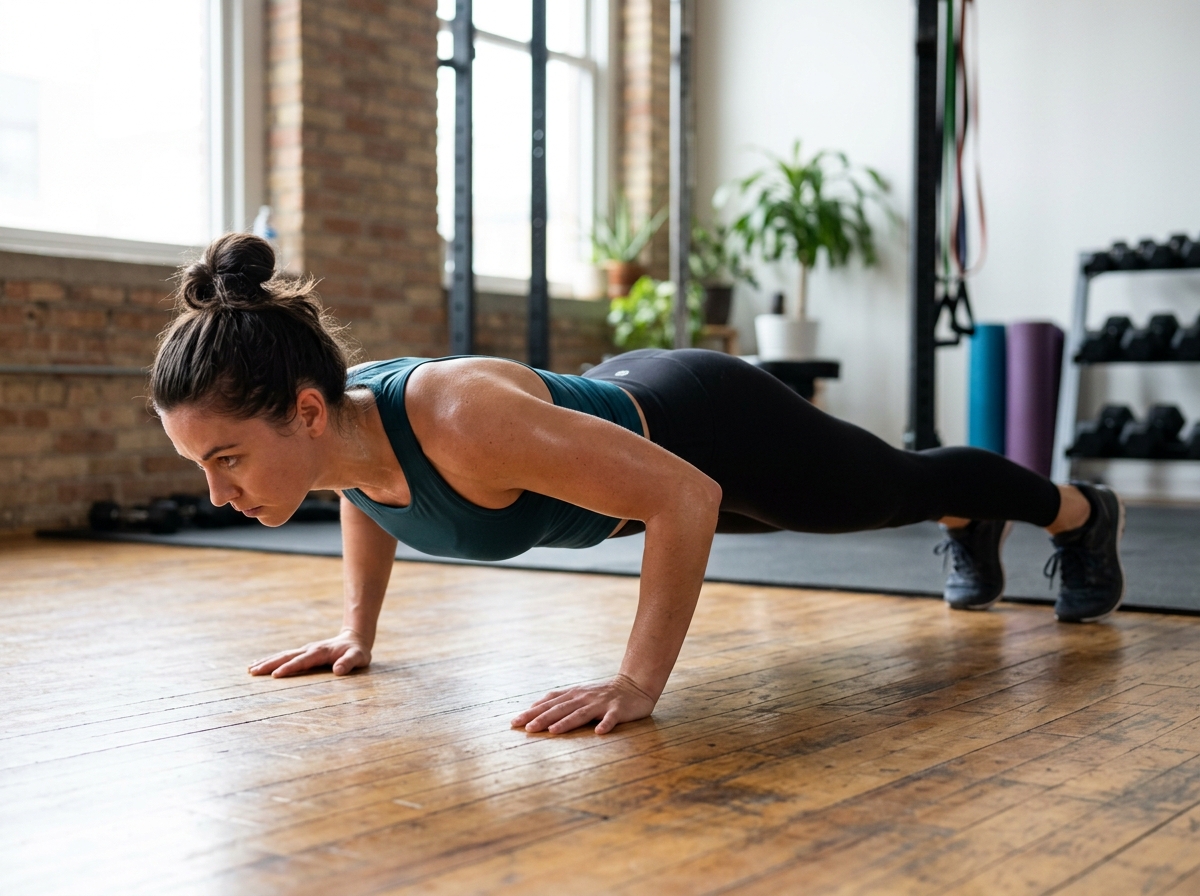
- Standard Push-Ups: The king of upper body exercises. Keep your hands slightly wider than shoulder-width and your body in a straight line from head to heels. If you find these difficult, start with our Easy Home Workout Without Equipment tips to build your base.
- Tricep Dips: Use a sturdy chair, the edge of your bed, or even the floor. Keep your back close to the “bench” and lower until your elbows are at a 90-degree angle. This move specifically targets the back of the arms to eliminate “bat wings.”
- Plank Up-Downs (Commandos): Start in a high plank, lower to your right forearm, then your left, then push back up to high plank. This is a “killer” move that spikes the heart rate while torching the shoulders and triceps.
- Superman to Pulldown: Lie on your stomach, lift your chest and arms, and then mimic a “lat pulldown” motion by pulling your elbows toward your ribs. This is one of the few ways to target the “pull” muscles (back and biceps) without a bar.
- Bear Crawls: Move across the floor on all fours with your knees hovering just an inch off the ground. This functional move builds incredible shoulder stability and arm endurance.
Advanced Progressions for Your No Equipment Arm Workout Upper
Once the basics feel easy, it’s time to “up the ante.” As fitness expert Danyele Wilson suggests, slowing the tempo or adding a reach can significantly increase the challenge.
- Pike Push-Ups: Walk your feet toward your hands until your body forms an inverted ‘V’. Lower your head toward the floor between your hands. This mimics an overhead press and builds capped shoulders.
- Eccentric Hand-Release Push-Ups: Lower yourself as slowly as possible (3-5 seconds). Once your chest touches the floor, lift your hands off the ground momentarily, then press back up. This removes momentum and forces the muscles to work harder.
- Diamond Push-Ups: Place your hands together so your index fingers and thumbs form a diamond shape. This narrow grip shifts almost all the load onto your triceps.
- Hindu Push-Ups: A fluid, sweeping motion that moves from a downward dog position into a cobra stretch and back. It improves shoulder mobility while building strength.
For those just starting out, we have a dedicated Beginners Upper Body Strength Workout that breaks these down even further.
Strategies to Maximize Your Results at Home
To get the most out of your no equipment arm workout upper body sessions, you need to train with a plan. It’s not just about doing the moves; it’s about how you do them.
The Mind-Muscle Connection
Have you ever finished a set and felt like you didn’t really “feel” it? You were likely just going through the motions. Focus on the muscle you are trying to work. When doing a tricep dip, visualize the back of your arm contracting to push your body up. Actively squeezing the muscle at the top of each rep can increase muscle activation significantly.
Progressive Overload Without Weights
In a gym, you add more weight to progress. At home, you must be more creative. You can achieve progressive overload by:
- Increasing Reps: If you did 10 last week, aim for 12 today.
- Reducing Rest: Shorten your break from 60 seconds to 30 seconds.
- Increasing Time Under Tension: Make the lowering phase even slower.
- Improving Form: Doing a “perfect” rep is much harder than a “sloppy” one.
Structuring Your Workout
We recommend a circuit-style approach. Pick 5 to 6 exercises and perform them back-to-back with minimal rest. This keeps the intensity high and adds a cardiovascular element.
- AMRAP (As Many Rounds As Possible): Set a timer for 15-20 minutes and see how many times you can complete the circuit.
- EMOM (Every Minute on the Minute): Start a new exercise at the start of every minute, using the remaining time in that minute to rest.
For more structured plans, see our articles on Building Upper Body Strength: Easy Home Workouts and specifically how to Home Chest Workout: Pump Up Your Pecs Without Leaving the House.
Frequently Asked Questions about Bodyweight Arm Training
Can you build significant muscle mass without weights?
Yes, but with caveats. You can certainly build a lean, defined, and muscular upper body using only your body weight. However, for “massive” bodybuilding-style growth, you eventually need heavy external resistance. Bodyweight training is excellent for muscle endurance, functional strength, and a “sculpted” look. To maximize mass, focus on difficult variations (like one-arm push-up progressions) and high-volume training. Check out more Bodyweight Exercises for Home to keep your muscles guessing.
How often should I perform these arm exercises?
For optimal results, we suggest training your upper body two to three times per week. Muscles need 48 hours to recover and repair. If you train your arms every single day, you may actually hinder your progress because the muscle fibers don’t have time to grow back stronger. Consistency over months is more important than intensity over days. Learn more about recovery in our guide on Home Workout for Muscle Toning.
What are the best modifications for beginners?
If standard moves feel too taxing, don’t get discouraged!
- Use Elevation: The higher your hands are (on a wall or counter), the easier a push-up becomes.
- Shorten the Lever: Drop to your knees for push-ups or planks.
- Reduce Range of Motion: Go halfway down until you build the strength to go all the way.
- Wall Angels: Simply standing against a wall and moving your arms like you’re making a snow angel is a fantastic way to build shoulder mobility and postural strength for beginners.
For a comprehensive approach, look at our Full Body Home Workout Plan.
Conclusion
Sculpting your arms doesn’t require a monthly subscription or a room full of iron. By utilizing a no equipment arm workout upper body routine, you are taking advantage of the most versatile piece of gym equipment ever created: your own body.
At Casa e Jardim Web, we’ve seen thousands of people transform their fitness from the comfort of their living rooms. The secret isn’t a “magic” exercise; it’s the combination of consistency, proper form, and progressive challenge. Whether you are doing wall push-ups or advanced pike presses, the goal is to keep moving forward.
Remember what fitness coach Corrine Carnation says: “When your arms start to shake and you’re wondering how something so simple can be so hard—that’s the beauty of it.” That shake is the sound of your muscles changing.
Ready to take the next step in your fitness journey? Whether you want to lose weight, gain strength, or just feel more capable in your daily life, we are here to help. Start your strength journey here and discover just how powerful you truly are. Keep pushing, keep dipping, and most importantly, keep showing up for yourself!
