
You Can Build a Real Chest Without Ever Going to the Gym
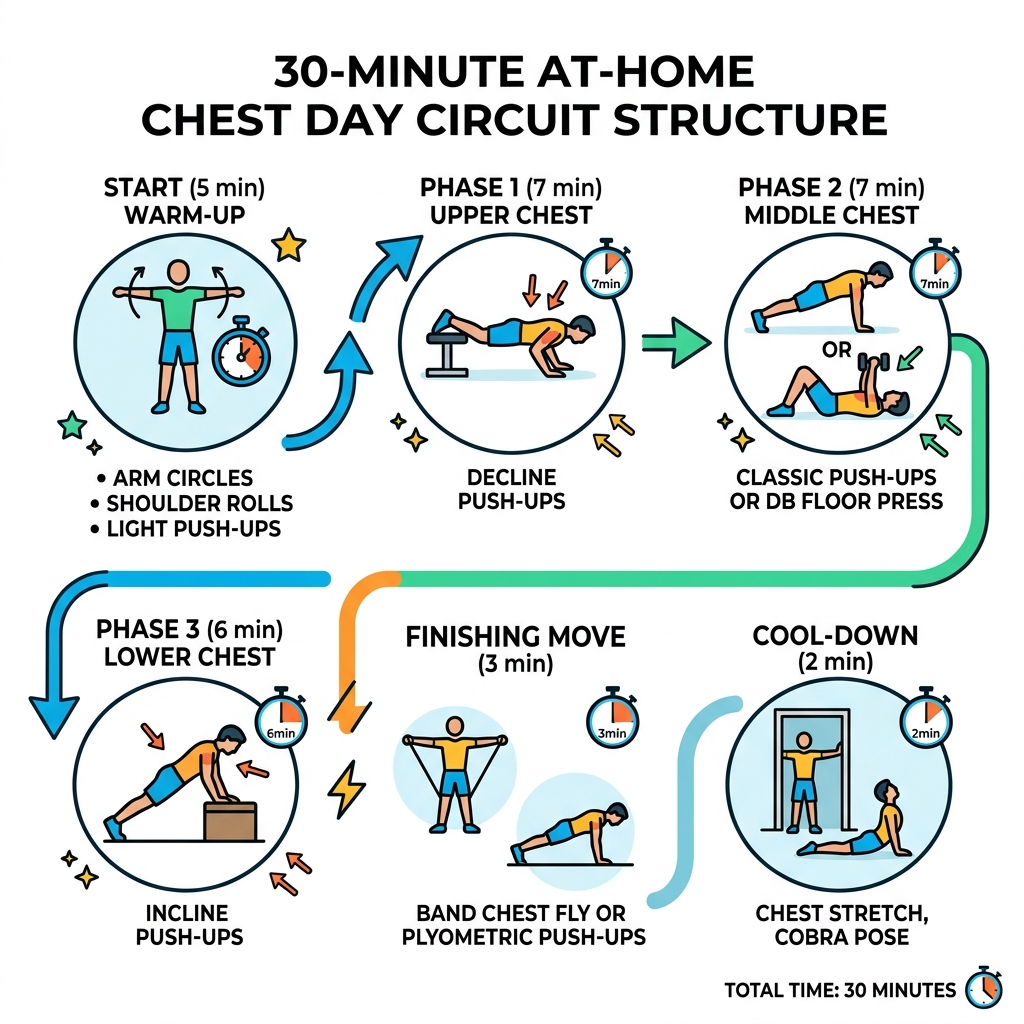
An at home chest day can build serious strength and muscle — no bench, no barbell, and no gym membership required. Here’s a quick look at how a 30-minute home chest session works:
Quick-start plan for a 30-minute at home chest workout:
- Warm-up (5 min) — arm circles, shoulder rolls, light push-ups
- Upper chest (7 min) — decline push-ups (feet elevated)
- Middle chest (7 min) — classic push-ups or dumbbell floor press
- Lower chest (6 min) — incline push-ups (hands elevated)
- Finishing move (3 min) — resistance band chest fly or plyometric push-ups
- Cool-down (2 min) — chest stretch, cobra pose
Think you need a gym to build your chest? You don’t.
Your pectoral muscles respond to tension and progressive overload — not the specific location where you train. Research shows that push-ups, when loaded appropriately, produce similar strength gains and muscle growth as the bench press.
The real challenge isn’t access to equipment. It’s knowing what to do and how to structure it well.
That’s exactly what this guide gives you: a clear, 30-minute at home chest routine that targets your upper, middle, and lower chest — using bodyweight, dumbbells, or resistance bands depending on what you have available.
Whether you’re a complete beginner or a seasoned lifter training around a busy schedule, this routine fits your life.
Understanding Your Anatomy for a Better At Home Chest Day
To truly master an at home chest day, we need to look under the hood. Your “chest” isn’t just one big slab of muscle; it’s a complex system designed to move your arms in various directions. By understanding the anatomy, we can stop “just doing push-ups” and start sculpting a balanced physique.
The stars of the show are the pectoralis major and the pectoralis minor. The pectoralis major is the large, fan-shaped muscle that gives the chest its bulk. It is divided into three distinct regions based on the direction of its muscle fibers:
- Clavicular Head (Upper Chest): These fibers start at your collarbone and run down toward your arm.
- Sternal Head (Middle Chest): This is the largest section, originating at the breastbone.
- Abdominal Head (Lower Chest): These fibers originate from the upper part of your abdominal sheath.
The pectoralis minor sits underneath the major and helps pull your shoulder blade forward and down. To target all these areas effectively, we have to change our arm angles. Scientific research on muscle hypertrophy and set volume suggests that doing 10 or more sets per muscle group per week is the sweet spot for growth. On a 30-minute at home chest day, we aim for high-quality sets that hit every fiber. For a deeper dive into the basics, check out our guide on how to home-chest-workout-pump-up-your-pecs-without-leaving-the-house.
Biomechanics of the Upper Chest
The upper chest, or the clavicular head, is often the most neglected area in home workouts. To activate these fibers, you need to perform movements that involve shoulder flexion—moving your arms upward and inward.
In a gym, you’d use an incline bench. At home, we flip the script with the decline push-up. By placing your feet on a chair, couch, or wall, you create a roughly 120-degree angle between your torso and your arms. This mimics the incline press perfectly. The higher your feet, the more tension shifts to the upper chest and front deltoids. Just don’t go so high that you turn it into a shoulder press!
Targeting the Middle and Lower Pectorals
The middle chest (sternal head) thrives at a 90-degree angle. This is your standard “pushing straight out” movement. The classic push-up is the undisputed king here, placing the most load on the largest part of the pec.
The lower chest (abdominal head) is best targeted with a 45-degree angle (pushing downward relative to your torso). To hit this at home, we use incline push-ups. By placing your hands on an elevated surface like a table or a sturdy chair, you angle your body upward. This mimics a decline bench press and helps define that lower “pec line” that many lifters strive for.
Essential Bodyweight Exercises for Your Routine
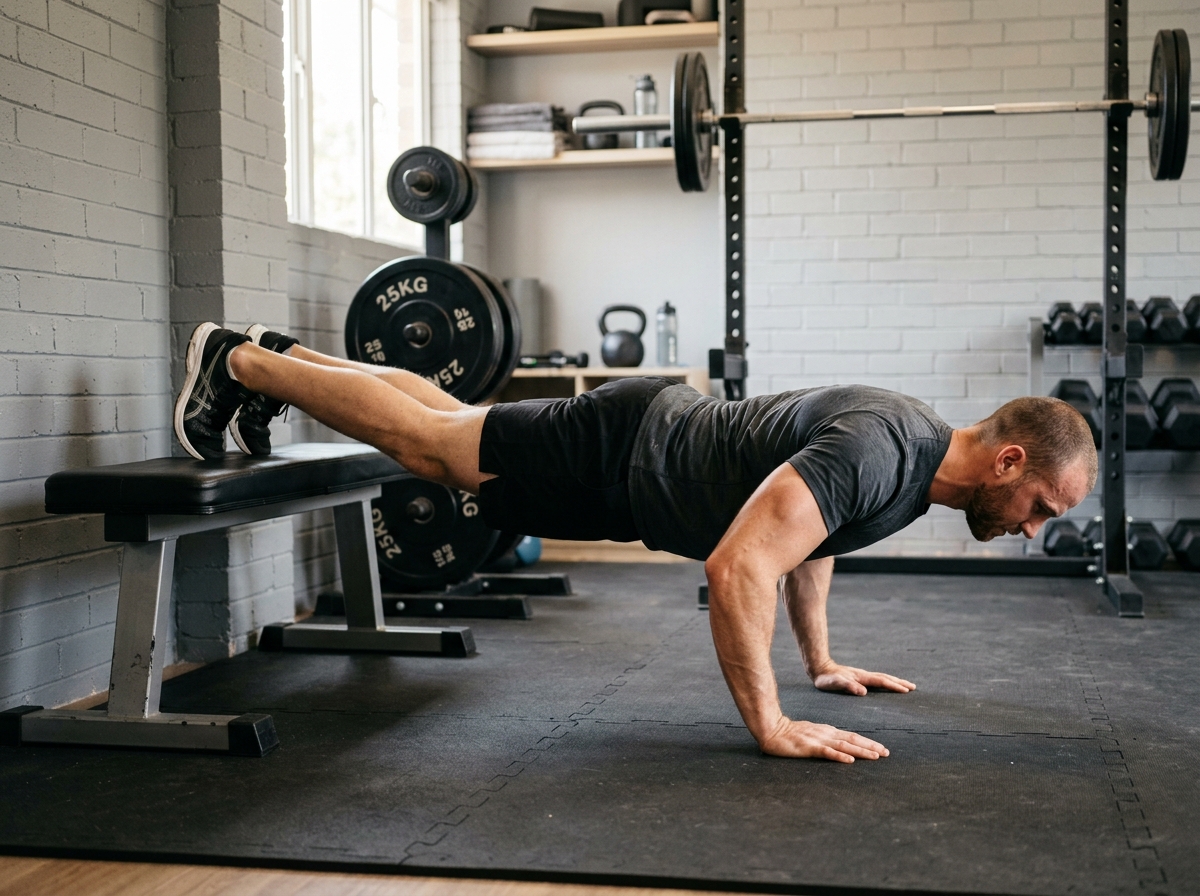
If you have zero equipment, don’t worry. Your body weight is a powerful tool when you know how to manipulate it. The key to a successful at home chest day is variety. If you only do standard push-ups, your muscles will eventually adapt and stop growing. We need to introduce new challenges.
- Classic Push-ups: The foundation. Keep your core tight and your elbows at a 45-degree angle from your ribs.
- Diamond Push-ups: By bringing your hands together so your index fingers and thumbs form a triangle, you increase the load on the inner chest and triceps.
- Archer Push-ups: A great “step-up” exercise. You keep one arm straight while the other does the heavy lifting, shifting your weight side-to-side. It’s like a self-assisted one-arm push-up.
- Plyometric Push-ups: These are explosive. Push off the ground with enough force that your hands leave the floor. This recruits “fast-twitch” muscle fibers, essential for power and size.
To get the most out of these, we use Time Under Tension (TUT). Instead of banging out reps as fast as possible, try taking 3 seconds to lower yourself and 1 second to explode up. This makes a “light” bodyweight rep feel significantly heavier. For more ideas on bodyweight movements, see our at-home-workout-for-upper-body guide.
Progressive Overload Without Weights
The biggest myth in fitness is that you need heavier plates to get stronger. In reality, your muscles only understand tension. Here is how we apply progressive overload during an at home chest day without adding a single pound:
- Tempo Training: Slow down the eccentric (lowering) phase.
- Pause Reps: Hold the bottom position for 2 seconds to remove momentum.
- Mechanical Drop Sets: Start with your hardest exercise (e.g., decline push-ups) until failure, then immediately move to classic push-ups, then finish with incline push-ups.
- Increasing Leverage: Move your hands further back toward your hips during a push-up to increase the percentage of body weight you are lifting.
- Training to Failure: Since the load is lighter than a barbell, we must push our sets until we literally cannot perform another rep with good form.
Leveling Up with Dumbbells and Resistance Bands
While bodyweight is great, adding a few tools can skyrocket your results. Dumbbells allow for a greater range of motion, and resistance bands provide “accommodating resistance”—meaning the exercise gets harder as the band stretches.
| Exercise | Equipment | Primary Target | Benefit |
|---|---|---|---|
| Floor Press | Dumbbells | Middle/Lower Chest | Saves shoulders, allows heavy loading |
| Banded Flyes | Resistance Band | Inner Chest | Constant tension, peak contraction |
| Banded Push-up | Band + Bodyweight | Overall Mass | Adds resistance at the top of the move |
| Dumbbell Flyes | Dumbbells | Chest Width | Deep stretch at the bottom |
The Dumbbell Floor Press is a fantastic alternative to the bench press. By lying on the floor, your range of motion is naturally limited, which protects your shoulder joints while still allowing you to move heavy weight.
Resistance bands are perhaps the most underrated tool for an at home chest day. Unlike dumbbells, where gravity only pulls downward, bands allow for horizontal adduction—the act of bringing your arms together across your body. This is the primary function of the chest and is the only way to get that “inner chest” squeeze. If you’re just starting out, our beginners-upper-body-strength-workout covers these basics perfectly.
Maximizing Hypertrophy During Your At Home Chest Day
To grow muscle (hypertrophy), you need more than just movement; you need a mind-muscle connection. Don’t just push the weight; feel your chest fibers stretching and contracting.
- 8-12 Rep Range: Aim for this range if you have weights. If using bodyweight, you may need to go up to 20-30 reps to reach failure.
- 2-3 Minute Rest Periods: Research shows that resting longer allows your ATP (energy) stores to recover, so you can push harder in the next set.
- Peak Contraction: At the top of every rep, squeeze your chest muscles as hard as you can for one second.
- Band Anchoring: Anchor your resistance bands to a sturdy door frame or heavy piece of furniture to perform standing chest presses and flyes.
Structuring Your 30-Minute Routine and Recovery
A workout is only as good as the preparation and recovery surrounding it. We don’t want you waking up with “junk” shoulders or injuries.
The 30-Minute Breakdown:
- 0-5 Minutes: Dynamic Warm-up. Use arm circles, shoulder rolls, and “bird-dog” stretches. This increases blood flow and prepares your joints.
- 5-25 Minutes: The Circuit. Perform 3-4 sets of your chosen exercises. We recommend a “superset” approach—pairing a heavy press with a flye movement to save time.
- 25-30 Minutes: Cool-down. Static stretching is your friend here. Hold a Cobra Pose (lying on your stomach and pushing your chest up) or a doorway chest stretch for 30 seconds each.
The 48-hour recovery rule is vital. Muscle isn’t built while you’re working out; it’s built while you sleep and recover. Training the same muscle group every single day actually hinders growth. For more tips on building a sustainable schedule, visit our guide on building-upper-body-strength-easy-home-workouts.
Avoiding Common Training Mistakes
We’ve all seen it: the person at the gym (or on YouTube) doing “ego reps.” To get results at home, your form must be surgical.
- Flared Elbows: If your elbows are at a 90-degree angle to your body during a push-up, you are begging for a rotator cuff injury. Keep them tucked at roughly 45 degrees.
- Limited Range of Motion: Go all the way down. If your chest doesn’t nearly touch the floor, you aren’t fully activating the muscle fibers.
- Excessive Arching: Keep your core engaged. Your body should be a straight line from head to heels. If your lower back sags, you’re losing tension in the chest.
- Overtraining: More isn’t always better. If you can’t complete your reps with good form, stop the set.
- Proper Hand Placement: For a standard push-up, your hands should be slightly wider than shoulder-width. Too wide puts stress on the shoulders; too narrow shifts the focus to the triceps.
Frequently Asked Questions about At-Home Chest Training
Can I build a big chest with just push-ups?
Absolutely. The chest doesn’t know the difference between a 225lb barbell and a difficult push-up variation. The key is loading. Once 20 standard push-ups become easy, you must move to harder variations like Archer push-ups, wear a weighted backpack, or use resistance bands. If you keep the intensity high and the volume sufficient, you can build a world-class chest with bodyweight alone.
How many times a week should I do an at home chest day?
For most people, twice a week is the sweet spot. This allows for a high volume of sets (10-20 per week) while giving the muscles 48-72 hours to recover and grow. Training once a week is often not enough stimulus for optimal growth, while training three times a week can lead to joint fatigue if the intensity is high.
What equipment is absolutely necessary for home workouts?
Technically, nothing is mandatory except floor space. However, if you want to maximize your results, we highly recommend a set of long resistance bands. They are cheap, portable, and provide the “squeeze” that bodyweight exercises lack. If you have the budget, a pair of adjustable dumbbells is the best investment you can make for home strength training.
Conclusion
Building a powerful, sculpted chest doesn’t require a monthly gym fee or a garage full of iron. By utilizing the principles of biomechanics—targeting the upper, middle, and lower fibers through smart arm angles—you can turn your living room into a high-performance training center.
The secret to an effective at home chest day is consistency and progressive overload. Don’t just go through the motions. Challenge yourself with slower tempos, harder variations, and a relentless focus on form.
At Casa e Jardim Web, we believe that fitness should be accessible to everyone, everywhere. Whether you are using a pair of water bottles as weights or performing explosive plyometric push-ups, you are taking a step toward a stronger, healthier version of yourself. Ready to expand your routine? Check out more info about strength training on our platform and keep pushing your limits!
