
Why You Need to Know the Names of Upper Body Stretches
Understanding the specific names of upper body stretches is more than just a vocabulary lesson; it is a fundamental part of maintaining a healthy, functional body. When we sit for hours at a desk or push through a heavy lifting session, our muscle fibers can become short, tight, and “tangled.” Without regular lengthening, this tightness leads to a cascade of issues.
First and foremost is posture improvement. Many of us suffer from “Upper Cross Syndrome,” where the chest becomes tight and the upper back becomes weak and overstretched, leading to that all-too-familiar hunched look. By regularly performing Upper Body Stretches, we can pull the shoulders back and align the spine.
Furthermore, stretching acts as a “lubricant” for your joints. It enhances blood circulation, which is vital for muscle recovery. When you stretch, you are essentially signaling your body to send oxygen-rich blood to the area, flushing out metabolic waste products like lactic acid. This is a core component of any Home Exercise for Flexibility.
Finally, injury prevention is a major factor. Tight muscles are brittle muscles. If you reach for a heavy object with “cold,” tight shoulders, you are significantly more likely to experience a strain or tear. Knowing these stretches allows you to target specific muscle groups—like the deltoids, pectorals, and trapezius—ensuring they remain pliable and ready for action.
Essential Dynamic Names of Upper Body Stretches for Warm-Ups
Before we dive into deep, relaxing holds, we must talk about “waking up” the muscles. Dynamic stretching involves moving through a range of motion in a slow, controlled manner. Unlike static stretching, you don’t hold these positions for long. The goal here is muscle activation and joint lubrication.
Think of your muscles like a rubber band that has been in the freezer; if you pull it hard immediately, it snaps. If you warm it up in your hands first, it becomes stretchy. This is why we always emphasize Pre-Workout and Post-Workout Tips that prioritize movement before intensity.
Dynamic Names of Upper Body Stretches for Mobility
Here are the heavy hitters for your dynamic warm-up:
- Cat-Cow: Start on all fours. As you inhale, drop your belly and look up (Cow). As you exhale, round your back like a literal angry cat (Cat). This is incredible for spinal mobility and relieving tension in the mid-back. Repeat 10 times.
- Shoulder Rolls: Stand tall and move your shoulders in large circles—up to your ears, back, and down. Do 10 circles forward and 10 circles backward.
- Arm Circles: Extend your arms out to the sides like a “T.” Make small circles, gradually getting larger until you are moving your entire arm through its full range of motion.
- Trunk Rotation: Stand with feet shoulder-width apart. Gently twist your torso from side to side, letting your arms swing naturally. This “loosens” the thoracic spine.
- Overhead Reach: Reach one arm toward the ceiling and lean slightly to the opposite side, then switch. This targets the obliques and the latissimus dorsi (the large muscles of your back).
Preparing for Strength Training
If you are heading into a session from our Strength Category, these dynamic movements are non-negotiable. They prep the nervous system for the load you’re about to lift. Whether you are doing a full Home Workout Category routine or just a quick set of push-ups, five minutes of dynamic movement will make your workout feel significantly smoother.
Top Static Names of Upper Body Stretches for Recovery
Once the hard work is done, it’s time to switch gears. Static stretching is where you hold a position for a set amount of time (usually 30 to 60 seconds). This is the “lengthening” phase that helps with long-term flexibility and cooling down the nervous system.
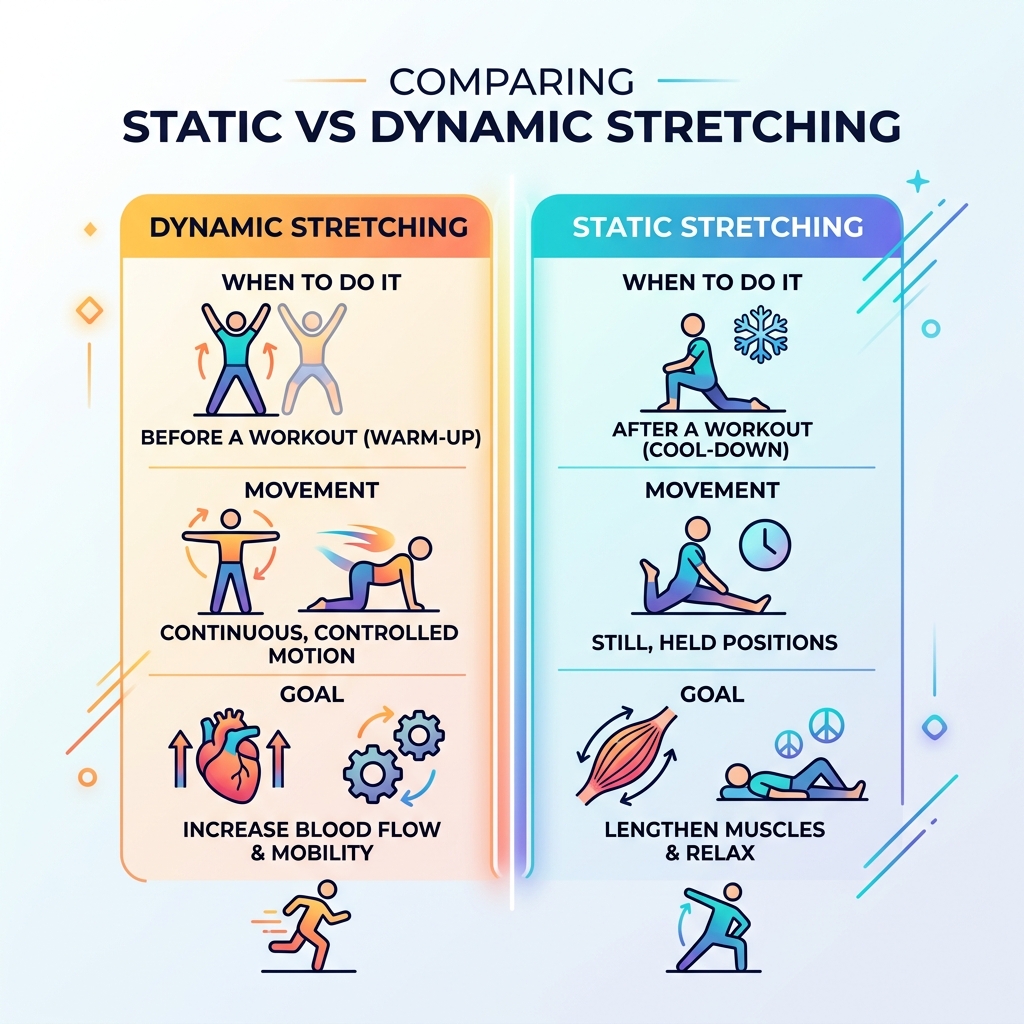
| Feature | Dynamic Stretching | Static Stretching |
|---|---|---|
| When to do it | Before a workout (Warm-up) | After a workout (Cool-down) |
| Movement | Continuous, controlled motion | Still, held positions |
| Goal | Increase blood flow & mobility | Lengthen muscles & relax |
| Hold Time | 1-2 seconds per rep | 30-60 seconds |
If you are dealing with persistent tightness, especially in the upper back, these moves are your best friend. For more specific relief, check out these 8 stretches for upper back pain relief. They are perfect to pair with a Home Workout for Muscle Toning to ensure your muscles don’t just get stronger, but also stay long and lean.
Static Names of Upper Body Stretches for Post-Workout
- Child’s Pose: From a kneeling position, sit back on your heels and fold forward, extending your arms on the floor in front of you. It’s the ultimate “reset” button for the entire back.
- Cobra Pose: Lie on your stomach and gently push your chest off the floor using your hands, keeping your hips grounded. This is the perfect antidote to a day spent slouching.
- Cross-Body Shoulder Stretch: Pull one arm across your chest and use the other arm to hold it in place. You’ll feel this in the back of the shoulder (posterior deltoid).
- Overhead Triceps Stretch: Reach one arm overhead, bend the elbow, and use the opposite hand to gently push the elbow down.
- Doorway Stretch: Stand in a doorway, place your forearms on the doorframe with elbows at shoulder height, and lean forward. This is arguably the best stretch for opening up tight pectoral muscles.
Deep Tissue Release
For those days when you need something a bit gentler, we recommend exploring our Low Impact Category. Many of these stretches can be integrated into Bodyweight Exercises for Home to create a balanced routine that prioritizes recovery just as much as effort.
Targeted Stretches for Neck, Wrists, and Back

Modern life is a literal pain in the neck. Between “tech neck” from looking at phones and “mouse wrist” from clicking all day, our smaller muscle groups are under constant siege. You don’t need a gym to fix this; most of these can be done right at your desk using No Equipment Home Exercises principles.
Relieving Desk Tension
- Marionette Stretch: Imagine a string is attached to the top of your head, pulling you toward the ceiling. Tuck your chin slightly and feel your spine lengthen. It’s a simple but powerful way to reset your posture.
- Reverse Prayer: Reach your hands behind your back and try to press your palms together in a prayer position, fingers pointing up. If you can’t touch palms, just grab opposite elbows. This opens the chest and rotates the shoulders externally.
- Thread the Needle: From all fours, reach one arm under your body and rest your shoulder on the floor. This provides a deep twist for the thoracic spine and is a great companion to a Home Chest Workout: Pump Up Your Pecs Without Leaving the House.
Stretches for Seniors and Beginners
Safety is our priority. If you are just starting out or looking for a Home Workout for Seniors, stretching should never feel like sharp pain. It should feel like a “productive” pull. We focus on Building Upper Body Strength: Easy Home Workouts that include these gentle mobility moves to keep joints healthy and reduce the risk of falls or strains.
Best Practices for Your Stretching Routine
To get the most out of the names of upper body stretches we’ve discussed, follow these golden rules:
- Don’t Bounce: This is called “ballistic stretching,” and for most people, it’s an invitation for injury. Keep your movements smooth.
- Breathe into the Tension: When you hit a tight spot, your instinct is to hold your breath. Do the opposite. Deep, diaphragmatic breathing tells your nervous system it’s safe to let the muscle relax.
- Hold Duration: For static stretches, 30 seconds is the “sweet spot.” It takes about that long for the muscle’s “stretch reflex” to subside and allow for actual lengthening.
- Frequency: Consistency beats intensity. Stretching for 5 minutes every day is better than stretching for 60 minutes once a week.
- Avoid Pain: A “tight” feeling is good. A “stabbing” or “burning” feeling is your body telling you to stop.
If you’re a beginner, check out our Beginners Upper Body Strength Workout for a routine that balances these stretches with foundational strength moves.
Frequently Asked Questions about Upper Body Stretches
How long should I hold each static stretch?
For most people, 30 seconds per stretch is ideal. If you are particularly tight, you can hold for up to 60 seconds. Research suggests that holding longer than 60 seconds provides diminishing returns for most general fitness goals.
When is the best time to perform upper body stretches?
Dynamic stretches (moving) should be done before your workout to prep the muscles. Static stretches (holding) should be done after your workout when the muscles are warm, or during breaks in your workday to relieve tension.
Can these stretches help reduce pain from sitting at a desk?
Absolutely. Most desk-related pain comes from muscles being stuck in a shortened position (like your chest and hip flexors) while others are overstretched and weak (like your upper back). Stretches like the Doorway Stretch and Cat-Cow directly counteract the “desk posture.”
Conclusion
Mastering the names of upper body stretches is the first step toward a more mobile, pain-free life. At Casa e Jardim Web, we believe that fitness should be accessible to everyone, regardless of whether they have a gym membership. By incorporating these dynamic and static movements into your daily routine, you are investing in your long-term health and mobility.
Whether you are a seasoned athlete or just looking for a way to stop your neck from hurting at the end of the day, these stretches are your toolkit for success. Stay consistent, keep moving, and don’t forget to check out our At-Home Workout for Upper Body for more guided routines!
