
Why Your Shoulders Deserve More Attention (And How Dumbbells Deliver It)
At home shoulder workouts with dumbbells are one of the most effective ways to build strong, well-rounded shoulders — no gym required. Here are the best exercises to get started:
- Dumbbell Shoulder Press – the core compound movement for overall shoulder strength
- Lateral Raises – targets the lateral deltoid for width and definition
- Front Raises – isolates the anterior (front) deltoid
- Reverse Flyes – hits the rear deltoid for balance and posture
- Arnold Press – works all three deltoid heads through a wide range of motion
Quick tips:
- Do 3-5 sets of 8-12 reps per exercise for muscle growth
- Train shoulders 1-2 times per week with at least 48 hours between sessions
- Always warm up with arm circles and shoulder rolls first
You feel it when you’re carrying groceries, reaching for something on a high shelf, or picking up a heavy bag. That dull ache creeping into your shoulders is your body telling you something: these muscles need more attention.
The good news? You don’t need a gym to fix it.
Dumbbells are one of the most versatile tools for shoulder training. Unlike barbells or machines, they allow each arm to move independently. This means your stabilizer muscles work harder, muscle imbalances get corrected, and you get a fuller range of motion — all of which add up to better results.
Research backs this up. A 2018 study found that dumbbells produce superior anterior deltoid activation during overhead presses compared to other equipment, because the instability forces more muscles to engage.
Whether you’re a complete beginner or a seasoned athlete training from home, this guide covers everything you need to master dumbbell shoulder training — exercises, structure, safety, and more.
Why Choose At Home Shoulder Workouts with Dumbbells?
When we think about building a powerful upper body, many people assume they need a massive rack of barbells or expensive cable machines. However, at home shoulder workouts with dumbbells offer several unique advantages that gym machines simply can’t match.
First, let’s talk about unilateral training. Because dumbbells require each arm to move independently, they are the ultimate tool for fixing muscle imbalances. Most of us have a dominant side that does more of the heavy lifting. Dumbbells force your “lazy” side to step up, ensuring symmetrical strength and aesthetics.
Furthermore, dumbbells provide a greater recruitment of stabilizing muscles. Because the weights aren’t on a fixed track (like a machine) or connected (like a barbell), your rotator cuff and smaller supporting muscles must fire constantly to keep the weight steady. This doesn’t just build “show” muscles; it builds functional joint stability that protects you from injury in daily life.
Scientific research supports the effectiveness of this approach. A study published in the International Journal of Exercise Science observed that dumbbells provide superior activation of the anterior deltoid during overhead presses because the inherent instability requires more muscular engagement.
If you are just getting started with your home gym setup, check out our guide on Dumbbells 101: Beginner-Friendly Home Strength Exercises to learn more about selecting the right equipment.
Benefits of At Home Shoulder Workouts with Dumbbells
One of the biggest perks of using dumbbells at home is the freedom of movement. Unlike a barbell, which locks your wrists into a fixed position, dumbbells allow you to rotate your palms. This is a game-changer for people with nagging shoulder pain. For example, switching to a neutral grip (palms facing each other) during a press can often alleviate impingement issues.
Dumbbells also facilitate a greater range of motion. You can lower the weights further than a barbell would allow, leading to better muscle stretch and, ultimately, more growth. Additionally, standing dumbbell exercises require significant core engagement. To keep those weights from wobbling, your abs and lower back have to work overtime to keep your torso upright. This makes every shoulder session a secret core workout! For more targeted advice, see our resource on At-Home Strength Training for Women.
Understanding Shoulder Anatomy for Targeted Growth
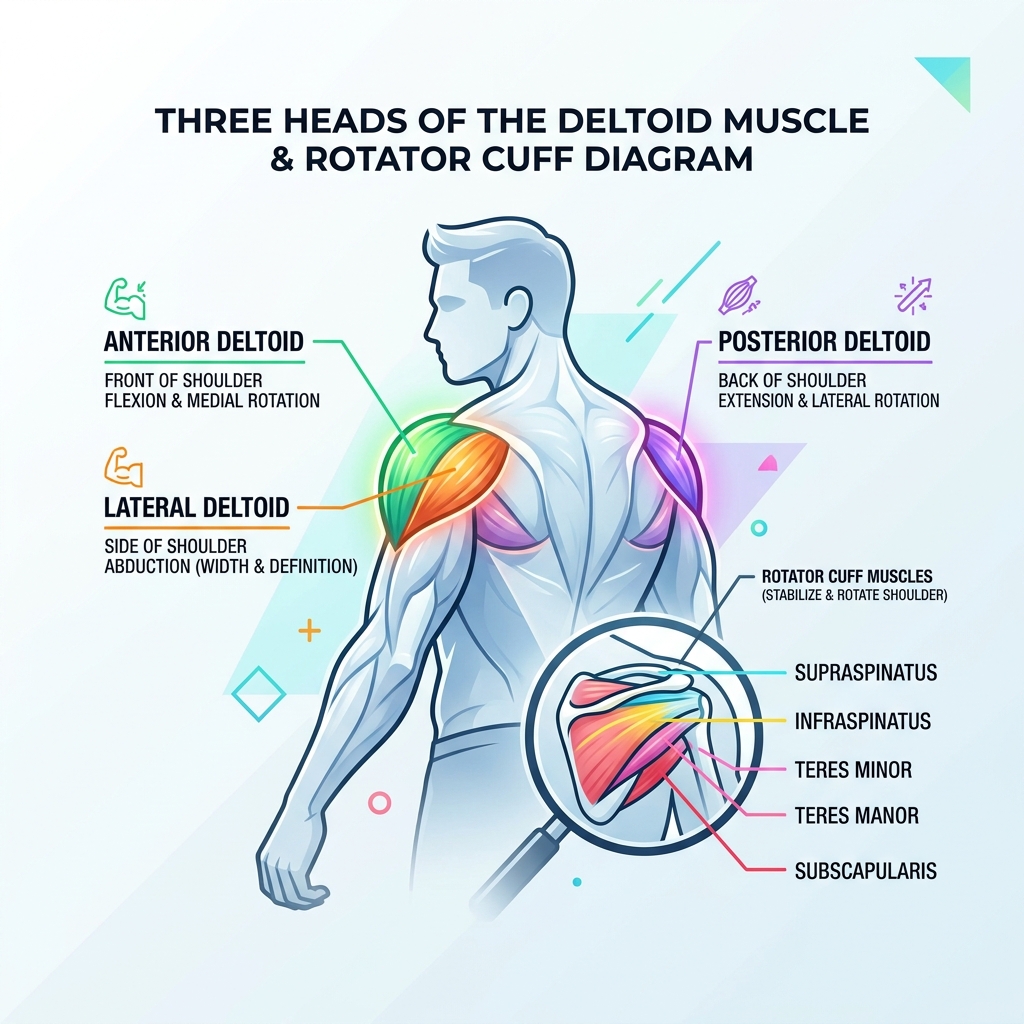
To master at home shoulder workouts with dumbbells, we need to understand the “three-headed” nature of the deltoid muscle. If you only perform one type of movement, you’ll end up with an unbalanced look and potentially poor posture.
- Anterior Deltoid (Front): Responsible for lifting the arm forward. It gets plenty of work during chest presses, but isolated front raises can help it pop.
- Lateral Deltoid (Side): This is the muscle that creates “width.” When people talk about “boulder shoulders,” they are usually referring to well-developed lateral delts. Lateral raises are the king here.
- Posterior Deltoid (Rear): Often the most neglected part of the shoulder. It pulls the arm backward and is crucial for good posture. Training the rear delts prevents that “hunched forward” look.
- Rotator Cuff: A group of four small muscles that stabilize the “ball and socket” joint. While they aren’t visible, keeping them strong is the key to training for decades without pain.
By targeting all three heads, you create a balanced, 3D look that improves both your appearance and your performance in other lifts. Learn more about balancing your routine in our guide on Building Upper Body Strength: Easy Home Workouts.
Essential Exercises for Your At Home Shoulder Workouts with Dumbbells
Now that we know the “why” and the “what,” let’s dive into the “how.” The best at home shoulder workouts with dumbbells combine heavy compound movements (which work multiple muscles) with isolation exercises (which target one specific head).
For a comprehensive list of movements to add to your library, see our Dumbbell Strength Exercises for Home Workouts and our At-Home Workout for Upper Body.
Top Pressing Movements for Strength
Pressing is the foundation of shoulder strength. These movements allow you to move the most weight and trigger the most overall growth.
- Standard Overhead Press (Standing): Stand with feet hip-width apart. Hold dumbbells at shoulder height with palms facing forward. Press the weights up until arms are straight, then lower slowly. Standing requires more core stability than sitting.
- Arnold Press: Named after the legendary Arnold Schwarzenegger, this move starts with your palms facing your chest. As you press up, you rotate your wrists so that your palms face forward at the top. This rotation engages all three deltoid heads in one fluid motion.
- Neutral Grip Press: If you have sensitive joints, this is your best friend. Keep your palms facing each other throughout the lift. This “hammer grip” is often much kinder to the shoulder joint.
- Z-Press: Sit on the floor with your legs spread out in front of you. Without the support of a bench or your legs, your core and upper back must work incredibly hard to stabilize the press. It’s a fantastic way to fix “cheating” and leaning back during presses.
For those just starting, our Beginner’s Upper Body Strength Workout provides a great entry point for these movements.
Isolation Moves for Definition and Width
Once the heavy pressing is done, it’s time to “sculpt” the muscle with isolation moves.
- Lateral Raises: Hold dumbbells at your sides. With a slight bend in your elbows, lift the weights out to the side until they reach shoulder height. Imagine you are pouring two pitchers of water at the top to keep the tension on the side delts.
- Front Raises: Lift the dumbbells straight out in front of you. This isolates the anterior delt. Keep the movement controlled — no swinging!
- Reverse Flyes (Bent-Over): Hinge at the hips until your torso is nearly parallel to the floor. Let the weights hang down, then lift them out to the sides like you’re flapping wings, squeezing your shoulder blades together. This is essential for the rear delts.
- Upright Rows: Hold dumbbells in front of your thighs. Pull them up toward your chin, leading with your elbows. Dumbbells are safer here than a barbell because they allow your wrists to move naturally.
These moves are perfect for Home Workout for Muscle Toning.
How to Structure At Home Shoulder Workouts with Dumbbells
To see real results, you can’t just pick up weights at random. You need a plan. The most effective way to grow is through progressive overload — gradually increasing the weight, reps, or intensity over time.
Research from a 2015 study in the Journal of Strength and Conditioning Research found that multiple sets (3–5 sets) are significantly superior to single sets for promoting muscle hypertrophy and strength.
| Goal | Rep Range | Sets | Rest |
|---|---|---|---|
| Strength | 3–6 reps | 3–5 | 2–3 mins |
| Hypertrophy (Size) | 8–12 reps | 3–5 | 60–90 secs |
| Endurance/Toning | 15–20 reps | 2–3 | 30–60 secs |
If you’re looking for a structured plan, check out our Muscle Building Home Workouts for Beginners.
Determining Sets, Reps, and Frequency
For most people, training shoulders 1–2 times per week is the sweet spot. The deltoids are involved in almost every upper-body movement (like push-ups and rows), so they need time to recover. A 2017 study indicated that upper-body muscles like the pectorals and triceps (which share the load with shoulders) take about 48 hours to fully recover.
We recommend starting with a total of 10–15 sets per week for shoulders, split across two sessions. For example:
- Session A: Heavy Overhead Press (4 sets) + Lateral Raises (3 sets)
- Session B: Arnold Press (3 sets) + Reverse Flyes (3 sets) + Front Raises (2 sets)
This frequency can be integrated into a Full Body Weight Training Routine at Home.
Advanced Techniques for Home Training
If you only have light dumbbells at home, you can still make massive gains by using advanced intensity techniques:
- Supersets: Perform two exercises back-to-back with no rest. For example, do a set of Shoulder Presses followed immediately by Lateral Raises. This increases “metabolic stress,” a key driver for muscle growth.
- Mechanical Drop Sets: Start with a difficult exercise (like a Lateral Raise) and, when you can’t do any more, immediately switch to an easier version of the same movement (like an Upright Row) to keep the muscle working.
- Eccentric Control: Muscle damage (the good kind!) happens mostly during the lowering phase. Try taking 3–4 seconds to lower the weight on every rep.
- Time Under Tension: Don’t rush! Keep the muscle working throughout the entire set without pausing at the bottom.
Safety First: Avoiding Common Mistakes and Warming Up
The shoulder is the most mobile joint in the body, which also makes it the most fragile. In at home shoulder workouts with dumbbells, form is everything.
Proper Form and Technique Cues
Avoid these common pitfalls to keep your joints healthy:
- Using Momentum: If you have to “bounce” your knees to get the weight up (unless you’re intentionally doing a Push Press), the weight is too heavy. Control the weight; don’t let it control you.
- Arching the Back: During overhead presses, people often lean back excessively. This puts dangerous pressure on the lower spine. Keep your core braced (imagine someone is about to punch you in the stomach) and your glutes squeezed.
- Shrugging the Shoulders: During lateral raises, keep your traps down. If your shoulders are touching your ears, you’re using your neck muscles instead of your delts.
- Cutting Range of Motion: Go all the way down and all the way up. Partial reps lead to partial results.
Maintaining a good diet is also part of the safety and recovery equation. See our Strength Training Nutrition Guide for more info.
Essential Warm-Up and Cool-Down Drills
Never dive straight into heavy lifting. A cold shoulder is an injured shoulder. Spend 5–10 minutes on:
- Arm Circles: Large and small circles to get blood flowing.
- Scapular Retractions: Squeezing your shoulder blades together and releasing.
- Face Pulls (with light dumbbells or bands): Pulling toward your face to activate the rear delts and rotator cuff.
- Wall Slides: Standing against a wall and sliding your arms up and down to improve overhead mobility.
After the workout, perform some light cross-body stretches to help the muscles relax and begin the recovery process.
Frequently Asked Questions about Shoulder Training
Can you build significant shoulder size with only dumbbells?
Absolutely. Dumbbells offer more muscle activation than barbells for many people because of the instability and range of motion. As long as you are practicing progressive overload (adding weight or reps over time) and eating enough protein, you can build “cannonball” shoulders at home.
How often should I train my shoulders at home?
We recommend 1–2 times per week. Because the shoulders are used in chest and back workouts, training them more often can lead to overtraining and joint pain. Ensure you have at least 48 hours of rest between direct shoulder sessions.
What is the best exercise for rear deltoid development?
The Bent-Over Reverse Fly is widely considered the gold standard. However, the Arnold Press and Face Pulls are also excellent for ensuring the posterior head isn’t neglected.
Conclusion
Mastering at home shoulder workouts with dumbbells is about more than just looking good in a t-shirt; it’s about building a functional, resilient body that can handle the “burdens” of daily life. By focusing on all three heads of the deltoid, prioritizing form over ego, and staying consistent with your routine, you can achieve professional-level results in the comfort of your own living room.
At Casa e Jardim Web, we believe that fitness should be accessible to everyone, regardless of whether they have a gym membership. Start with the basics, master the movements, and watch your strength reach new heights.
Ready to take your training further? Explore more at-home workout guides and start your transformation today!
