
You Can Transform Your Body at Home — Here’s What Actually Works
An at home body transformation is absolutely achievable — no gym membership, no expensive machines, and no hours of commuting required. Research shows visible changes in body composition can happen within 4 to 12 weeks of consistent training and solid nutrition.
Quick answer: How to start an at home body transformation
- Train 4-5 days per week using bodyweight or minimal equipment (resistance bands, dumbbells)
- Apply progressive overload — gradually make exercises harder each week
- Eat enough protein — roughly 0.5–1g per pound of bodyweight daily
- Create a modest calorie deficit of 200–500 calories if fat loss is your goal
- Prioritize sleep and recovery — 7–9 hours per night supports muscle repair
- Track non-scale wins — strength gains, better-fitting clothes, improved energy
The results are real. One documented beginner lost 17 lbs of fat and gained 6 lbs of muscle — dropping body fat from 32.8% to 23.5% — in just 100 days using only dumbbells and a bench at home.
The catch? Most people underestimate what consistency with a smart plan can do. And they overestimate how much gear they need to get started.
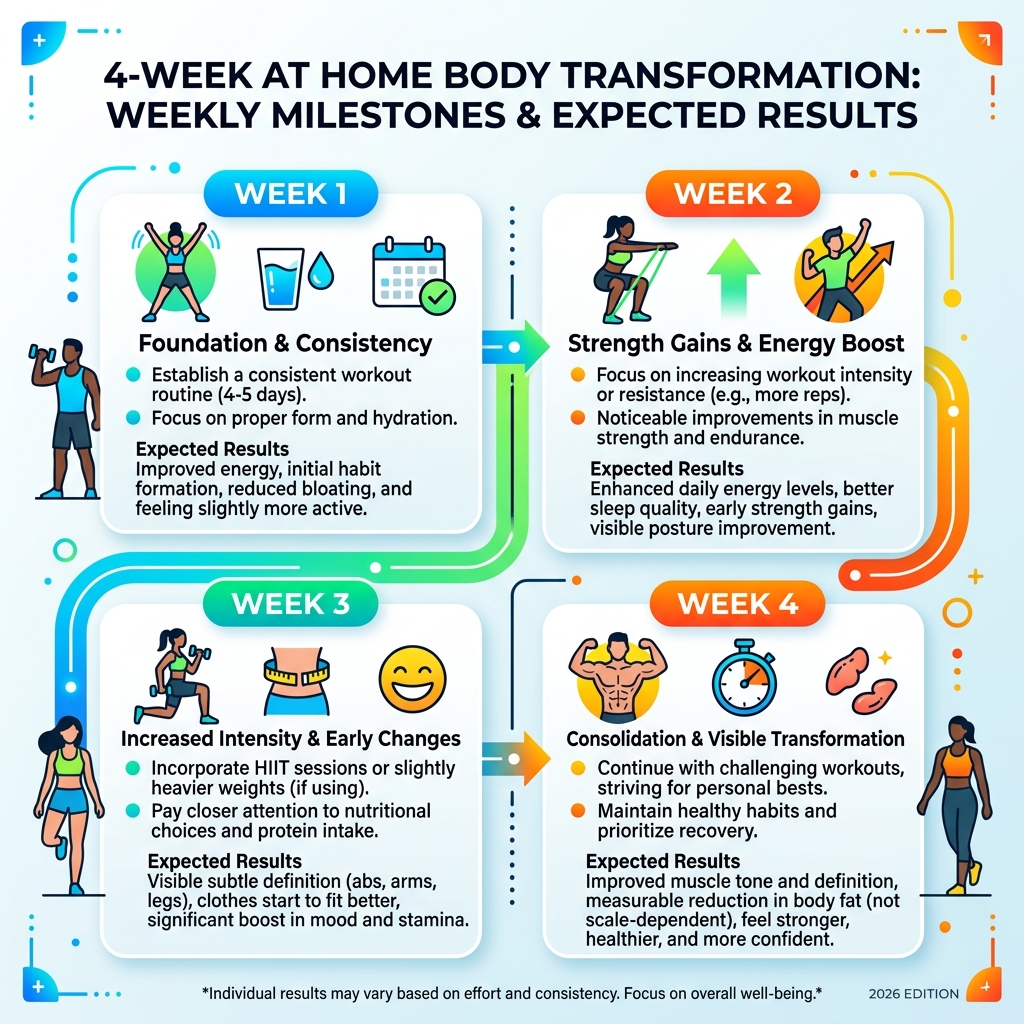
This guide gives you a complete, no-fluff 4-week plan to build strength, burn fat, and reshape your body — all from your living room.
Defining Your At Home Body Transformation Goals
Before we start sweating, we need to talk about what “transformation” actually means. It isn’t just about the number on the scale. In fact, for many of us, a successful at home body transformation involves “body recomposition”—the process of losing fat and gaining muscle simultaneously.
Understanding Body Composition
When we talk about body composition, we are looking at the ratio of fat to lean muscle mass. Muscle is metabolically active tissue, meaning it burns more calories at rest than fat does. This is why two people can weigh exactly 150 lbs, but the person with more muscle will look leaner and firmer.
Scientific research indicates that during the first few weeks of a new program, your body undergoes “neural adaptations.” This means your nervous system is getting better at communicating with your muscles. You might not see a huge change in the mirror in week one, but you will feel significantly stronger.
Toning vs. Bulking
We often hear the word “toning,” especially from women. Physically, “toning” simply means building muscle and losing enough body fat to see that muscle. You don’t need a gym full of machines to achieve this; you just need enough resistance to challenge your fibers. On the flip side, “bulking” requires a significant calorie surplus and very heavy lifting. Don’t worry about accidentally waking up like a professional bodybuilder—it takes years of dedicated effort to build that kind of mass!
Tracking Non-Scale Victories (NSVs)
The scale is a fickle friend. It fluctuates based on water retention, salt intake, and even stress. To stay motivated during your home-workout-for-weight-loss, we recommend tracking these victories instead:
- Strength Gains: Can you do five more push-ups than last week?
- Energy Levels: Do you still feel like a zombie at 3 PM?
- Clothing Fit: Are those jeans feeling a bit looser around the waist?
- Progress Photos: Take pictures every two weeks. The mirror often lies, but photos don’t.

Essential Equipment and Foundation for At Home Body Transformation
One of the biggest myths in fitness is that you need a $2,000 treadmill to get fit. We’ve seen incredible results from people using nothing but a pair of dumbbells and a kitchen chair. At Casa e Jardim Web, our mission is to make fitness accessible, which starts with a minimalist setup.
The Essential Toolkit
If you’re ready to invest a small amount, here is what we recommend:
- Resistance Bands: These are “gyms in a pocket.” They provide constant tension and are excellent for glute work and upper body pulling movements.
- Dumbbells: Even a single pair of adjustable dumbbells can take you through an entire 12-week program.
- A Yoga Mat: Essential for floor work and protecting your joints (and your carpet).
- A Bench or Sturdy Chair: Used for step-ups, dips, and rows.
The Power of Progressive Overload
This is the “secret sauce” of an at home body transformation. If you do 10 squats every day for a year, you will get very good at doing 10 squats, but your body won’t change after the first few weeks. To keep seeing results, you must apply progressive overload. This means:
- Increasing the weight (if you have it).
- Increasing the repetitions.
- Decreasing the rest time between sets.
- Improving your form or range of motion.
| Exercise Type | Pros | Cons |
|---|---|---|
| Bodyweight | Free, can be done anywhere, great for beginners. | Harder to isolate specific muscles, limited resistance. |
| Weighted (Dumbbells/Bands) | Easier to track progress, faster muscle growth. | Requires a small financial investment and space. |
If you’re just starting, check out our beginner-friendly-home-workout-plan to get the basics down before adding weights.
Building a Strong Foundation for At Home Body Transformation
Before you start throwing weights around, we need to focus on the “Mind-Muscle Connection.” This isn’t just “fitness talk”—it’s a real physiological phenomenon. When you perform a squat, are you actually feeling your glutes and quads work, or are you just moving through the motion?
Form Priority Over Everything We always say: “Bad form is a debt you’ll eventually have to pay with an injury.”
- Core Stability: In almost every exercise, your core should be engaged. Imagine someone is about to poke you in the stomach—that “bracing” feeling is core engagement.
- Compound Movements: Focus on exercises that use multiple joints, like squats, lunges, and push-ups. These burn more calories and build more functional strength.
- Slow Down: For an effective full-body-weight-training-routine-at-home, focus on the “eccentric” phase (the lowering part). Count to three on the way down. You’ll feel the burn!
The 4-Week Full-Body Workout Routine
We have designed this routine to be efficient. You don’t need two hours; 45 minutes of focused work is plenty. This plan utilizes a mix of strength training and metabolic conditioning.
The Routine Structure
We recommend a “Full Body” approach for beginners and intermediates. This allows you to hit every muscle group three times a week, which is the gold standard for muscle protein synthesis.
Sample Circuit (Perform 3-4 Rounds):
- Goblet Squats or Bodyweight Squats: 12-15 reps (Focus on depth).
- Push-Ups (on knees if needed): 10-12 reps (Keep elbows at a 45-degree angle).
- Bulgarian Split Squats: 10 reps per leg (This is the “king” of leg exercises).
- Dumbbell or Resistance Band Rows: 12 reps (Squeeze your shoulder blades).
- Plank: 45-60 seconds (Keep your back flat).
For days when you’re short on time, our 20-minute-fat-burning-workout-at-home is a perfect substitute to keep the momentum going. You can also explore a more detailed full-body-home-workout-plan for variety.
Weekly Schedule for At Home Body Transformation
Consistency is the only thing that separates those who succeed from those who don’t. Here is a realistic 4-week schedule:
- Monday: Full Body Strength
- Tuesday: Active Recovery (Walking 30 mins + Mobility/Stretching)
- Wednesday: Full Body Strength
- Thursday: HIIT (High-Intensity Interval Training) or Cardio
- Friday: Full Body Strength
- Saturday: Fun Activity (Hiking, Bike Ride, or a jumpstart-your-fitness-30-day-strength-training-challenge)
- Sunday: Full Rest
The 10,000 Step Goal Don’t underestimate the power of walking. It is the most underrated tool for an at home body transformation. Walking helps with recovery by increasing blood flow to sore muscles without adding extra stress to your central nervous system. Aim for 8,000 to 12,000 steps daily.
Nutrition and Recovery Strategies for Success
You can’t out-train a bad diet. We know, it’s a cliché, but it’s true. If you are training like an athlete but eating like a toddler, your results will be limited.
The Macronutrient Blueprint
To transform your body, you need the right fuel. Here is a simple breakdown:
- Protein (The Builder): Essential for repairing muscle tissue. Aim for 0.5g to 1g of protein per pound of bodyweight. Sources: Chicken, tofu, eggs, Greek yogurt, beans.
- Carbohydrates (The Fuel): Don’t fear carbs! They provide the energy for your workouts. Sources: Oats, sweet potatoes, brown rice, fruit.
- Fats (The Regulator): Necessary for hormone production. Sources: Avocado, nuts, olive oil.
Creating a Calorie Deficit
If your goal is fat loss, you must be in a calorie deficit. However, don’t go too low. A deficit of 200–500 calories below your maintenance level is sustainable. If you drop your calories too low, your metabolism will slow down, and you’ll likely lose muscle mass instead of fat. Our fat-loss-meal-plan-for-home-workouts provides a great starting point for structuring your plates.
Hydration and Pre/Post Workout Habits
- Water: Drink at least 2-3 liters a day. Dehydration can mimic hunger and lead to poor performance.
- Pre-Workout: A small snack with simple carbs (like a banana) 30-60 minutes before training can give you a boost.
- Post-Workout: Within an hour of training, try to get a meal with protein and carbs to kickstart recovery. Check out our home-workout-and-diet-plan for specific meal ideas.
The Importance of Sleep
Muscle doesn’t grow while you’re working out; it grows while you’re sleeping. During deep sleep, your body releases growth hormones that repair the micro-tears in your muscles caused by exercise. Aim for 7–9 hours of quality sleep. If you’re stressed and sleep-deprived, your cortisol levels will rise, making it much harder to lose belly fat.
Frequently Asked Questions about Home Fitness
How long does it realistically take to see noticeable changes?
While your metabolism starts to shift within the first three weeks, most people see noticeable aesthetic changes (tighter clothes, more muscle definition) between weeks 4 and 8. By week 12, friends and family will likely start asking what you’ve been doing! The first 30 days are about building the habit; the next 60 are about building the body.
Can women achieve toning and muscle-building goals at home?
Absolutely. In fact, many women find that home workouts are less intimidating and allow for better focus. Because women have lower testosterone levels than men, you won’t “bulk up” by lifting weights. Instead, you’ll achieve that lean, sculpted look by building muscle and reducing body fat. Resistance training is also vital for women’s bone health as they age.
What are the most common mistakes to avoid during a transformation?
- Changing your routine too often: Stick to a plan for at least 4-6 weeks before swapping exercises. Your body needs time to master a movement to grow.
- Ignoring “Hidden” Calories: Those extra splashes of oil or handfuls of nuts can add up and stall fat loss.
- Sacrificing Form for Reps: Doing 50 bad squats is worse than doing 10 perfect ones.
- Expecting Perfection: If you miss a workout or eat a “cheat” meal, don’t throw in the towel. Just get back on track with your next meal or session.
Conclusion
An at home body transformation is not a 30-day sprint; it is the start of a sustainable lifestyle. At Casa e Jardim Web, we believe that fitness should fit into your life, not consume it. By focusing on progressive overload, smart nutrition, and consistent recovery, you can build a body you’re proud of without ever stepping foot in a commercial gym.
Start small. Maybe today it’s just a 15-minute walk and 10 push-ups. Tomorrow, it’s a full circuit. Over time, these small choices compound into a total transformation. We are here to support you every step of the way with our guides and community.
Ready to take the first step? Grab a water bottle, clear some space in your living room, and let’s get to work!
For more guides and workout tips, visit us at https://www.casaejardimweb.com/
