
You Don’t Need a Squat Rack to Build Powerful Legs
A bodyweight leg workout for men can absolutely build serious muscle, strength, and power — no gym membership or equipment required.
Here’s a quick answer to get you started:
- Squats – targets quads, glutes, and hamstrings
- Bulgarian split squats – unilateral strength and glute development
- Glute bridges / hip thrusts – posterior chain and hip power
- Walking or reverse lunges – balance, quads, and hamstrings
- Jump squats – explosive power and fast-twitch muscle fiber recruitment
- Calf raises – isolated lower leg strength
- Nordic curls – hamstring strength and injury prevention
Push these close to failure with enough volume, and your legs will grow.
Most guys assume heavy barbells are the only path to big legs. They’re not. Research confirms that bodyweight training improves lower body muscle force and power when exercises are selected well and performed with enough intensity.
The key words there are intensity and selection. A few lazy air squats won’t cut it. But the right moves, done with full range of motion and smart programming, can rival a gym session.
The lower body houses the largest muscle groups in the body — your glutes, quads, and hamstrings. Training them without weights just means you need to be smarter about how you apply stress to those muscles.
This guide walks you through exactly how to do that.
The Science of the Bodyweight Leg Workout for Men
To understand how a bodyweight leg workout for men actually works, we need to look at the mechanics of muscle growth, or hypertrophy. Your muscles don’t have eyes; they don’t know if you are holding a $500 barbell or simply lifting your own torso. They only respond to three primary stimuli: mechanical tension, metabolic stress, and muscle damage.
When we perform Strength Exercises for Men: A Beginner’s Guide, we are creating mechanical tension by stretching and contracting muscle fibers under load. In a bodyweight context, we maximize this by using “mechanical disadvantage”—choosing harder variations like single-leg movements that force the muscle to work harder against gravity.
Metabolic stress is that “burn” you feel during high-repetition sets. This occurs when metabolites like lactate accumulate in the muscle, signaling the body to release growth-related hormones. Because we aren’t using external weights, we often rely on higher volume and shorter rest periods to achieve this state.
Fast-Twitch Fibers and Explosive Power
Research on the effectiveness of bodyweight resistance training indicates that bodyweight programs can substantially improve lower body muscle force. One way we achieve this is by targeting fast-twitch muscle fibers. These fibers are larger than slow-twitch fibers and have a much higher potential for growth. By incorporating explosive movements—like jump squats or plyometric lunges—we recruit these high-threshold motor units that might otherwise stay dormant during a casual stroll.
The Principle of Progressive Overload
The biggest mistake men make with home workouts is stagnation. To keep growing, you must apply progressive overload. This doesn’t just mean adding weight. You can progress by:
- Increasing total repetitions.
- Decreasing rest time between sets.
- Increasing “Time Under Tension” (slowing down the movement).
- Moving to a more difficult exercise variation (e.g., from a regular squat to a pistol squat).
Essential Exercises for Quads, Glutes, and Hamstrings
If we want to build “tree trunk” legs, we have to move beyond the basic air squat. Unilateral training (working one leg at a time) is the secret weapon of the home athlete. It doubles the load on the working limb and forces your stabilizer muscles to fire like crazy.
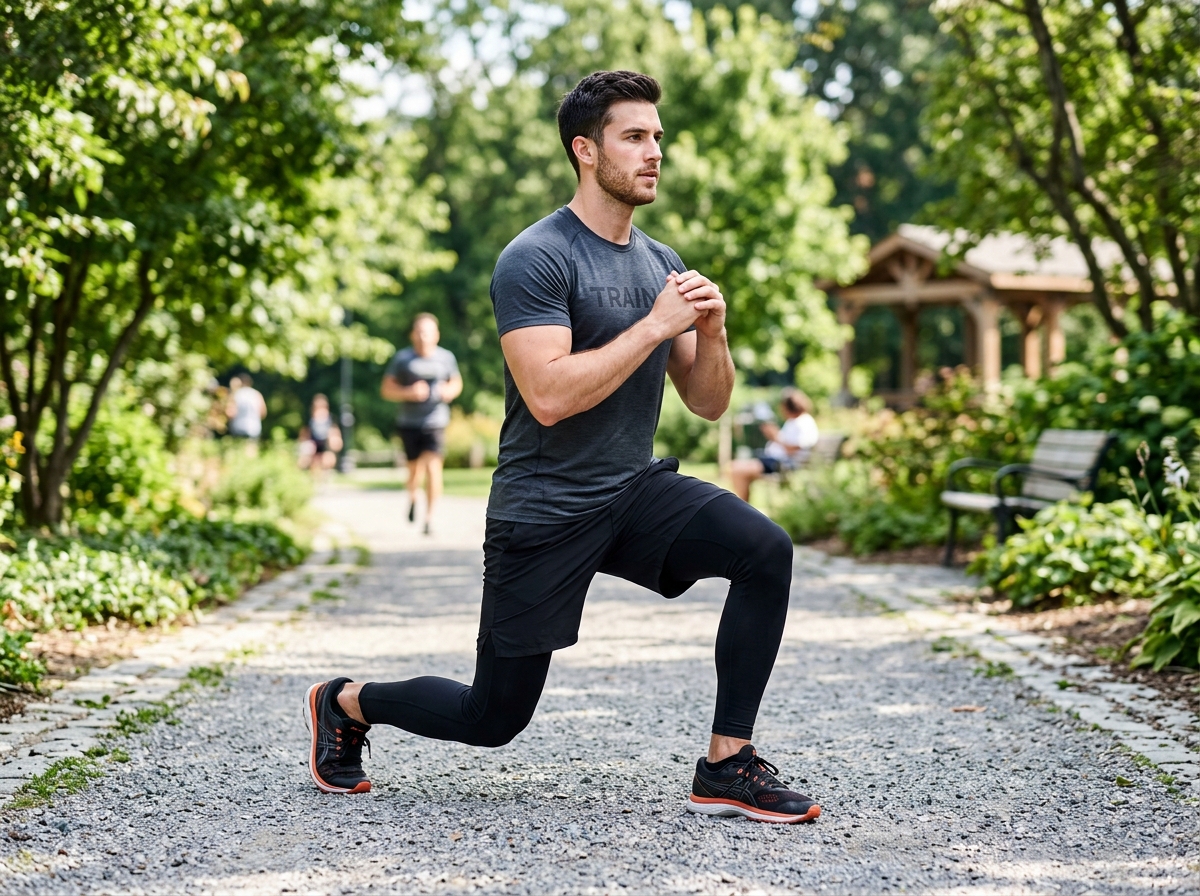
The “Big Three” Home Leg Builders
- Bulgarian Split Squats: Many experts consider this the single most efficient bodyweight leg workout for men. By elevating your rear foot on a chair or couch, you shift the vast majority of your weight onto the front leg. It targets the quads and glutes with surgical precision.
- Pistol Squats (Single-Leg Squats): This is the ultimate test of lower body strength and balance. It requires immense quad strength and ankle mobility. If you can’t do a full pistol yet, we recommend holding onto a doorframe for assistance.
- Nordic Hamstring Curls: Often called the “poor man’s leg curl,” this move is legendary for building bulletproof hamstrings. Kneel on the floor with your ankles secured under a heavy couch. Slowly lower your torso toward the ground, using your hamstrings to resist gravity.
For those just starting, check out our Lower Body Weight Training Plan for Beginners and explore more Bodyweight Exercises for Home to build your foundational strength.
Targeting the Anterior Chain: Quads and Calves in a Bodyweight Leg Workout for Men
The quads make up the bulk of the thigh’s front. To make them pop, we need to emphasize knee flexion.
- Heels-Raised Squats: By placing your heels on a small book or plank, you allow your knees to track further forward. This creates a “bodyweight leg extension” effect, putting massive tension on the quads.
- Sissy Squats: Don’t let the name fool you. By leaning back and pushing your knees forward while staying on your toes, you create an incredible stretch in the quad muscles.
- Explosive Jump Squats: These are essential for hitting those fast-twitch fibers. Aim for maximum height and a soft, controlled landing.
Don’t forget the calves! To build the “inverted heart” shape, perform Single-Leg Calf Raises off a step. The key is the range of motion—drop your heel as low as possible and pause for a full second at the bottom to eliminate the “bounce” from your Achilles tendon. For more quad-focused ideas, see our guide on Muscle Building Home Workouts for Beginners.
Strengthening the Posterior Chain and Hips in a Bodyweight Leg Workout for Men
A common pitfall in a bodyweight leg workout for men is over-focusing on the quads and neglecting the back of the legs. A strong posterior chain is the engine of your athleticism.
- Single-Leg Glute Bridges: Lie on your back, one foot on the floor, and drive your hips toward the ceiling. This isolates the glutes and hamstrings. To make it harder, place your foot on an elevated surface like a chair.
- Lateral Lunges: Most men only move forward and backward. Lateral lunges hit the adductors (inner thighs) and the glute medius, which are crucial for hip stability and preventing knee pain.
- Adductor Slides: Using a towel on a smooth floor, slide one leg out to the side and pull it back in using only your inner thigh strength.
We often emphasize these moves in our Home Workout for Men Beginners because hip health is the foundation for all other leg movements.
How to Structure Your Routine for Maximum Gains
To see results, you need a plan. We recommend using different protocols like EMOM (Every Minute on the Minute) to keep intensity high or Circuit Training to boost cardiovascular health alongside muscle growth.
| Fitness Level | Structure | Recommended Volume | Rest Interval |
|---|---|---|---|
| Beginner | Standard Sets/Reps | 3 sets of 10-12 reps | 60-90 seconds |
| Intermediate | Circuits | 4 rounds of 5 exercises | 30-45 seconds |
| Advanced | AMRAP / EMOM | 20-30 minutes non-stop | Minimal (under 15s) |
For a deep dive into structuring your week, refer to our Beginners Guide Strength Exercises for Men or our Full Body Weight Training Routine at Home.
The “APEX” Circuit Method
A highly effective way to structure your bodyweight leg workout for men is the APEX method:
- Anterior (Squat variation)
- Posterior (Bridge or RDL variation)
- Explosive (Jump or sprint-in-place)
- X-Factor (Hip corrective or calf work)
Perform these four moves back-to-back, rest for 60 seconds, and repeat for 5 rounds. This ensures no muscle group is left behind while keeping your heart rate in the fat-burning zone.
Mastering Form and Progressive Overload at Home
Without the safety of a squat rack, your “form” is your only protection against injury. It is also the tool you use to make an easy exercise feel incredibly difficult.
The Power of Tempo
If 20 squats feel easy, don’t just do 50. Instead, change the tempo. Try a 3-second eccentric phase (the lowering part). By slowing down, you increase the time under tension, which is a primary driver for hypertrophy. Adding a 2-second pause at the bottom of a lunge removes all momentum, forcing your muscles to generate force from a “dead stop.”
Mind-Muscle Connection
In a bodyweight leg workout for men, you must consciously “squeeze” the target muscle. When doing a glute bridge, don’t just move your hips up; visualize your glutes doing 100% of the work. This mental focus has been shown to increase muscle fiber recruitment.
For more advanced tips on perfecting your movement patterns, read our Ultimate Guide to Full Body Weight Training at Home.
Frequently Asked Questions about Bodyweight Leg Training
Can men effectively build leg muscle using only bodyweight?
Yes. While you may eventually hit a ceiling for absolute maximal strength (like a 500lb squat), you can build significant mass and “functional” power. The key is training to or near failure. Research shows that as long as the intensity is high, high-rep bodyweight training can produce similar hypertrophy to low-rep weighted training.
How do I achieve progressive overload without adding weights?
Beyond increasing reps, you should look at “mechanical disadvantage.” For example, moving from a regular lunge to a lunge with your front foot elevated increases the range of motion, making the muscle work through a longer, harder arc. You can also reduce rest periods—try doing the same workout in 15 minutes that used to take you 20.
Why is it important to include hip exercises in a leg workout?
Weak hips are the most common cause of “valgus collapse” (knees caving in), which leads to ACL and meniscus injuries. Exercises like Jane Fonda side-raises or lateral bounds strengthen the hip abductors, ensuring that your larger muscles (quads and glutes) have a stable base to pull from. This leads to more power and fewer injuries.
Conclusion
Building massive, powerful legs doesn’t require a garage full of iron. It requires discipline, a high pain tolerance, and a smart bodyweight leg workout for men. By mastering unilateral movements, manipulating tempo, and staying consistent with your progressive overload, you can achieve a physique that rivals any gym-goer.
Your muscles grow while you sleep, not while you’re working out. Ensure you are getting 7-8 hours of quality rest and consuming enough protein (aim for roughly 1 gram per pound of body weight) to support that new growth.
Ready to start your journey? Check out our Kickstart Your Fitness Lower Body Weight Training Plan and explore more home workout guides at Casa e Jardim Web. Let’s get to work!
