
From Flat to All That with the Best Push Up Variations for Mass
Why the Best Push Up Variations for Mass Beat Basic Training
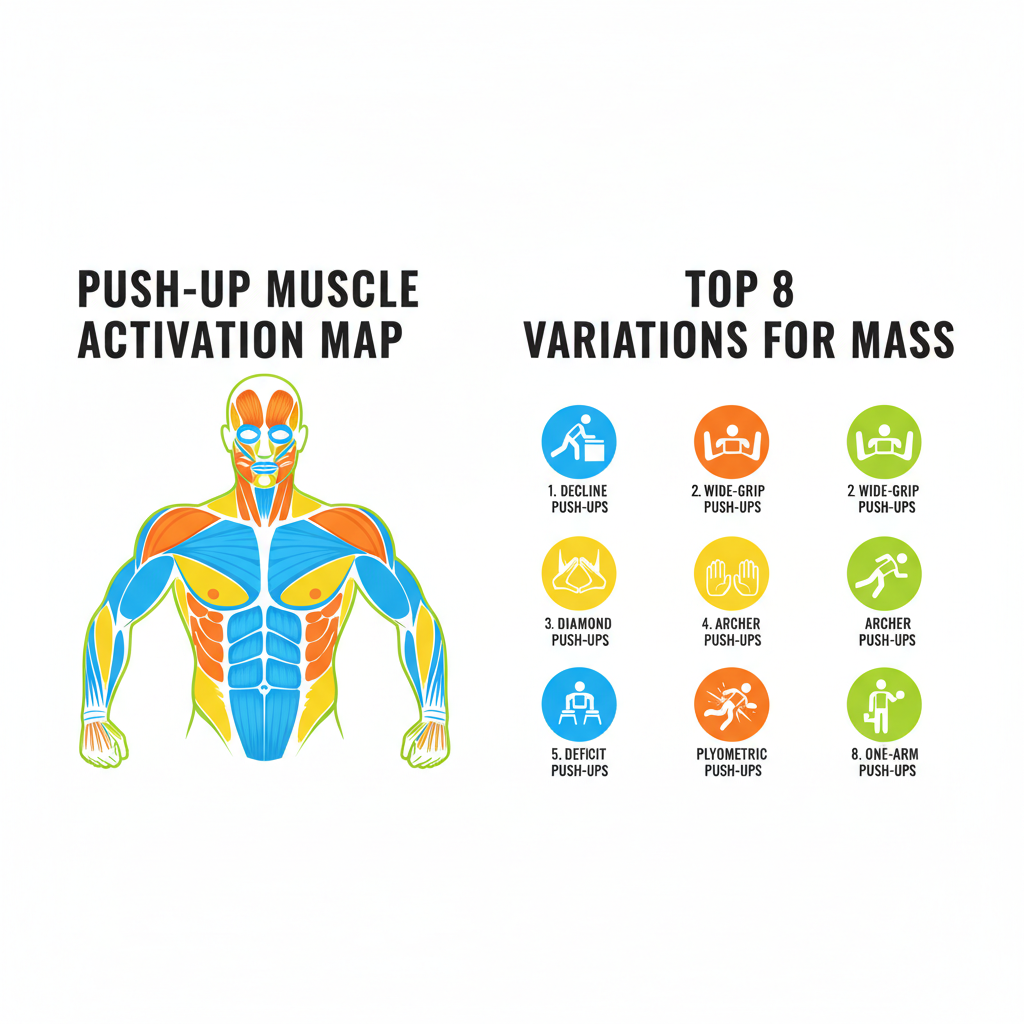
The best push up variations for mass include these top picks:
- Decline Push-Ups – targets upper chest (clavicular head)
- Wide-Grip Push-Ups – maximizes pectoral activation
- Diamond Push-Ups – emphasizes triceps and inner chest
- Archer Push-Ups – builds unilateral strength and mass
- Deficit Push-Ups – increases range of motion for deeper muscle stretch
- Plyometric Push-Ups – recruits fast-twitch fibers for power and size
- Feet-Elevated Push-Ups – shifts load to upper chest and anterior deltoids
- One-Arm Push-Ups – advanced overload for serious hypertrophy
Push-ups have been used by militaries around the world to build fighting-fit soldiers. And for good reason. A standard push-up asks your body to move nearly 75% of its own weight — making it a serious compound movement, not just a warm-up drill.
But here’s the problem most people hit: basic push-ups stop working.
Once your body adapts, doing more reps doesn’t cut it. More reps builds endurance. More challenge builds mass. That’s the difference between spinning your wheels and actually growing your chest, shoulders, and triceps.
The fix is simple — progressive overload through smarter variations. By changing your hand position, body angle, or movement tempo, you force your muscles to work harder without ever touching a weight.
Whether you’re training at home with zero equipment or just want to build serious upper body mass without a gym membership, the right push-up variations can take you from flat to full.
The Science of Building Mass with Push-Ups
To understand how to grow, we first have to look at what’s happening under the skin. When we talk about “mass,” we are talking about muscle hypertrophy. This isn’t just about doing a movement; it’s about creating enough mechanical tension and metabolic stress to force the muscle fibers to repair themselves thicker and stronger.
The standard push-up is a phenomenal compound movement. It primarily targets the pectoralis major (your chest), the anterior deltoids (front of your shoulders), and the triceps brachii (the back of your arms). However, it also recruits your core, glutes, and even your upper back to maintain a rigid “plank” position.
Body Weight vs. The Barbell
A common myth is that you need a bench press to build a “monster chest.” While the bench press is great, science tells a different story. Research has shown that push-ups and bench pressing at 40% of your one-rep max (1RM) over eight weeks are similarly effective for increasing muscle thickness and strength.
When you perform a standard push-up, you are supporting nearly 75% of your total body weight. If you weigh 180 lbs, that’s 135 lbs of resistance. The beauty of the best push up variations for mass is that they allow you to manipulate this percentage. By elevating your feet, you can increase the intensity by up to 33% compared to a standard or hands-elevated version.
Time Under Tension (TUT)
For mass, “Time Under Tension” is your best friend. Instead of banging out 50 fast, sloppy reps, we focus on controlled descents and explosive ascents. This keeps the muscle fibers firing for longer durations, leading to greater micro-tears and subsequent growth.
| Variation Type | Estimated Body Weight % | Primary Muscle Focus |
|---|---|---|
| Knee Push-Ups | 36% – 45% | Chest / Triceps (Beginner) |
| Standard Push-Ups | 64% – 75% | Mid-Chest / Shoulders |
| Feet-Elevated (Decline) | 70% – 80%+ | Upper Chest / Shoulders |
| One-Arm Push-Up | 90%+ (Unilateral) | Full Upper Body / Core |
Best Push Up Variations for Mass: Targeting the Chest
If your goal is a thick, wide chest, you cannot rely on a single hand position. The chest is a large fan-shaped muscle, and to achieve total development, we need to hit it from multiple angles.
Wide-Grip Push-Ups
By placing your hands 1.5 to 2 times shoulder-width apart, you reduce the involvement of the triceps and place the brunt of the load onto the pectorals. This variation emphasizes the outer “sweep” of the chest. Be careful not to flare your elbows too much; keep them at a 45-degree angle to your torso to protect your shoulders.
Archer Push-Ups
This is one of the best push up variations for mass because it introduces unilateral (one-sided) loading. As you lower yourself, you extend one arm out straight while the “working” arm does the heavy lifting. This mimics the intensity of a heavy dumbbell press and helps correct left-to-right strength imbalances.
For those just starting out, check out our guide on building upper body strength with easy home workouts or explore a complete at-home workout for upper body to see how these fit into a full routine.
Best Push Up Variations for Mass: The Upper Chest Focus
The “clavicular head” of the pectoralis major is often the hardest part of the chest to fill out. If your upper chest is flat, your whole physique looks less powerful.
The Decline Push-Up is the gold standard here. By placing your feet on a chair, bench, or even a couch, you shift the center of gravity toward your head and shoulders. This forces the upper fibers of the chest to work much harder.
- Pro Tip: The higher your feet, the more the load shifts to your shoulders. For maximum upper chest mass, a 12-to-18-inch elevation is usually the “sweet spot.”
Using bodyweight exercises for home is the most efficient way to build this area without needing an adjustable gym bench.
Best Push Up Variations for Mass: Inner and Lower Pectorals
To get that “defined” look at the bottom and center of the chest, we use variations that emphasize adduction—the act of bringing your arms toward the midline of your body.
- Incline Push-Ups: By placing your hands on an elevated surface (like a table or bench), you target the lower portion of the chest (the sternal head). This is also a great regression for beginners who find standard push-ups too taxing.
- Diamond Push-Ups: By placing your hands together so your index fingers and thumbs form a diamond, you create intense activation in the triceps and the inner portion of the pectorals. Research shows that narrow hand positions elicit greater activation for both the triceps and the pectoralis major than wide positions.
If you are a beginner, we recommend starting with muscle building home workouts for beginners to master your form before moving to these high-intensity variations.
Advanced Variations for Maximum Hypertrophy
Once you can comfortably perform 20-30 standard push-ups with perfect form, it’s time to level up. Doing 100 easy push-ups will make you good at doing 100 push-ups, but it won’t necessarily make you bigger. To grow, you need to increase the mechanical tension.
The 1.5 Rep Method
This is a “hidden gem” for hypertrophy. You go all the way down, come halfway up, go back down again, and then push all the way to the top. This counts as one rep. This technique doubles the time spent in the “stretched” position of the movement, which is the most critical phase for muscle growth.
Plyometric (Explosive) Push-Ups
Plyometrics aren’t just for athletes. Explosive movements like the “clapping push-up” recruit fast-twitch muscle fibers, which have the greatest potential for growth. A study showed that 3 sets of 5 plyometric push-ups can actually enhance your performance on the bench press immediately afterward.
- Safety Note: Focus on landing softly with slightly bent elbows to absorb the impact.
Deficit Push-Ups
By placing your hands on two elevated surfaces (like parallettes, sturdy books, or dumbbells), you allow your chest to sink lower than floor level. This extra range of motion provides a deep stretch to the muscle fibers, leading to more significant growth.
The One-Arm Push-Up
The ultimate test of upper body strength. This variation places almost your entire body weight on a single arm. It requires immense core stability and triceps strength. Most people should start with “Archer” push-ups as a bridge to this elite move.
How to Structure Your Push-Up Routine for Growth
To build mass, you can’t just “drop and give me twenty” whenever you feel like it. You need a structured plan.
Rep Ranges and Volume
For hypertrophy, the “sweet spot” is typically 3 to 4 sets of 8 to 12 repetitions. If a variation is so easy that you can do 20 reps, it’s time to switch to a harder variation (like moving from standard to decline).
Training to Failure
In bodyweight training, “technical failure” is key. This means performing reps until you can no longer do another one with perfect form. This ensures you’ve recruited every possible muscle fiber.
Rest and Frequency
Muscle doesn’t grow while you’re working out; it grows while you’re sleeping.
- Frequency: Aim for 2 to 3 chest-focused sessions per week.
- Rest: Give your muscles at least 48 hours of recovery between sessions.
- Rest Intervals: During your workout, rest for 60 to 90 seconds between sets to allow for ATP (energy) recovery while maintaining metabolic stress.
The Role of Nutrition
You can do the best push up variations for mass all day, but if you aren’t eating enough protein and calories, you won’t grow. Muscle is metabolically expensive to build. Check out our nutrition tips for muscle building and our strength training nutrition guide to ensure your kitchen habits match your workout efforts.
Frequently Asked Questions about Push-Ups for Mass
Can push-ups alone build a big chest?
Yes, absolutely. As long as you apply progressive overload, push-ups can build a chest that rivals any “gym rat’s.” The key is to never stay comfortable. Once standard push-ups are easy, you must move to declines, archers, or weighted vests to keep the mechanical tension high.
How many push-ups should I do daily for mass?
Surprisingly, doing push-ups every single day is usually counterproductive for mass. High-frequency training is better for endurance. For hypertrophy, your muscles need recovery time to repair the micro-tears created during training. Stick to 3–4 times a week for the best results.
Are diamond push-ups better for triceps or chest?
Diamond push-ups are world-class for the triceps brachii. Because your hands are narrow, the leverage shifts away from the chest and onto the arms. However, they also provide a unique “squeeze” for the inner pectorals (pectoralis minor and sternal head), making them a great finishing move for any chest day.
Conclusion
At Casa e Jardim Web, we believe that you don’t need a fancy gym membership to achieve the body of your dreams. The best push up variations for mass prove that with a little bit of floor space and a lot of discipline, you can build a powerful, muscular upper body.
The secret isn’t in the number of reps—it’s in the quality of the movement and the courage to progress. Start where you are, master your form, and then challenge yourself with the advanced variations we’ve discussed today. Whether it’s the deep stretch of a deficit push-up or the raw power of a plyometric clap, every rep is a step toward “all that.”
Ready to take the next step in your fitness journey? Start your strength journey today and explore our full library of home-grown gains. Consistent effort always beats occasional intensity. Now, drop and give us your best!
