
Survival of the Fittest Desk Job Upper Body Routine
Your Desk Job Is Hurting Your Upper Body Right Now
A solid desk job upper body routine is one of the smartest things you can add to your workday — and the research makes it clear why.
Quick answer: The best desk job upper body routines combine short stretching sessions with targeted strengthening moves done every 1-2 hours throughout the workday. No gym or equipment required. Key exercises include:
- Chin tucks – corrects forward head posture
- Shoulder blade squeezes – reactivates weak upper back muscles
- Neck rotations and upper trap stretches – releases tension
- Chest openers – counteracts rounded shoulders
- Desk push-ups and chair dips – builds functional upper body strength
- Seated cat-cow and thoracic rotations – restores spinal mobility
Results: most people feel less stiffness within 7 days, and meaningful postural improvement within 4 weeks of consistent daily practice.
The numbers are hard to ignore. Over 80% of US jobs are predominantly sedentary. Office workers spend roughly 97% of their working hours sitting or doing very light activity. And more than half of office and computer workers develop work-related musculoskeletal disorders — with the neck, shoulders, and upper back taking the most damage.
Here’s the thing most people miss: those aches aren’t just annoying. They’re your muscles adapting to a position you’re holding for 7-8+ hours a day. Over time, your chest tightens, your upper back weakens, and your thoracic spine loses the ability to rotate freely. That’s when tension headaches, shoulder pain, and that familiar mid-afternoon stiffness set in.
The good news? Periodic workplace stretching alone may reduce pain by up to 72 percent. Add some targeted strengthening, and you’re not just managing symptoms — you’re fixing the root cause.
Why Your Desk Job is Wrecking Your Upper Body
We’ve all been there: you stand up after a focused four-hour stretch of emails, and your upper back feels like it’s been set in concrete. This isn’t just “getting older”; it’s a mechanical adaptation. When we sit at a desk, our bodies undergo a predictable series of changes often referred to as “Upper Crossed Syndrome.”
Tech Neck and Rounded Shoulders
The most common culprit is “tech neck.” For every inch your head shifts forward from its neutral position, the effective load on your cervical spine increases by roughly 10 pounds. At a typical desk, most people’s heads are 2 to 3 inches forward, meaning your neck muscles are trying to support an extra 20–30 pounds of weight all day. This leads to chronic stress-induced neck pain and those agonizing tension headaches that start at the base of the skull.
Thoracic Immobility and Muscle Imbalances
Your thoracic spine (the middle and upper back) is designed to rotate and extend. However, hours of typing lock it into a rounded position. This “thoracic lock” forces your neck and lower back to overcompensate, leading to pain in areas far away from the actual stiffness.
Mechanically, your body begins to experience:
- Chest Shortening: The pectoral muscles become tight and short, pulling the shoulders forward.
- Rhomboid Inhibition: The muscles between your shoulder blades (rhomboids and middle trapezius) become overstretched and “turned off.”
- Scapular Weakness: Your shoulder blades lose their ability to glide properly, leading to shoulder impingement or “winging.”
According to the Best Posture Exercises for Desk Workers (15-Min Routine), the problem isn’t just weakness or tightness in isolation; it’s a system of compensations. If you only stretch without strengthening, you might actually make the instability worse.
The Ultimate Desk Job Upper Body Routine: Stretch and Mobilize
To survive the “desk potato” lifestyle, we need to rehydrate our tissues. Prolonged sitting causes connective tissue to lose water and oxygen. A consistent desk job upper body routine should start with mobility to “wake up” the nervous system and move the joints through their full range of motion.
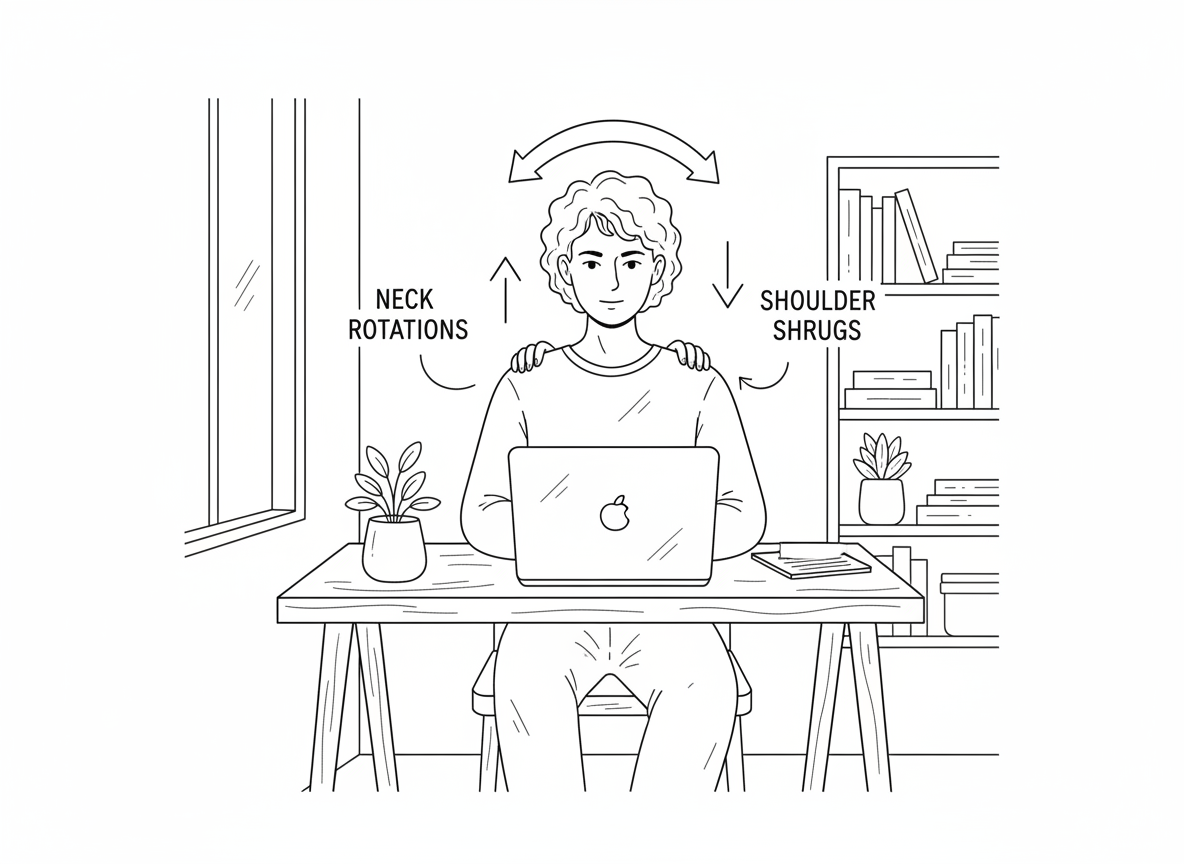
1. Neck Rotations and Shoulder Shrugs
Start simple. Slowly rotate your neck in a half-moon shape from shoulder to shoulder. Follow this with exaggerated shoulder shrugs—pull your shoulders up to your ears, then forcibly drop them down. This helps release the “holding” tension we carry when we’re stressed or focused.
2. Seated Cat-Cow
You don’t need a yoga mat for this. While sitting, place your hands on your knees. Inhale, arch your back, and look toward the ceiling (Cow). Exhale, round your spine, and tuck your chin to your chest (Cat). This provides a vital “reset” for the entire spinal column.
3. Thoracic Rotation
Sit sideways in your chair. Keep your hips facing forward and use the back of the chair to gently rotate your upper body to one side. This targets the thoracic spine, which is the most critical movement lost during sedentary work. If you’re looking to transition these moves into a more robust home practice, check out our guide on building upper body strength with easy home workouts.
4. Chest Openers and Spinal Twists
Clasp your hands behind your back and gently lift your arms while pushing your chest forward. This counteracts the “closed” posture of typing. Combine this with a seated latissimus reach—reaching one arm over your head and leaning to the opposite side—to open up the side body and ribs.
Quick Stretches for a Desk Job Upper Body Routine
If you only have two minutes between Zoom calls, focus on these “big wins”:
- Triceps Stretch: Reach one hand over your shoulder and use the other hand to gently push the elbow down.
- Upper Trap Release: Gently tilt your ear toward your shoulder and hold for 30 seconds.
- Pectoral Stretch: Use a doorway or the corner of a cubicle to lean forward and stretch the chest.
- Forward Rhomboid Stretch: Interlace your fingers in front of you and “push” your hands away while rounding your upper back.
- Wrist Flexor Relief: After hours of typing, pull your fingers back toward your forearm to stretch the wrists and prevent carpal tunnel symptoms.
For those just starting their fitness journey, integrating these moves is a great precursor to a beginners upper body strength workout that you can do after hours.
Strengthening Your Posture: The “Deskercise” Circuit
Stretching feels good, but strengthening is what makes the change permanent. We need to “turn on” the muscles that have gone dormant.
| Feature | Passive Stretching | Active Strengthening |
|---|---|---|
| Primary Goal | Temporary relief of tightness | Long-term postural support |
| Muscle Effect | Lengthens short tissues | Shortens and tones weak tissues |
| Frequency | Every 30–60 minutes | 2–3 times per day |
| Result | Increased range of motion | Functional stability and reduced pain |
1. Desk Push-Ups
Stand a few feet away from your desk, place your hands on the edge, and perform a push-up. This strengthens the chest, shoulders, and core. Because you’re at an incline, it’s easier than a floor push-up but highly effective for building a workout for the upper body at home.
2. Scapular Retractions (The “Back Pocket” Move)
Imagine you are trying to tuck your shoulder blades into your back pockets. Squeeze them down and together, holding for 3-5 seconds. This reactivates the rhomboids and mid-trapezius. Perform 15 reps to start seeing results.
3. Wall Angels
Stand with your back against a wall. Try to keep your head, shoulders, and elbows in contact with the wall as you slide your arms up and down like you’re making a snow angel. This is the ultimate test of thoracic mobility and upper back strength.
4. Chin Tucks
This is the “anti-slouch” move. Pull your chin straight back, as if you’re making a double chin. Hold for 5 seconds. This strengthens the deep neck flexors that support your head.
Building Strength with a Desk Job Upper Body Routine
For those who want to take it a step further, keep a pair of light weights or a resistance band in your drawer.
- Chair Dips: Use a stable (non-rolling!) chair to lower and lift your body weight, targeting the triceps and shoulders.
- Seated Arm Raises: Using beginner-friendly dumbbells, perform lateral raises to strengthen the deltoids.
- Resistance Band Rows: Wrap a band around a sturdy desk leg and pull toward your hips. This is one of the best resistance band exercises to boost strength while remaining seated.
Ergonomics and Integration: Staying Pain-Free at Work
Even the best desk job upper body routine can’t fully compensate for a workstation that’s actively working against you. Proper ergonomics is the foundation of workplace wellness.
The Ideal Setup
- Monitor Height: The top of your screen should be at or slightly below eye level. If you use a laptop, get a stand and a separate keyboard.
- Keyboard and Mouse: Your elbows should be at a 90-degree angle, with your wrists in a neutral, straight position.
- Lumbar Support: Your chair should support the natural curve of your lower back. If it doesn’t, a rolled-up towel can work wonders.
Integration Strategies
The biggest hurdle isn’t the exercises themselves; it’s remembering to do them.
- The Pomodoro Technique: Work for 25 minutes, then take a 5-minute movement break.
- Habit Stacking: Do three chin tucks every time you finish a phone call or “stack” a chest stretch onto your morning coffee break.
- Standing Desks: If possible, alternate between sitting and standing every 30-45 minutes.
For men looking for a structured start, our strength exercises for men: a beginners guide offers great tips on integrating movement. Similarly, women can find tailored advice in our guide for effective strength training for women at home.
Frequently Asked Questions about Desk-Based Fitness
How often should I perform a desk job upper body routine?
Ideally, you should move every hour. Research shows that even 5-minute “micro-breaks” can reduce pain by up to 72% and provide a significant cognitive boost. Consistency is more important than intensity. Doing a few dumbbell strength exercises at the end of the day is great, but it won’t undo 8 hours of static sitting. Aim for 5-minute bouts every two hours.
Can I do these exercises discreetly in an open office?
Absolutely. Chin tucks, shoulder blade squeezes, and seated twists are very subtle. Most people will just think you’re adjusting your seat or stretching your neck. Shoulder shrugs and ankle pumps are also virtually invisible. You don’t need to roll out a yoga mat to save your spine.
How long until I see results from these exercises?
- Immediate: You’ll likely feel a “release” of tension and improved mental clarity right after the first session.
- 7 Days: Most people notice a significant reduction in morning and end-of-day stiffness.
- 4 Weeks: This is when meaningful postural changes happen. Your muscles will begin to “remember” the correct alignment, and you’ll find yourself slouching less often.
Conclusion
At Casa e Jardim Web, we believe that fitness should be accessible, whether you’re in a gym or a cubicle. Your desk job upper body routine isn’t just about avoiding a sore neck; it’s about maintaining your long-term health, energy levels, and productivity. By habit-stacking these small movements into your workday, you turn your desk from a source of pain into a place of active wellness.
Ready to take your strength to the next level? Explore our full category of strength training guides to find the perfect routine for your lifestyle. Your body will thank you!
