
Your Back Deserves Better Than “I Don’t Have a Gym”
A back workout with minimal equipment is not only possible — it’s one of the smartest things you can do for your body, whether you train at home, travel, or simply want to build better foundational strength.
Here’s a quick overview of the best minimal-equipment back exercises to get you started:
| Exercise | Equipment Needed | Primary Muscles |
|---|---|---|
| Superman Hold | None | Lower back, glutes |
| Reverse Snow Angel | None | Rhomboids, upper back |
| Bird Dog | None | Erector spinae, core |
| Inverted Row | Table or bar | Lats, mid-back |
| Bed Sheet Lat Pulldown | Bed sheets + door | Lats, biceps |
| Scapular Push-Up | None | Shoulder blades, traps |
| Wall Angels | None | Upper back, shoulders |
Here’s a sobering fact: 8 out of 10 people will experience back pain at some point in their lives. Yet most home workout routines are packed with push-ups and squats — and almost nothing for the back.
The result? A muscle imbalance that quietly wrecks your posture, strains your spine, and limits your strength in almost every other lift.
The good news is you don’t need a cable machine, a barbell, or even a pull-up bar to fix this. Your bodyweight, a sturdy table, or even a set of bed sheets can do the job — if you know how to use them.
This guide walks you through everything: the right exercises, how to do them properly, and how to structure a routine that actually produces results.
Why You Need a Back Workout with Minimal Equipment
We often think that to build a strong back, we need to be hoisting massive iron plates in a commercial gym. However, the reality of modern life—hunching over laptops and scrolling through smartphones—means our backs need consistent attention more than they need heavy weights.
As mentioned, 80% of us will face back issues. This is often due to “Upper Crossed Syndrome,” a fancy way of saying our chests are too tight and our backs are too weak, leading to that “caveman” rounded-shoulder look. By focusing on a back workout with minimal equipment, we can restore muscular balance.
Research shows that multi-joint resistance exercises, like the bodyweight pulling movements we’ll discuss, can lead to up to 19% greater strength gains compared to single-joint exercises. Furthermore, these movements improve our VO₂max and functional mobility. For many of us, especially those looking for Simple and Effective Strength Training for Women at Home, these exercises provide a safe, low-impact way to protect the spine and improve daily movement patterns.
If you are already using Resistance Band Exercises to Boost Strength, adding these bodyweight and household-item hacks will round out your routine perfectly.
Key Muscle Groups Targeted in a Back Workout with Minimal Equipment
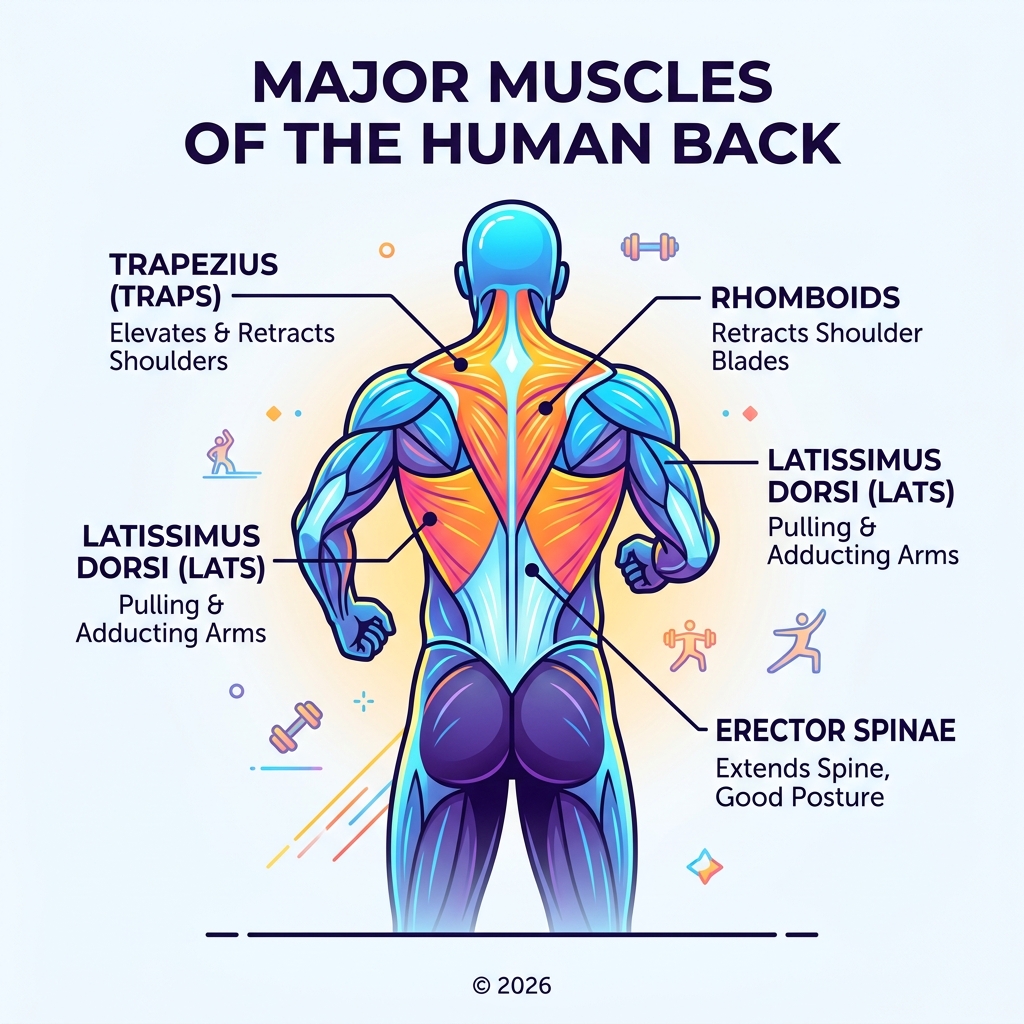
To train effectively, we need to understand what we are actually hitting. The back isn’t just one muscle; it’s a complex network of over 40 muscles working in harmony.
- Latissimus Dorsi (Lats): These are the large “wing” muscles. They give you that classic V-taper and are responsible for pulling your arms down and back.
- Trapezius (Traps): This diamond-shaped muscle covers your upper back and neck. It’s responsible for shrugging and moving your shoulder blades.
- Rhomboids: Located between your shoulder blades, these are crucial for “retraction”—pulling your shoulders back to fix that slouch.
- Erector Spinae: These muscles run along your spine. They keep you upright and are the stars of exercises like the Superman.
- Rear Deltoids: The back of your shoulders, which often get ignored but are vital for shoulder health.
Vertical vs. Horizontal Pulling
To get a complete back, we need to pull from different angles.
| Movement Type | Example Exercise | Primary Focus |
|---|---|---|
| Vertical Pull | Door Pull-up, Sliding Lat Pulldown | Lat width, V-taper |
| Horizontal Pull | Table Row, Bed Sheet Row | Mid-back thickness, Rhomboids |

Developing a strong mind-muscle connection is the “secret sauce” here. Because we can’t always add more weight, we must focus on scapular stability. This means learning to move your shoulder blades before your arms move. Imagine trying to squeeze a pencil between your shoulder blades on every rep!
Best No-Equipment Exercises for Back Strength
If you have a floor and a wall, you have a gym. These exercises are perfect for No-Equipment Home Exercises and are fundamental for Bodyweight Exercises for Home.
1. The Superman
This is the gold standard for lower back health. Lie face down, arms extended. Simultaneously lift your arms, chest, and legs off the floor. Hold for 2–5 seconds, squeezing your glutes and lower back. It’s deceptively difficult!
- Pro Tip: Don’t look up; keep your neck neutral by looking at the floor.
2. Reverse Snow Angel
Remember making snow angels as a kid? This is the “work” version. Lie face down, lift your chest slightly, and sweep your arms from your hips to over your head in a controlled arc. This is incredible for rhomboid activation and posture.
3. Bird Dog
Start on all fours. Extend your right arm forward and your left leg back. Hold, then switch. This is a staple in physical therapy because it strengthens the erector spinae without placing excessive strain on the spine.
4. Cat-Cow
Move through a range of spinal flexion and extension. It’s a great warm-up to improve mobility and “wake up” the nerves in your back.
5. Back Widow
Lie on your back with knees bent. Drive your elbows into the floor to lift your upper back and chest off the ground. This is one of the few ways to get a “rowing” motion with zero equipment.
6. Scapular Push-ups
Get into a plank position. Without bending your elbows, simply “sink” your chest by bringing your shoulder blades together, then push the floor away to spread them apart. This builds the stability needed for heavy lifting.
7. Wall Angels
Stand with your back against a wall. Press your arms, elbows, and wrists against the wall and slide them up and down. If you find this hard, your posture likely needs work! It’s an Easy Home Workout Without Equipment that pays massive dividends in shoulder mobility.
Effective Back Workout with Minimal Equipment Hacks
When we want to move beyond basic floor moves, we have to get creative. This is where we turn “minimal equipment” into “maximum results.”
The Bed Sheet Row (The DIY TRX)
This is a game-changer. Take two long bed sheets. Tie a large, secure knot at one end of each. Throw the knots over the top of a door that opens away from you. Close the door firmly. Now you have a suspension trainer!
- How to do it: Grab the sheets, lean back, and pull your chest toward the door. The more horizontal your body, the harder it gets.
Table Rows (Inverted Rows)
Find a sturdy dining table. Lie underneath it, grab the edge, and pull your chest up. It’s exactly like a barbell row but uses your own weight. If you’re a beginner, bend your knees to make it easier. For more of a challenge, check out our Dumbbells 101: Beginner-Friendly Home Strength Exercises for ways to add resistance.
Towel Rows and Sliding Lat Pulldowns
If you have a slick floor (wood or tile), grab a towel. Lie face down. Reach forward, press your hands into the towel, and “pull” your body forward across the floor. This mimics a lat pulldown perfectly. It requires immense core tension and lat engagement.
Mastering the Pull-Up and Row as a Back Workout with Minimal Equipment
Pulling is harder than pushing at home because gravity wants to pull us down, not up. To master these:
- Elbow Drive: Don’t think about pulling with your hands. Think about driving your elbows into your back pockets. This shifts the work from your biceps to your lats.
- Scapular Retraction: Always start the movement by pulling your shoulder blades down and back.
- Isometric Holds: Can’t do a full pull-up? Jump to the top and hold yourself there for as long as possible. This builds “sticking point” strength.
- Full Range of Motion: Go from a “dead hang” at the bottom to chest-to-bar at the top. Half-reps give half-results.
For more tips on refining these movements, our Beginner’s Upper Body Strength Workout is an excellent resource. You can also integrate Dumbbell Strength Exercises for Home Workouts if you have a pair of weights lying around.
How to Structure Your Home Routine for Maximum Gains
A workout is only as good as its structure. We don’t just want to “do movements”; we want to build muscle.
1. The Warm-Up
Never skip this. A proper warm-up can increase physical performance by up to 79%. Spend 5–10 minutes on dynamic movements like Cat-Cows, arm circles, and light jogging in place. Check out our Full Body Home Workout Plan for a comprehensive warm-up sequence.
2. Progressive Overload
Since we aren’t adding 45lb plates, we use other methods to make things harder:
- Leverage Changes: In a row, move your feet further under the table or door to increase the weight you’re pulling.
- Tempo Manipulation: Try the 3-0-1-0 tempo. Take 3 seconds to lower yourself, no pause at the bottom, 1 second to pull up, and no pause at the top. This increases “Time Under Tension.”
- Training to Failure: Scientific research suggests that for bodyweight exercises, training until you literally cannot do another rep with good form is key for hypertrophy (muscle growth).
3. Sets and Reps
For a back workout with minimal equipment, we recommend:
- Hypertrophy (Growth): 3–4 sets of 10–15 reps.
- Endurance/Posture: 2–3 sets of 15–20 reps.
- Rest Periods: Keep rest short (30–60 seconds) to keep the intensity high.
If you’re looking for a complete plan, our Full Body Weight Training Routine at Home provides a great template for balancing back work with the rest of your body.
Frequently Asked Questions about Back Training at Home
Can I build a big back without heavy weights?
Absolutely. Muscle growth is driven by mechanical tension and metabolic stress. Your muscles don’t know if you’re holding a $500 barbell or a $5 bed sheet; they only know how much tension they are under. By using leverage and training close to failure, you can stimulate significant growth. Beginners can find more details in our guide on Muscle Building Home Workouts for Beginners.
How often should I perform a back workout with minimal equipment?
We recommend training your back 2–3 times per week. Muscle protein synthesis typically lasts 24–48 hours, so hitting the back every other day allows for maximum growth and recovery. This frequency is ideal for Home Workout for Muscle Toning.
What are common mistakes to avoid during home back exercises?
- Arm Dominance: If you feel it only in your biceps, you aren’t using your back. Focus on the “elbow drive” cue.
- Rounded Spine: Especially in rows or Supermans, keep your spine neutral to avoid injury.
- Momentum: If you have to “swing” to get up, the exercise is too hard. Regress the movement until you can do it with control.
- Lack of Core Tension: Your back works best when your core is a solid “brace.” Squeeze your glutes and abs! For more upper body tips, see our At-Home Workout for Upper Body.
Conclusion
Building a strong, sculpted, and pain-free back doesn’t require a gym membership. It requires consistency, attention to form, and a little bit of creativity with your surroundings. By prioritizing movements like the Superman for stability and the Bed Sheet Row for strength, you are investing in a body that moves better and looks better.
The best workout is the one you actually do. Start with two sessions a week, focus on that mind-muscle squeeze, and don’t be afraid to train hard!
Ready to level up the rest of your physique? Explore our Category: Strength for more expert guides on building a better you from the comfort of your home. At Casa Jardim Web, we believe that fitness should be accessible to everyone, everywhere. Now, let’s get to work!
