
You Don’t Need a Gym to Train Your Whole Body
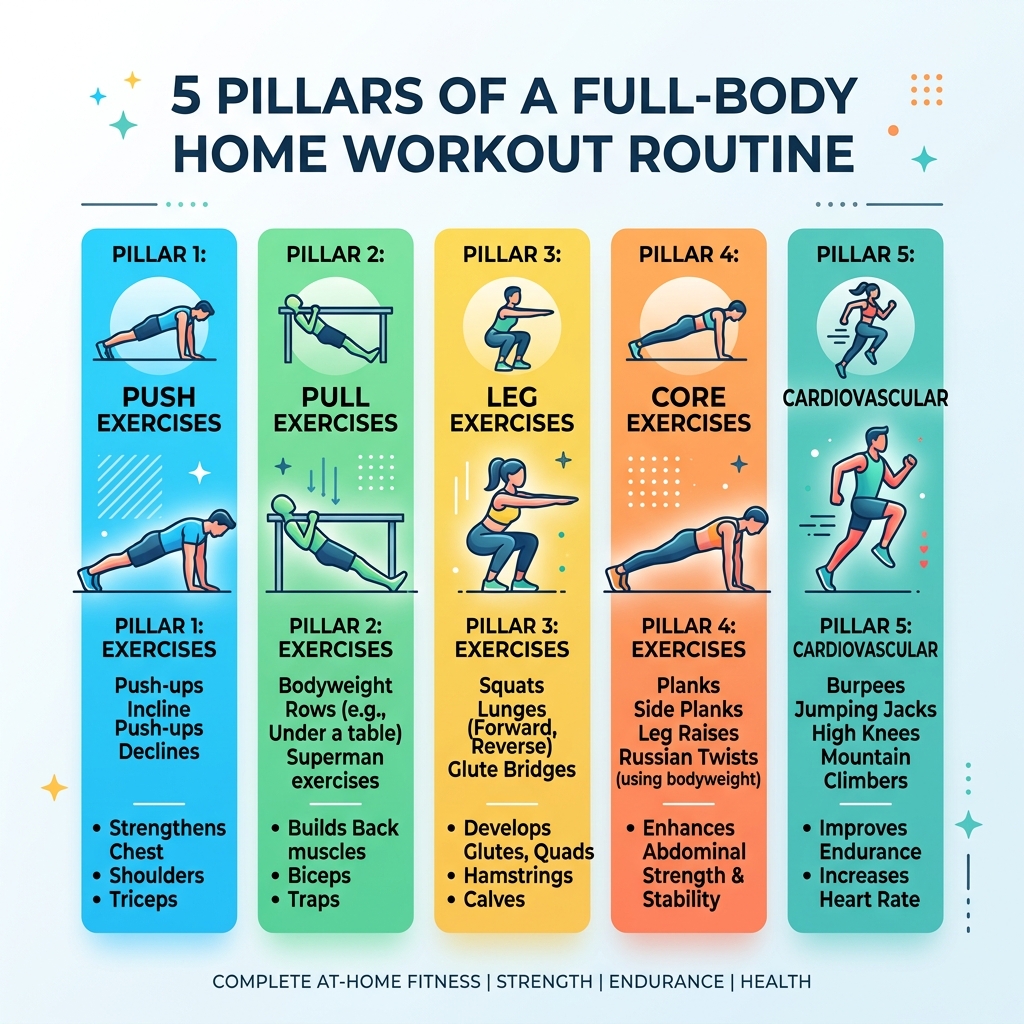
An entire body workout at home is exactly what it sounds like — a training session that works all your major muscle groups without stepping foot in a gym.
Here’s a quick snapshot of what an effective home full-body routine looks like:
| Element | What to Do |
|---|---|
| Exercises | Squats, push-ups, lunges, planks, burpees |
| Session length | 20–30 minutes |
| Frequency | 2–3 times per week |
| Equipment needed | None (optional: dumbbells) |
| Fitness levels | Beginner to advanced |
| Format | Circuit training with short rest periods |
No equipment. No commute. No excuses.
The truth is, you don’t need a gym membership or fancy gear to get strong. Research shows you can build real strength in as little as 20 minutes a day, five days a week — right in your living room. A complete full-body workout can even be built around as few as four exercises.
Whether you’re a total beginner or a seasoned athlete just working around a busy schedule, bodyweight training delivers results. It builds muscle, burns fat, and improves your fitness — all without leaving home.
This guide walks you through everything: the best exercises, how to structure your sessions, and how to keep making progress over time.
The Science and Benefits of an Entire Body Workout at Home
When we talk about an entire body workout at home, we aren’t just talking about “moving around” to break a sweat. There is real science behind why training every major muscle group in a single session is incredibly effective for fat loss and muscle building.
One of the primary drivers of these results is the use of compound exercises. Unlike isolation moves (like a bicep curl), compound movements involve multiple joints and muscle groups working in unison. Think of a squat: you aren’t just working your quads; you’re engaging your glutes, hamstrings, core, and even your lower back. This efficiency is why we can achieve a complete workout with as few as four to eight moves.

The Metabolic Boost and EPOC Effect
Full-body sessions are famous for the “afterburn effect,” technically known as Excess Post-exercise Oxygen Consumption (EPOC). Because you are recruiting so many muscles at once, your body requires more energy to recover after the workout is over. This means you continue burning calories at an elevated rate for hours after you’ve finished your last set. If you want a neutral overview of this recovery process, Wikipedia’s article on excess post-exercise oxygen consumption provides additional background.
Meeting National Guidelines
The Physical Activity Guidelines for Americans recommend at least 150 minutes of moderate-intensity exercise or 75 minutes of high-intensity exercise per week, plus muscle-strengthening activities at least twice a week. By performing a 30-minute entire body workout at home several times a week, you easily hit these targets.
Functional Strength and Balance
Training your whole body ensures “muscular balance.” In a gym, it’s easy to focus on “mirror muscles” (the ones you see in the mirror, like chest and biceps) while neglecting the back and legs. At home, our routines emphasize functional strength-the kind of strength that helps you carry heavy groceries, climb stairs without getting winded, or play with your kids without back pain. For a deeper dive into the mechanics of this, check out our Ultimate Guide To Full Body Weight Training At Home.
Structuring Your Session: Reps, Sets, and Rest
To see results, you need a plan. You can’t just do random push-ups whenever you feel like it and expect a transformation. We recommend a circuit training format. This involves performing a series of exercises back-to-back with minimal rest, which keeps your heart rate elevated and provides both strength and cardiovascular benefits.
A typical circuit can take anywhere from 11 to 54 minutes, depending on your fitness level and how many rounds you choose to complete.
How to Structure Your Circuit
Depending on where you are in your fitness journey, your work-to-rest ratio will change. Here is how we suggest organizing your entire body workout at home:
| Fitness Level | Work Interval | Rest Between Moves | Rest Between Rounds | Total Rounds |
|---|---|---|---|---|
| Beginner | 20 seconds | 30–60 seconds | 2 minutes | 1–2 |
| Intermediate | 30–40 seconds | 20 seconds | 90 seconds | 2–3 |
| Advanced | 50 seconds | 10 seconds | 60 seconds | 3–5 |
The Power of Progressive Overload
To keep getting stronger, you must practice progressive overload. This simply means making the workout harder over time. Since we aren’t necessarily adding heavy plates to a barbell, we do this by:
- Increasing the number of repetitions.
- Decreasing the rest time between exercises.
- Adding more rounds to the circuit.
- Moving to a more difficult version of the exercise (e.g., moving from knee push-ups to full push-ups).
If you’re short on time, a Quick Daily Workout At Home can still be effective if you maintain high intensity during those short work windows.
Essential Exercises and Progressions for Every Level
The beauty of an entire body workout at home is that every exercise can be scaled. Whether you are an absolute beginner or an elite athlete, there is a version of every move that will challenge you.
For a comprehensive list of moves, you can explore our guides on No Equipment Home Exercises and Bodyweight Exercises For Home.
Beginner-Friendly Foundations
If you’re just starting, focus on form over speed. It is much better to do five perfect repetitions than twenty sloppy ones.
- Chair Squats: Instead of dropping into a full squat, sit back onto a sturdy chair and stand back up. This teaches you to keep your weight in your heels and your chest up.
- Knee Push-ups: These build the chest and tricep strength needed for full push-ups without overtaxing your joints.
- Bird-Dog: Get on all fours and extend your opposite arm and leg. This is fantastic for core stability and balance.
- Wall Sits: Hold a squat position with your back against the wall for 30–60 seconds. It’s a great way to build leg endurance with zero impact.
For those just starting, our Beginner Friendly Home Workout Plan offers a step-by-step roadmap.
Advanced Progressions for an Entire Body Workout at Home
Once the basics feel easy, it’s time to ramp up the intensity. Advanced moves often incorporate “plyometrics” (jumping) or unilateral work (single-leg/arm) to increase the load.
- Burpees: The ultimate full-body torch-bearer. It combines a squat, a plank, a push-up, and a jump.
- Jumping Lunges: These develop explosive power in the legs and significantly raise your heart rate.
- Pike Push-ups: By piking your hips high in the air, you shift the weight to your shoulders, mimicking an overhead press.
- Hollow Holds: A core-shredding move where you lie on your back and lift your legs and shoulders off the ground, creating a “banana” shape.
- Single-Leg Bridges: Elevating one leg while performing a glute bridge significantly increases the demand on your hamstrings and glutes.
If you are ready to push your limits, try our Full Body Weight Training Routine At Home.
Incorporating Dumbbells or Household Items
While gear isn’t required, adding a little resistance can accelerate muscle growth. If you have dumbbells (or even heavy water bottles or a backpack filled with books), you can add these moves:
- Goblet Squats: Hold the weight at your chest while squatting to add a core and leg challenge.
- Overhead Press: Press weights toward the ceiling to build strong shoulders.
- Bent-Over Rows: Pull the weights toward your hips while hinged at the waist to target your back muscles.
Adding resistance is one of the fastest ways to see changes in definition. Learn more about this in our guide on Home Workout For Muscle Toning.
Frequently Asked Questions about Home Fitness
How often should I do an entire body workout at home?
We generally recommend performing a full-body routine 2 to 3 times per week. Because these workouts hit every major muscle group, your body needs time to repair the micro-tears in the muscle fibers. This recovery is actually when the “growth” happens!
Ideally, you should have at least one rest day between full-body sessions. On your off days, you can still stay active with light walking, yoga, or a Daily Home Exercise Schedule that focuses on mobility and stretching.
Can I build muscle without any gym equipment?
Absolutely. The key is Time Under Tension (TUT). If you find bodyweight squats too easy, try lowering yourself very slowly (taking 3–5 seconds) and then exploding upward. This forces the muscle to work harder for a longer duration.
Training “close to failure”—the point where you can’t perform another rep with good form—is also essential for muscle hypertrophy (growth). You can find more tips on this in our article on Easy Home Workout Without Equipment.
What are the best tips for staying motivated?
Motivation is a feeling, but consistency is a habit. Here are our favorite tricks:
- Habit Stacking: Do your workout immediately after a daily habit, like finishing your morning coffee or getting home from work.
- Track Your Progress: Keep a notebook. Seeing that you did 15 push-ups today when you could only do 10 last week is a massive motivator.
- Use an Interval Timer: Download a free app so you don’t have to watch the clock. It keeps you honest during those tough work intervals!
- Join a Challenge: Sometimes having a set end-date helps. Try our Jumpstart Your Fitness 30 Day Strength Training Challenge to build the foundation of a lasting habit.
Conclusion
Mastering an entire body workout at home is one of the most empowering things you can do for your health. It removes the barriers of cost, time, and “gym-timidation,” leaving you with a direct path to your fitness goals.
At Casa e Jardim Web, we believe that effective strength training should be accessible to everyone. Whether you are starting with chair squats or crushing burpees, the most important step is the one you take today. Consistency is the “secret sauce”—just 20 to 30 minutes a few times a week can lead to a stronger, more confident version of yourself.
Ready to get started? Check out our comprehensive Full Body Home Workout Plan and let’s get moving!
