
The Quickest Way to Stronger Glutes Starts Here
Booty band exercises are resistance-based movements that use a looped fabric or latex band around your legs to activate and strengthen your glutes, thighs, and hips — no gym required.
Here are the most effective booty band exercises to get started:
- Banded Squats — targets the gluteus maximus and quads
- Glute Bridges — isolates the gluteus maximus with constant band tension
- Clamshells — activates the gluteus medius and minimus
- Lateral Band Walks — fires up the hip abductors and side glutes
- Donkey Kicks — isolates the glutes through full hip extension
- Fire Hydrants — targets the gluteus medius for rounder, wider glutes
- Curtsy Lunges — works glutes from multiple angles for balanced strength
- Standing Kickbacks — hits the gluteus maximus with peak contraction
- Sumo Squats — emphasizes inner thighs and side glutes
- Frog Pumps — a low-impact warm-up move for deep glute activation
Booty bands look simple. But don’t let their size fool you.
These small loops create constant tension through every inch of a movement — both when your muscles shorten and when they lengthen. That’s something dumbbells and bodyweight exercises can’t always match.
Whether you’re a beginner working out in your living room or an athlete looking for a glute finisher after leg day, booty bands fit right in. They’re lightweight, portable, and surprisingly powerful for targeting all three glute muscles — the gluteus maximus, gluteus medius, and gluteus minimus.
Below, you’ll find everything you need to make them work for you.
What Are Booty Bands and Why Use Them?
At Casa e Jardim Web, we often get asked: “Can a simple piece of elastic really transform my workout?” The answer is a resounding yes. Booty bands—also known as mini bands or glute loops—work by providing external resistance that your muscles must fight against.
The magic lies in constant tension. Unlike free weights, where the resistance can vary depending on gravity and the angle of your limb, booty band exercises keep your muscles engaged during both the concentric phase (when the muscle shortens) and the eccentric phase (when it lengthens). This leads to greater metabolic stress and muscle fiber recruitment.
Scientific research supports this; a systematic review and meta-analysis of 10 studies found that training with elastic resistance produces muscular strength gains comparable to conventional resistance training with free weights. You can learn more about how these tools compare in our guide on resistance band exercises to boost strength.
Targeting the “Big Three” Glute Muscles
To get that rounded, strong look, we need to target all three parts of the gluteal group:
- Gluteus Maximus: The largest muscle in your body, responsible for hip extension (think standing up from a chair).
- Gluteus Medius: Sits on the outer hip; it’s crucial for stability and hip abduction (moving your leg away from your body).
- Gluteus Minimus: Located under the medius, it helps with hip stabilization and rotation.
Combatting Quad Dominance
Many of us suffer from “quad dominance,” where our thighs take over during squats and lunges because our glutes are “sleepy” from sitting all day. Booty bands force your knees outward, engaging the hip abductors and ensuring the glutes actually do the work. This not only improves your physique but also protects your lower back and knees from injury.
| Feature | Fabric Booty Bands | Latex/Rubber Mini Bands |
|---|---|---|
| Resistance Level | High (up to 150 lbs) | Low to Medium (10-40 lbs) |
| Comfort | Soft on skin, doesn’t pinch | Can pinch skin or pull hair |
| Durability | Long-lasting, won’t snap easily | Can snap or overstretch over time |
| Stability | Stays in place, doesn’t roll | Prone to rolling up the leg |
Choosing the Right Resistance for Your Booty Band Exercises
Choosing a band is a bit like choosing a pair of shoes—it has to fit your current “size” or fitness level. If the band is too light, you won’t stimulate muscle growth. If it’s too heavy, your form will break down, and you’ll end up using your lower back instead of your booty.
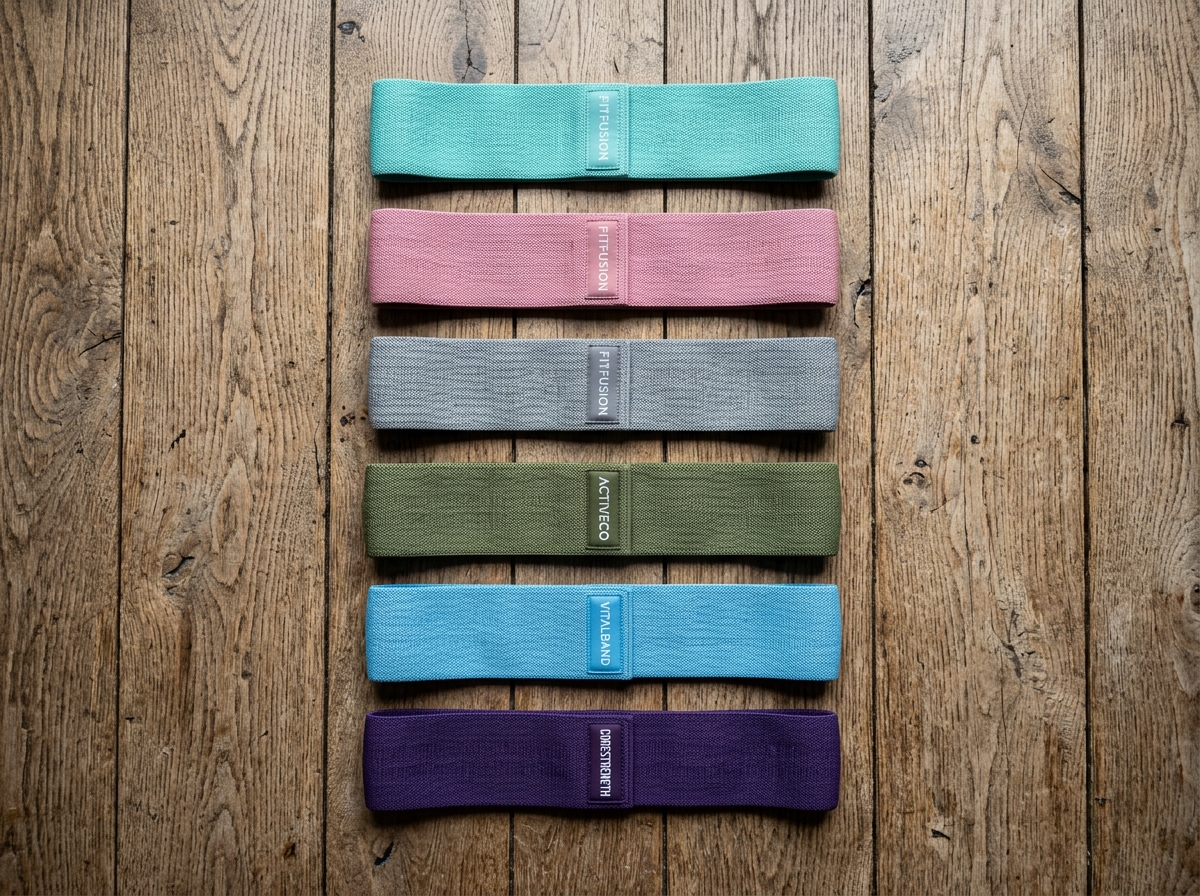
Fabric vs. Latex
We generally recommend fabric bands for most booty band exercises. Fabric bands provide significantly more resistance—often up to 150 lbs—which is necessary for powerful muscles like the glutes. They also feature a “no-slip” inner grip that prevents the band from rolling into a thin, painful cord mid-set.
The Principle of Progressive Overload
To see continuous results, we must apply progressive overload. This means as you get stronger, you need to increase the challenge. You can do this by:
- Moving to a thicker, heavier band.
- Increasing your repetitions (reps).
- Slowing down the movement to increase “time under tension.”
If you are just starting out, check out our at-home strength training for women for foundational tips. Once you’re ready to level up, explore more advanced resistance band exercises to boost strength.
Top 10 Booty Band Exercises for Sculpted Glutes
Ready to feel the burn? These are our favorite moves to incorporate into your home routine. For the best results, place the band about 2-6 inches above your knees.
1. Banded Squats
Stand with feet shoulder-width apart. As you squat down, actively press your knees outward against the band. This prevents the knees from caving in and ensures your glutes are firing throughout the movement. Keep your chest up and weight in your heels.
2. Clamshells
Lie on your side with knees bent at a 45-degree angle. Keeping your feet together, lift your top knee as high as possible without shifting your pelvis. This is the ultimate move for the gluteus medius—the muscle that gives the hips a “lifted” look.
3. Glute Bridges
Lie on your back with knees bent and feet flat. Drive through your heels to lift your hips toward the ceiling, squeezing your glutes hard at the top. The band adds extra resistance, forcing your abductors to stay engaged. For more variety, see our dumbbell strength exercises for home workouts.
4. Donkey Kicks
On all fours, keep one knee bent and kick your foot up toward the ceiling. The band should stay around your thighs. Focus on moving from the hip, not the lower back. Don’t arch your spine!
5. Fire Hydrants
Remaining on all fours, lift your knee out to the side (like a dog at a fire hydrant). This targets the outer glutes and improves hip mobility.
6. Lateral Band Walks
Get into a quarter-squat position and take small steps to the side. Keep constant tension on the band—never let your feet come all the way together. This “burnout” move is a favorite for finishing a session.
7. Sumo Squats
Take a wider stance than a normal squat with toes pointed slightly out. This variation puts more emphasis on the inner thighs and the lower portion of the gluteus maximus.
8. Curtsy Lunges
Step one foot back and across the other, as if performing a curtsy. The band adds lateral resistance that makes your stabilizing muscles work overtime. This is excellent for simple and effective strength training for women at home.
9. Standing Kickbacks
Stand tall and kick one leg straight back behind you. Keep the movement small and controlled. If you find your back arching, you’ve gone too far!
10. Frog Pumps
Lie on your back with the soles of your feet together and knees dropped open (like a butterfly stretch). Perform a glute bridge from this position. It looks a bit silly, but the glute activation is incredible.
Structuring Your Routine Around Booty Band Exercises
Knowing the moves is only half the battle; how you put them together determines your results.
The Reps and Sets
For muscle firming and endurance, we recommend:
- Beginners: 10-12 reps per side, 2-3 sets.
- Advanced: 15-20 reps per side, 3-4 sets.
- Frequency: 2-3 times per week with at least one rest day in between.
The 8-8-8 Rule
This is a fantastic glute isolation technique. Perform 8 full-range reps (e.g., Hip Thrusts), followed by 8 “pulse” reps at the top of the movement, and finish with an 8-second isometric hold. This maximizes muscle fatigue and “pumps” blood into the glutes for hypertrophy.
Warm-ups and Finishers
You don’t have to dedicate an entire hour to booty band exercises.
- As a Warm-up: Use light bands to “wake up” the glutes before a heavy lifting session or a run.
- As a Finisher: At the end of a workout, perform a circuit of lateral walks and fire hydrants until you reach “the burn.”
For a structured approach, check out our lower body weight training plan for beginners or our kickstart your fitness lower body weight training plan.
Frequently Asked Questions about Booty Band Exercises
Can booty band exercises help build muscle or just tone?
They absolutely build muscle! While people often use the word “toning,” what they usually mean is building muscle while losing fat. Booty bands create significant time under tension, which is a primary driver for hypertrophy (muscle growth). Because they allow for high-volume training with low joint impact, you can recruit deep muscle fibers that are often missed with heavy weights alone. Scientific research on muscle activation with elastic bands confirms their effectiveness in targeting the gluteal group.
How long does it take to see results from booty band exercises?
Consistency is key. Most people notice their glutes feeling firmer and “waking up” within 2-3 weeks of consistent 3x weekly training. Visible changes in shape and muscle definition typically appear within 4-6 weeks, with more significant transformation occurring at the 8-12 week mark.
Are fabric booty bands better than latex mini bands?
For glute-specific work, yes. Fabric bands are wider and made of a cotton-elastic blend that won’t snap or roll. They offer higher resistance (up to 150 lbs), which is necessary because your glutes are the strongest muscle group in your body. Latex bands are great for upper body work, but for the “booty,” fabric is king.
Conclusion
At Casa e Jardim Web, we believe that fitness should be accessible, effective, and—dare we say it—fun. Booty band exercises prove that you don’t need a room full of expensive machinery to build a strong, functional, and aesthetic lower body. By incorporating these moves into your routine, you’re not just working on your “rear”; you’re improving your hip stability, protecting your joints, and building functional strength that carries over into everyday life.
Whether you’re doing a “lazy girl” circuit in front of the TV or a brutal finisher after a gym session, these bands are your best friend. Ready to take the next step? Start your strength journey today and see what a little bit of resistance can do for you!
