
You Don’t Need a Gym to Build Muscle (Here’s the Proof)
At home workouts that build muscle are not just possible — they’re backed by science and used by athletes at every level.
Quick answer: Here are the most effective bodyweight exercises for building muscle at home:
| Goal | Best Exercises |
|---|---|
| Chest & triceps | Push-ups, diamond push-ups, tricep dips |
| Back & biceps | Inverted rows, bed sheet curls |
| Shoulders | Pike push-ups, handstand wall walks |
| Legs & glutes | Squats, lunges, glute bridges, pistol squats |
| Core | Planks, mountain climbers, reverse crunches |
How to make them work:
- Train at least 2-3 days per week
- Push each set close to failure
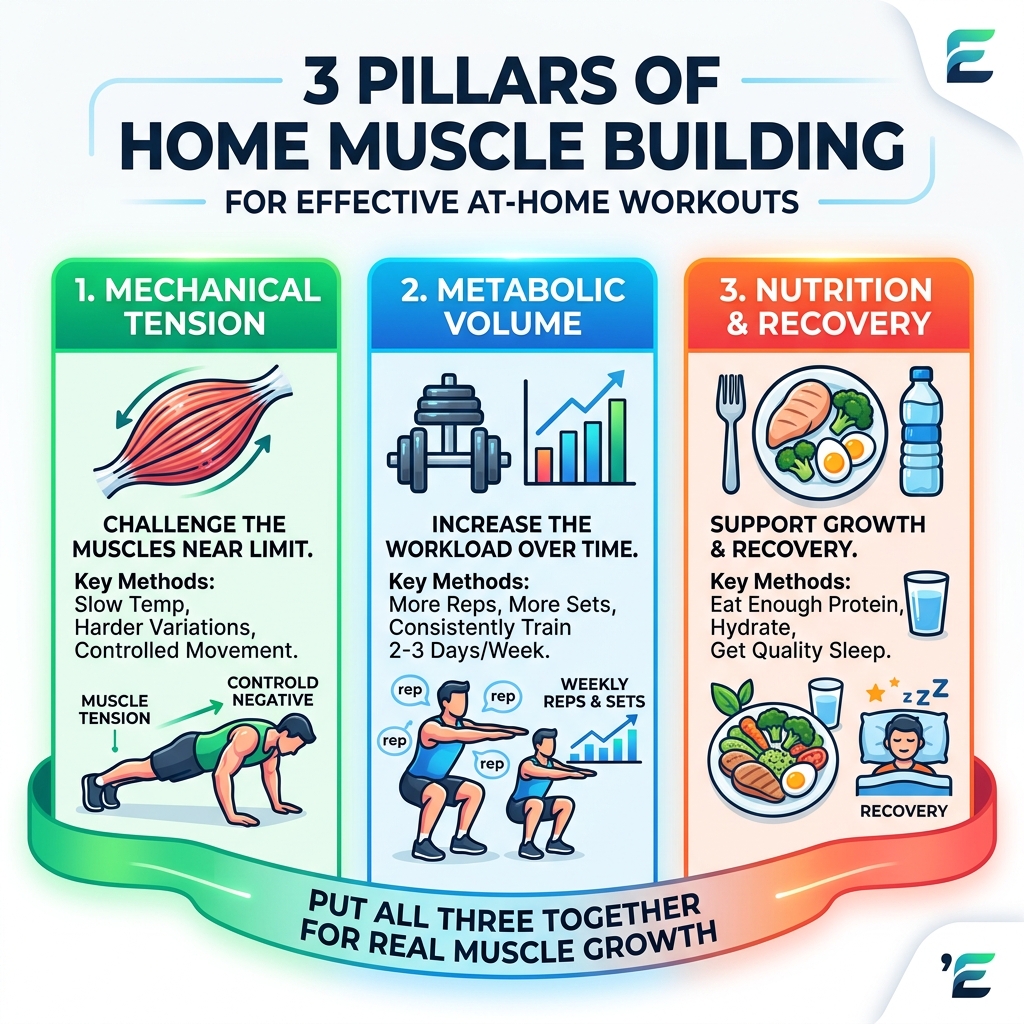
- Add progressive overload (more reps, harder variations, slower tempo)
- Eat enough protein to support recovery
Most people assume you need a barbell and a gym membership to get stronger. That assumption is wrong.
A 2016 study published in Physiology and Behavior found that muscle growth can occur independent of an external load — meaning your own bodyweight is a legitimate tool for building real muscle. Another study found that push-up training was comparably effective to bench press training for muscle and strength gains over 8 weeks.
The living room, the park, the bedroom floor — none of that matters. What matters is tension, volume, and consistency.
This guide will show you exactly how to put all three together.
The Science of At Home Workouts That Build Muscle
To understand how we grow muscle in the living room, we have to look at the biology of “getting swole.” Your muscles don’t have eyes; they don’t know if you are lifting a $2,000 Olympic barbell or pushing your own torso off the carpet. They only respond to mechanical tension, metabolic stress, and muscle damage.
When we perform at home workouts that build muscle, we are essentially creating a stimulus that tells the body: “The current muscle mass is insufficient for this task. Build more.” Research, such as the 2016 study in Physiology and Behavior, confirms that as long as you are challenging the muscle near its limit, it will adapt and grow.
| Gym Exercise | Bodyweight Equivalent | Primary Target |
|---|---|---|
| Bench Press | Push-ups / Diamond Push-ups | Chest & Triceps |
| Barbell Row | Inverted Row (using a table or bedsheet) | Back & Biceps |
| Overhead Press | Pike Push-ups / Handstand Wall Walk | Shoulders |
| Back Squat | Bulgarian Split Squat / Pistol Squat | Quads & Glutes |
| Leg Press | Step-ups / Wall Sits | Quads |
Furthermore, a study in the Journal of Exercise Science & Fitness showed that push-up training with a load similar to 40% of a person’s 1-rep max bench press was just as effective for hypertrophy and strength gain after 8 weeks. This proves that high-rep bodyweight training isn’t just “toning”—it’s building.
Can You Really Build Muscle Without a Gym?
The short answer is a resounding yes. The key lies in motor unit recruitment. To grow, you need to recruit as many muscle fibers as possible. In a gym, we do this with heavy weights. At home, we do this by taking our sets close to failure.
When you perform a set of push-ups and reach the point where you can only do one or two more reps with good form, your body has recruited nearly all available motor units. Science suggests that working with loads as low as 30-40% of your 1-rep max (1RM) can maximize growth, provided the effort is high.

The Role of Hypertrophy in At Home Workouts That Build Muscle
Hypertrophy is the increase in the size of muscle cells. For this to happen, we need a “trigger.” This trigger is usually a combination of volume (how much you do) and intensity (how hard it is).
In our at home workouts that build muscle, we often operate in the 5-30 rep range. While old-school bodybuilding logic said 8-12 reps was the “magic” number, modern research shows that anything from 5 to 30 reps builds muscle equally well, as long as you are pushing yourself. By increasing time under tension—slowing down the movement—we can make even simple exercises feel incredibly heavy, stimulating satellite cells to repair and grow the muscle tissue.
Essential Exercises for Every Muscle Group
To build a balanced, “jacked” physique, we need to target every major muscle group. We don’t need fancy machines; we can use our bodyweight, the floor, and a few household items.
Upper Body: Chest, Back, and Arms
Building a big chest and strong back at home requires creativity. For the chest, the Push-up is king. To make it harder, try Diamond Push-ups (hands close together), which increase activation in the triceps and inner chest.
For the back—the hardest area to train without equipment—we recommend Inverted Rows. You can do these by lying under a sturdy table and pulling your chest toward the underside. If you have a doorway, Bedsheet Curls (wrapping a sheet around a door handle) can target the biceps. For shoulders, Pike Push-ups (hips high in the air) mimic an overhead press.
If you’re looking for more variety, check out our strength training guides for detailed breakdowns of these movements.
- Chest: Standard Push-ups, Wide Push-ups, Floor Presses (using water bottles).
- Back: Inverted Rows, Sliding Lat Pulldowns (using a towel on a smooth floor).
- Arms: Tricep Dips (using a chair), Bicep Curls (using a heavy backpack).
Lower Body: Quads, Hamstrings, and Glutes
Your legs are your largest muscle group, so they need high volume. Air Squats are a great start, but to really build muscle, we need to move to unilateral (one-legged) exercises.
The Bulgarian Split Squat is arguably the best leg exercise you can do at home. Place one foot behind you on a couch or chair and squat with the other. It targets the quads and glutes with intense focus. For hamstrings, try Sliding Hamstring Curls using socks on a wooden floor or a towel on tile. Pistol Squats (single-leg squats) are the “final boss” of leg training, requiring immense strength and balance.
Core Stability and Abs
Ab training shouldn’t be complicated. We focus on “anti-extension” and “anti-rotation” to build a core that is both functional and aesthetic.
- Planks: The foundation. Keep your glutes squeezed and your core tight.
- Mountain Climbers: Great for adding a cardiovascular element while hitting the lower abs.
- Reverse Crunches: Target the lower abdominal region more effectively than standard sit-ups.
- V-Sits: Hold the position to build isometric strength that translates to better posture.
Mastering Progressive Overload Without Heavy Weights
The biggest mistake people make with at home workouts that build muscle is doing the same 20 push-ups every day for a year. Muscle only grows if the challenge increases over time. This is called progressive overload.
In a gym, you just add 5 lbs to the bar. At home, we have to be more clever. We can increase the number of reps, decrease the rest time between sets, or increase the “training density” (doing more work in the same amount of time).
Increasing Intensity Through Tempo and Variations
One of our favorite ways to increase intensity is by manipulating tempo. Instead of rushing through reps, try the 2-second rule: take 2 seconds to lower yourself (the eccentric phase) and 2 seconds to push up.
- Negative Reps: Focus entirely on the lowering phase. For example, take 5-10 seconds to lower yourself into a push-up.
- Isometric Pauses: Hold the “bottom” of a squat or push-up for 3 seconds to eliminate momentum.
- Explosive Concentrics: Push up as fast as possible to engage fast-twitch muscle fibers.
Strategic Programming for At Home Workouts That Build Muscle
To keep building muscle, you need a plan. We recommend a Full Body Split for beginners (3 days a week) or an Upper/Lower Split for intermediates (4 days a week).
- Supersets: Perform two exercises back-to-back with no rest (e.g., Push-ups followed immediately by Squats).
- Agonist-Antagonist Sets: Pair opposing muscles (e.g., a chest exercise followed by a back exercise). This saves time and allows one muscle to rest while the other works.
- AMRAP: “As Many Reps As Possible.” On your final set, go until you literally cannot do another rep with good form.
- EMOM: “Every Minute on the Minute.” Do a set number of reps at the start of every minute for 10-20 minutes. This builds incredible work capacity.
Nutrition and Recovery: The Unsung Heroes of Growth
You don’t build muscle during your workout; you build it while you sleep. At home workouts that build muscle only work if you provide your body with the raw materials it needs to repair the tissue you’ve challenged.
Fueling Your Home Workouts
To grow, you generally need to be in a caloric surplus—eating more than you burn. However, beginners can often build muscle and lose fat at the same time (the “recomposition” phase).
We recommend a modest 250-calorie surplus above your maintenance level. This is roughly the equivalent of a large Greek yogurt with some fruit or a handful of nuts.
The Protein Factor: Aim for roughly 0.8g to 1g of protein per pound of body weight. Protein provides the amino acids (like leucine) that trigger muscle protein synthesis.
- Complex Carbs: Eat oats, brown rice, or potatoes before your workout for sustained energy.
- Hydration: Even a 2% drop in hydration can significantly decrease your strength. Drink water throughout the day!
The Importance of Rest Days
We suggest following the 48-hour rule: avoid training the same muscle group two days in a row. If you hit your chest hard on Monday, wait until Wednesday to do it again. This gives your central nervous system and muscle fibers time to recover.
Don’t just sit on the couch, though. Active recovery—like a 20-minute walk or light stretching—can improve blood flow and speed up the removal of metabolic waste products from your muscles.
Frequently Asked Questions about Home Muscle Building
How long does it take to see results from home workouts?
Most people will start to feel stronger within 2 weeks as their nervous system gets better at “firing” the muscles. Visible muscle growth (hypertrophy) usually takes 4 to 8 weeks of consistent training and proper nutrition. “Newbie gains” are real—beginners often see the fastest results!
Can I build muscle with just 20 minutes a day?
Yes, provided the intensity is high. A 20-minute CrossFit-style AMRAP (like 5 pull-ups, 10 push-ups, and 15 squats repeated for 20 minutes) has been shown to provide a greater training stimulus than running on a treadmill at 85% max heart rate. Focus on density: do more work in those 20 minutes every week.
Do I need to buy dumbbells to keep seeing gains?
Eventually, you might hit a plateau with pure bodyweight. However, you can go a long way by using external loads like a backpack filled with books or water bottles. If you decide to invest, a single pair of adjustable dumbbells or a set of resistance bands can provide enough variety to keep you growing for years.
Conclusion
At Casa e Jardim Web, we believe that fitness should be accessible to everyone, regardless of whether they have a gym pass or a garage full of iron. At home workouts that build muscle are a powerful, science-backed way to transform your physique and improve your long-term health.
The secret isn’t a “magic” exercise; it’s the willingness to push yourself, stay consistent, and respect the recovery process. Whether you are a beginner taking your first steps or an advanced athlete looking to maintain your gains while traveling, the living room is a perfectly capable “temple of iron.”
Ready to take the next step? Start your strength training journey today by exploring our detailed exercise libraries and workout plans. Your future, stronger self will thank you.
