
Why Upper Body Exercises for Beginners Are Worth Starting Today
Upper body exercises for beginners are the foundation of building a stronger back, better posture, and real-world strength — whether you have gym access or not.
Here are the best starting points:
- Modified push-ups – chest, shoulders, triceps
- Dumbbell rows – back, biceps, core
- Overhead press – shoulders, triceps
- Bicep curls – biceps, forearms
- Tricep dips – triceps, shoulders
- Lateral raises – deltoids, upper back
- Superman extensions – lower back, glutes, rear deltoids
Most beginners can get results training just 2 to 3 times per week, with sessions as short as 20 to 30 minutes.
No gym required. No complicated equipment. Just consistent effort and good form.
Here’s the thing most people miss: your upper body does a lot of heavy lifting in everyday life — carrying groceries, lifting kids, reaching overhead. Building strength there doesn’t just make you look better. It protects your spine, improves your posture, and makes daily tasks genuinely easier.
The good news? You don’t need dozens of exercises. A handful of well-chosen movements, done consistently, is enough to build a solid foundation.
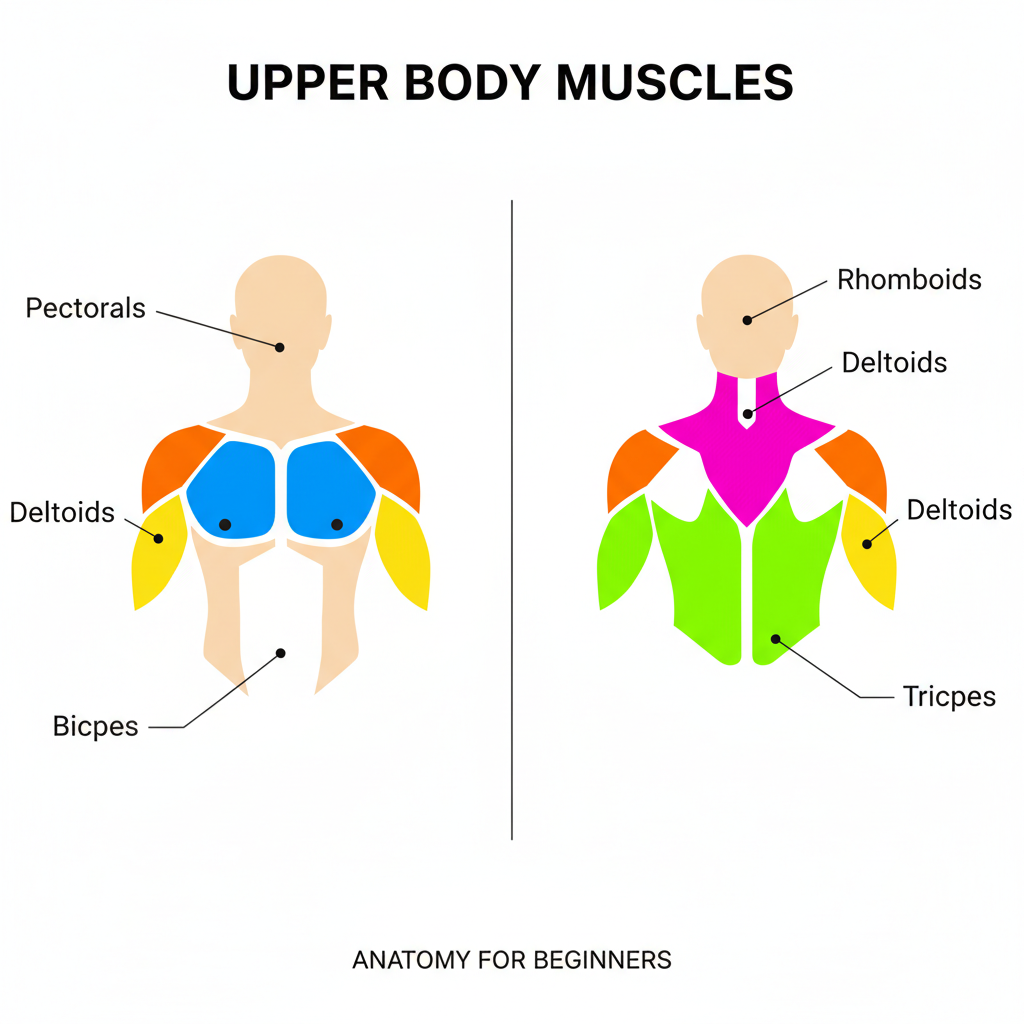
Benefits of Upper Body Strength Training for Beginners
When we talk about upper body exercises for beginners, many people immediately think of big biceps or bench pressing heavy weights. While those are fine goals, the benefits of strength training go much deeper than what you see in the mirror.
One of the most immediate changes we notice is an improvement in posture. Many of us spend our days hunched over laptops or smartphones, which leads to tight chest muscles and weak, overstretched back muscles. By strengthening the “pulling” muscles in our back, we naturally pull our shoulders back and down, keeping our spine in a safer, more neutral alignment.
Beyond aesthetics, there is a strong scientific research on strength training and quality of life. Research shows a positive correlation between physical strength and independence, especially as we age. Stronger muscles act as a protective shield for our joints and spine, significantly reducing the risk of injury during daily activities.
For those of us looking to manage weight, building lean muscle provides a metabolic boost. Muscle tissue is more metabolically active than fat, meaning your body burns more calories even while you are resting. Additionally, resistance training is a proven way to increase bone density, which is a vital defense against conditions like osteoporosis.
If you are looking for a place to start your journey, check out our guide on beginners-upper-body-strength-workout/ to see how these benefits come together in a simple routine.

Essential Upper Body Exercises for Beginners
Starting a new routine can feel overwhelming, but we like to keep things simple. The most effective upper body exercises for beginners are often “compound movements.” These are exercises that work multiple muscle groups at the same time. For example, a push-up doesn’t just work your chest; it engages your shoulders, triceps, and even your core.
To build a balanced physique and avoid injury, we need to focus on a “push-pull” balance. This means for every exercise where you push something away (like a push-up), you should include an exercise where you pull something toward you (like a row). This balance ensures that your front and back develop at the same rate.
You don’t need a gym full of machines to get started. In fact, bodyweight exercises are often the best way to learn the ropes. However, adding a pair of dumbbells can help you progress faster.
| Exercise Type | Bodyweight Option | Dumbbell Alternative | Primary Muscles |
|---|---|---|---|
| Push | Incline Push-Up | Dumbbell Chest Press | Chest, Triceps, Shoulders |
| Pull | Superman Extensions | Dumbbell Row | Back, Biceps, Rear Delts |
| Shoulders | Pike Push-Up | Overhead Press | Deltoids, Triceps |
| Arms | Plank Raise | Bicep Curl / Tricep Kickback | Biceps, Triceps |
For more details on choosing the right tools for your home setup, read our article on dumbbells-101-beginner-friendly-home-strength-exercises/.
Mastering Form for Upper Body Exercises for Beginners
Before you pick up a heavy weight, we must emphasize that form is everything. Sloppy form is the fastest way to get an injury and the slowest way to see results. Here are our golden rules for beginner form:
- Neutral Spine: Keep your head, neck, and back in a straight line. Avoid looking up at the ceiling or down at your feet during movements like rows or push-ups.
- Core Engagement: Imagine someone is about to poke you in the stomach; that “bracing” feeling is core engagement. It protects your lower back from arching.
- Controlled Tempo: Don’t use momentum. If you are swinging the weights, they are too heavy. Aim for a “2-1-2” tempo: two seconds to lift, a one-second pause at the top, and two seconds to lower.
- Shoulder Blade Retraction: For back exercises, think about squeezing an orange between your shoulder blades. This ensures you are using your back muscles rather than just your arms.
Top 7 Movements for a Stronger Back and Chest
Now, let’s dive into the specific upper body exercises for beginners that we recommend for every starter routine. These moves cover all the major muscle groups and can be modified for any fitness level.
- Modified Push-ups: If a standard push-up is too difficult, start with your knees on the mat. Keep a straight line from your head to your knees. This builds the foundational strength needed for chest and shoulder stability.
- Dumbbell Rows: Hinge at your hips with a flat back and pull the weight toward your hip. This is the king of back exercises, targeting the lats and rhomboids.
- Overhead Press: Stand tall and press dumbbells from shoulder height toward the ceiling. This builds strong, stable shoulders.
- Bicep Curls: Keep your elbows glued to your sides as you curl the weights. This isolates the front of the arm.
- Tricep Dips: Using a sturdy chair or bench, lower your hips toward the floor by bending your elbows. This targets the “back of the arm” muscles.
- Lateral Raises: Lift dumbbells out to your sides until they reach shoulder height. This creates that “capped” shoulder look and improves upper back stability.
- Superman Extensions: Lie on your stomach and lift your arms and legs off the floor simultaneously. This is essential for strengthening the lower back and improving posture.
For a deeper look at how to perform these with weights, visit dumbbell-strength-exercises-for-home-workouts/.
How to Structure Your Beginner Upper Body Workout
We often get asked: “How much is enough?” For a beginner, the sweet spot is training the upper body two to three times per week on non-consecutive days.
Research on muscle protein synthesis shows that the muscle-building process tends to drop off about 36 to 48 hours after a workout. By training every two or three days, we keep that process “turned on” without overtraining. A session lasting 20 to 30 minutes is plenty of time to hit all the major groups if you stay focused.
A simple structure we recommend is:
- Warm-up: 8-12 minutes
- Circuit: 3 rounds of 10-12 repetitions for each of the Top 7 movements
- Rest: 60-90 seconds between sets
- Cool-down: 5 minutes of stretching
If you’re training at home, you can find a full routine structure at at-home-workout-for-upper-body/.
Warm-up and Cool-down Essentials
Never skip the warm-up! It takes an average of 8 to 12 minutes to fully prepare your joints and muscles for the stress of lifting. A good warm-up increases blood flow and improves your range of motion, which helps you perform exercises with better form.
Our Favorite Warm-up Moves:
- Arm Circles: 30 seconds forward, 30 seconds backward.
- Cat-Cow Stretch: Transitions between arching and rounding your back to wake up the spine.
- Windmills: Standing with feet wide, reach your hand toward the opposite foot to engage the core and shoulders.
After your workout, spend a few minutes on “static” stretches. This is where you hold a position for 20-30 seconds. This helps lower your heart rate and begins the recovery process. Focus on stretching your chest (the doorway stretch) and your back (the child’s pose).
Common Mistakes and How to Progress
Even with the best intentions, beginners often fall into a few common traps. The biggest one? Ego lifting. This is when we try to lift weights that are too heavy, causing our form to break down. If you find yourself arching your back or “shrugging” your shoulders up to your ears during a lift, it’s time to lower the weight.
Another mistake is skipping recovery. Muscles don’t grow while you’re lifting; they grow while you’re resting. Ensure you are getting enough sleep and eating enough protein. A general guideline is aiming for roughly 1 gram of protein per pound of body weight to support muscle repair.
You can learn more about avoiding these pitfalls in our guide to building-upper-body-strength-easy-home-workouts/.
Progressing Your Upper Body Exercises for Beginners
Once the initial “newbie gains” slow down, you’ll need to use progressive overload to keep seeing results. This doesn’t always mean lifting heavier weights. You can progress by:
- Increasing Repetitions: If you were doing 10 reps, try to reach 12 or 15 with the same weight.
- Slowing the Eccentric Phase: Spend 3-4 seconds lowering the weight. This increases “time under tension,” which is a powerful driver for muscle growth.
- Adding Resistance: Once you can comfortably do 15 reps with perfect form, it’s time to grab a slightly heavier dumbbell or a tighter resistance band.
- Tracking Progress: Use a notebook or an app to log your sets and reps. Seeing your numbers go up over time is the best motivation!
Frequently Asked Questions about Upper Body Training
Can I build upper body strength at home without weights?
Absolutely! Bodyweight upper body exercises for beginners are incredibly effective. You can make push-ups harder by slowing down the movement or placing your feet on a chair (decline push-ups). Movements like “Inchworms” and “Plank Raises” are fantastic for building shoulder and core stability without a single piece of equipment. You can also use household items like water bottles or heavy books as makeshift weights.
How often should beginners train their upper body?
We recommend training the upper body twice weekly as a starting point. This allows for the optimal 48-hour recovery window between sessions. As you get stronger and your body adapts, you might move to three times a week, but consistency is far more important than intensity in the first few months.
What muscles does a typical upper body workout target?
A well-rounded routine targets:
- Pectorals (Chest): For pushing movements.
- Latissimus Dorsi & Rhomboids (Back): For pulling and posture.
- Deltoids (Shoulders): For overhead reaching and stability.
- Biceps & Triceps (Arms): For lifting and extending.
- Trapezius (Upper Back/Neck): For shoulder health.
- Core Stabilizers: Which work during almost every movement to keep you upright.
Conclusion
At Casa e Jardim Web, we believe that fitness should be accessible to everyone, regardless of whether they have a gym membership. Starting your journey with upper body exercises for beginners is one of the best investments you can make in your long-term health. By focusing on a stronger back and balanced muscle development, you’re not just building a better physique — you’re building a body that is resilient, capable, and ready for whatever daily life throws at it.
The goal isn’t to be perfect on day one. The goal is to show up, move with intention, and listen to your body. Whether you’re doing modified push-ups in your living room or rows with a pair of water bottles, every rep counts toward a stronger you.
Ready to take the next step? Start your strength training journey today and explore our full range of guides designed to help you succeed at home!
