
You Don’t Need a Gym — Or Much Time — to Build a Stronger Upper Body
A quick upper body home workout can build real strength in as little as 10-20 minutes, no gym required. Here’s what works:
- Push-ups (standard, diamond, pike) — chest, shoulders, triceps
- Tricep dips — using a chair or couch
- Plank variations — core plus shoulder stability
- Bent-over rows — with dumbbells or household items
- Overhead press — dumbbells or resistance bands
Best approach for beginners: 2-3 sets of 8-12 reps per exercise, 2-3 times per week, with at least one rest day between sessions.
Let’s be honest. Most of us put off working out because it feels like a huge time commitment.
But here’s the thing: it doesn’t have to be.
Research shows the average person has roughly 20 minutes of free time available for exercise on a given day. That’s actually enough. Studies confirm that sets of 6-12 reps across 3-6 rounds are optimal for building muscle — and you can hit all of that in under 20 minutes, right in your living room.
You don’t need a rack of weights. You don’t need a membership. You just need a plan and a small patch of floor.
This guide gives you exactly that.
Why a Quick Upper Body Home Workout Actually Works
We often fall into the trap of thinking that if we aren’t spending ninety minutes grunting under a barbell, it doesn’t count. Science says otherwise. A quick upper body home workout is surprisingly effective at triggering muscle hypertrophy and improving functional health.
When we perform resistance training, even in short bursts, we spark a metabolism boost that lasts long after the shower. This “afterburn” effect means our bodies continue to torch calories as they repair muscle tissue. Beyond the scale, these routines are essential for posture correction. In an age where most of us spend hours hunched over laptops or phones, strengthening the “pulling” muscles of the back and the stabilizing muscles of the shoulders acts as a natural antidote to the “tech-neck” slump.
Scientific research highlights that short-duration resistance training—specifically sessions lasting around 20 minutes—can significantly improve bone density and cardiovascular health. For those looking for maximum efficiency, some high-intensity movements can engage up to 86% of your muscles in a single session. By focusing on compound movements that hit the chest, back, and shoulders simultaneously, we achieve massive building-upper-body-strength-easy-home-workouts without the need for a commute to the gym.
Furthermore, these workouts are the ultimate tool for injury prevention. By strengthening the rotator cuffs and the supporting muscles around the spine, we make daily tasks—like lifting a heavy suitcase into an overhead bin or carrying a week’s worth of groceries—much safer. Consistency is the secret sauce here; a 20-minute daily habit is infinitely more effective than a three-hour gym session once a month.
Essential Gear for Your Quick Upper Body Home Workout
One of the best things about training at home is the minimalist setup. You don’t need a dedicated room or expensive machines to see results. Depending on your goals and space, you can choose between three main paths: bodyweight, dumbbells, or resistance bands.
Equipment Comparison Table
| Feature | Bodyweight | Dumbbells | Resistance Bands |
|---|---|---|---|
| Cost | Free | Moderate | Low |
| Space Required | Zero | Small corner | A drawer |
| Progression | Change angles/tempo | Increase weight | Heavier tension |
| Best For | Beginners & Endurance | Pure Strength/Mass | Toning & Mobility |
If you are just starting out, your own body provides plenty of resistance. However, as you get stronger, adding dumbbells-101-beginner-friendly-home-strength-exercises can help you target smaller muscle groups like the biceps and lateral deltoids more effectively. For those in small apartments, adjustable weights are a lifesaver, replacing an entire rack of iron with just two handles.
Don’t overlook the power of resistance-band-exercises-to-boost-strength. Bands provide “variable resistance,” meaning the exercise gets harder as the band stretches, which is fantastic for muscle activation. If you have absolutely no gear, household items like gallon water jugs, heavy textbooks, or a sturdy backpack filled with cans can serve as improvised weights.
Top 5 Bodyweight Exercises for No-Equipment Strength
No gear? No problem. You can build a world-class physique using nothing but gravity. Here are the heavy hitters we recommend for any quick upper body home workout.
1. Push-Up Variations
The push-up is the king of home exercises. It targets the chest, front shoulders, and triceps while demanding core stability.
- Standard: Hands slightly wider than shoulders.
- Diamond: Bring hands together so fingers form a diamond shape to torch the triceps.
- Pike: Elevate your hips into a “V” shape to shift the focus to your shoulders.
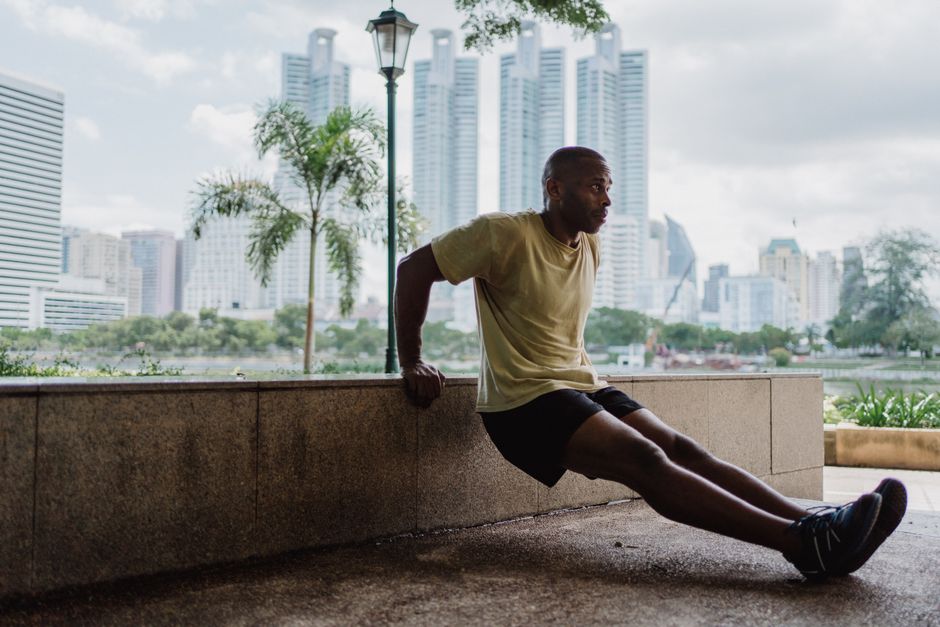
2. Tricep Dips
Find a sturdy chair or the edge of your couch. Grip the front edge, lift your body, and lower yourself until your elbows are at 90 degrees. This is one of the most effective ways to build the back of the arms. For more variety, check out our at-home-workout-for-upper-body guide.
3. Plank Raises and Shoulder Taps
Starting in a forearm plank and pushing up to a high plank (one hand at a time) builds incredible stability. If that’s too much, try shoulder taps: stay in a high plank and alternate touching your opposite shoulder without letting your hips rock.
4. Inchworms
Start standing, hinge at the hips to touch the floor, and walk your hands out into a plank. Hold for a second, then walk them back. This is a fantastic dynamic move that warms up the shoulders while building functional strength. It’s a staple in any beginners-upper-body-strength-workout.
5. Hindu Push-Ups and Back Extensions
Hindu push-ups involve a sweeping, circular motion that improves shoulder mobility and strength simultaneously. To balance out all the “pushing,” don’t forget back extensions. Lie on your stomach and lift your chest off the floor to engage the lower and mid-back—essential for counteracting a day spent sitting.
How to Structure and Progress Your 15-Minute Routine
To get the most out of a short window, you need a structure that maximizes “time under tension.” We recommend a frequency of 2-3 times per week to allow for adequate muscle recovery.
The 15-Minute Blueprint
- Warm-up (2 Minutes): Arm circles, shoulder rolls, and cross-body pulls to get the blood flowing.
- The Circuit (10-12 Minutes): Choose 4-5 exercises. Perform each for 45 seconds, followed by 15 seconds of rest. Repeat the circuit 2-3 times.
- Cool-down (1-2 Minutes): Static stretches for the chest and triceps, accompanied by deep breathing to activate the parasympathetic nervous system for recovery.
The Secret of Progressive Overload
If you do the same 10 push-ups every day for a year, you’ll eventually stop seeing results. To keep gaining, you must use progressive overload. This can mean:
- Increasing Reps: Going from 8 to 12 reps.
- Slowing the Tempo: Taking 3 seconds to lower yourself in a push-up.
- Reducing Rest: Shortening your break from 30 seconds to 15.
- Rep-Drop Format: A “12-10-8-6” format where you lift heavier as the reps decrease.
For busy people, the 15-minute-home-workout-for-busy-people is a perfect starting point. The goal is to hit a “moderate” volume—usually 3-6 sets per muscle group—to ensure growth without burnout. If you’re consistent, even a quick-daily-workout-at-home can lead to massive changes over time.
Frequently Asked Questions about Quick Upper Body Home Workouts
Can a quick upper body home workout build real muscle?
Absolutely. Muscle hypertrophy (growth) is triggered by mechanical tension and metabolic stress. You don’t need a gym for that; you just need to challenge your muscles. By staying in the 6-12 rep range and performing 3-6 sets, you create micro-tears in the muscle fibers. When these fibers repair, they grow back thicker and stronger. An 18-minute session can burn anywhere from 80 to 224 calories while building the foundation for a more muscular frame. For those just starting, we have a great strength-exercises-for-men-a-beginners-guide that explains these concepts in more detail.
How do I modify exercises for my fitness level?
Every exercise has a “regression” (easier version) and a “progression” (harder version).
- For Beginners: If standard push-ups are too hard, use an elevated surface like a kitchen counter or drop to your knees. This reduces the percentage of body weight you have to lift.
- For Advanced Athletes: If bodyweight feels easy, wear a weighted vest or a backpack. You can also change the angle (like putting your feet on a chair for decline push-ups) to increase the difficulty. Our beginners-guide-strength-exercises-for-men covers many of these scaling options.
What are common mistakes to avoid in a quick upper body home workout?
The biggest mistake is ego lifting—trying a variation that is too hard and sacrificing form.
- Form Priority: Always keep a straight line from your head to your heels during planks and push-ups.
- Elbow Flaring: In push-ups and overhead presses, keep your elbows tucked at a 45-degree angle rather than letting them flare out to the sides, which can pinch the shoulder joint.
- Core Engagement: Every upper body move is also a core move. Squeeze your glutes and abs to protect your lower back.
- Overtraining: Don’t skip rest days. Muscle grows while you sleep, not while you’re working out. For more tips on avoiding injury, see our guide on dumbbell-strength-exercises-for-home-workouts.
Conclusion
Building a powerful upper body doesn’t require a lifestyle overhaul. It requires twenty minutes and a bit of discipline. At Casa e Jardim Web, we believe that effective strength training should be accessible to everyone, whether you’re a total beginner or a seasoned athlete looking for a time-efficient burn.
By focusing on compound movements, mastering your form, and gradually increasing the challenge, you can turn your living room into a high-performance training ground. Start today—even if it’s just one set of push-ups during a commercial break. Those small wins add up to long-term health and a physique you can be proud of.
Ready to take your training to the next level? Check out More expert strength training guides for more tips on building the body you want from the comfort of your home.
