
Can You Build Bigger Arms Without Equipment?
Bicep curls without weights are entirely possible – and more effective than most people think. Here are the best ways to do them at home:
Quick Answer: Best Bicep Curls Without Weights
- Door frame curls – grip a door frame, lean back, and pull your body up
- Towel curls – loop a towel under your foot or thigh and curl against the resistance
- Chin-ups – underhand grip targets biceps directly
- Inverted rows – use a table edge with an underhand grip
- Self-resisted curls – use one arm to resist the other
- Isometric wall curls – press fists into a wall and squeeze hard for 30 seconds
- Side-lying bodyweight curls – use your leg as resistance while lying on your side
No gym membership. No dumbbells. No problem.
Most people assume you need weights to build strong, defined arms. But your biceps don’t actually care what’s creating the resistance – they just respond to tension, effort, and progressive challenge.
The real key? How you train matters more than what equipment you use.
Research backs this up. The eccentric phase of a curl – the slow lowering portion – produces the greatest gains in strength and muscle size. And you can apply that principle with nothing but your own body, a towel, or a door frame.
You can expect strength gains in as little as 2-3 weeks, with visible definition starting to show around 4-6 weeks when combined with consistent training and good nutrition.
Whether you’re stuck at home, traveling, or just skipping the gym, this guide will show you exactly how to build and maintain strong biceps without a single piece of equipment.
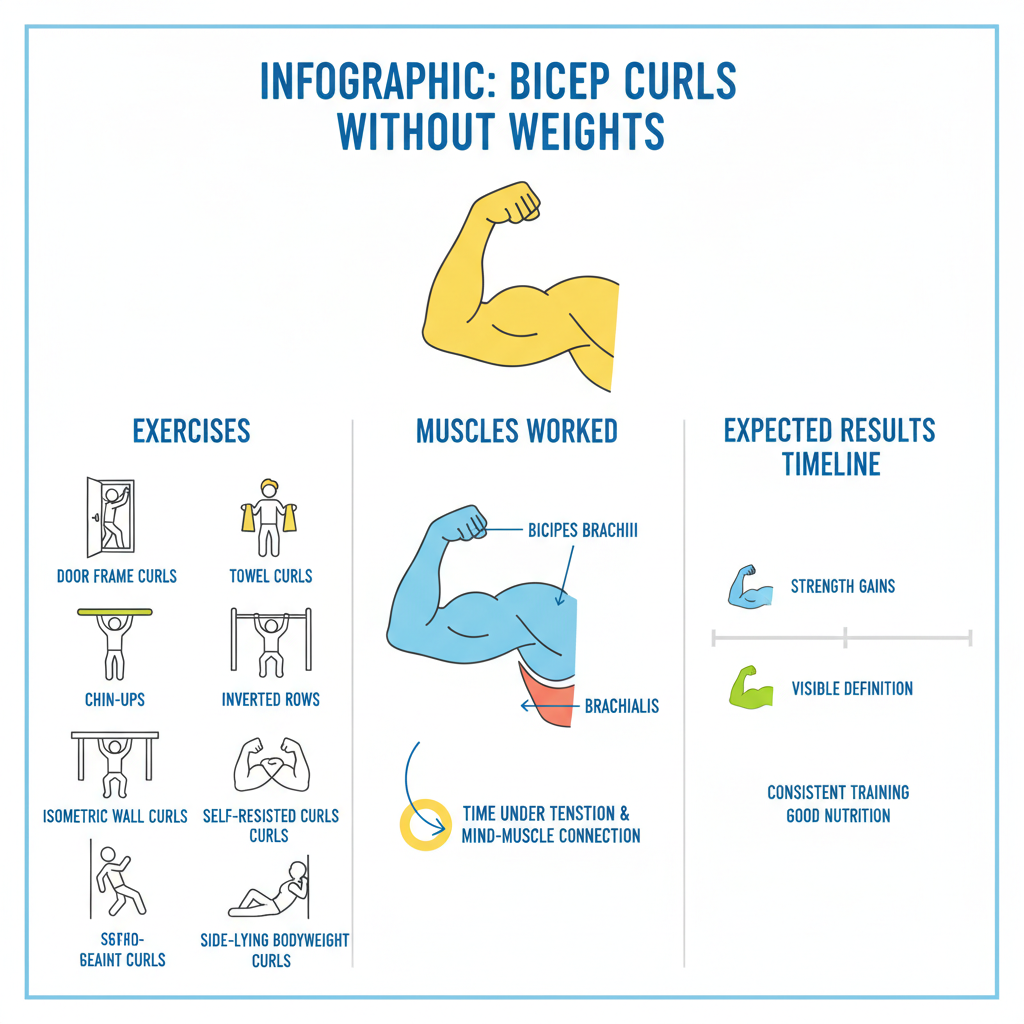
When we talk about building arms, we have to look at the anatomy. The biceps are made up of two main parts: the biceps brachii (the “peak” that everyone sees) and the brachialis (the muscle that sits underneath and adds thickness to your arm). To get that rounded, powerful look, we need to target both.
In a traditional gym, you’d just grab a heavier dumbbell. At home, we use hypertrophy triggers like time under tension and the mind-muscle connection. By slowing down your movements and consciously squeezing the muscle, you can create enough stimulus for growth. This isn’t just “toning”; it’s functional strength that helps you carry groceries, lift your kids, or move furniture without breaking a sweat.
If you are looking for a complete routine, you can check out our guide on bodyweight-exercises-for-home to see how these arm moves fit into a full-body plan.
Top Exercises for Bicep Curls Without Weights
Building muscle is all about finding creative ways to create resistance. Since the biceps’ primary job is to flex the elbow (bring your hand toward your shoulder), we can simulate a curl by pulling our body toward a fixed object or using one part of our body to resist another.
Here are some of our favorite ways to perform bicep curls without weights:
1. Side-Lying Bodyweight Curls
This is a hidden gem in calisthenics. It’s an isolation move that uses your own leg as the weight.
- How to do it: Lie on your left side with your knees slightly bent. Reach down with your right hand and grab under your left thigh.
- The Move: Use your bicep to “curl” your upper body off the floor by pulling against your leg.
- The Secret: You have to assist slightly with your torso to avoid straining the bicep, but focus the effort on the arm. Hold the contraction at the top for two seconds.
2. Towel Curls (The Resistance King)
Towels aren’t just for the shower; they are one of the most versatile pieces of “gym equipment” in your house.
- Dynamic Tension: Loop a long towel under your foot while standing. Hold the ends of the towel with an underhand grip. As you curl the towel up, use your foot to provide resistance.
- Isometric Version: Sit on a chair and loop the towel under your thighs. Pull up as hard as you can and hold for 30-60 seconds. This builds incredible “staying power” and density in the muscle.
3. Self-Resisted Curls
This is the ultimate “anywhere” exercise. You use your own strength to fight yourself.
- How to do it: Place your right hand in your left palm. Try to curl your left hand toward your shoulder while your right hand pushes down as hard as possible.
- Why it works: You can adjust the resistance perfectly. If you feel strong, push harder!
For more ideas on how to stay fit without a gym, take a look at our no-equipment home exercises list.
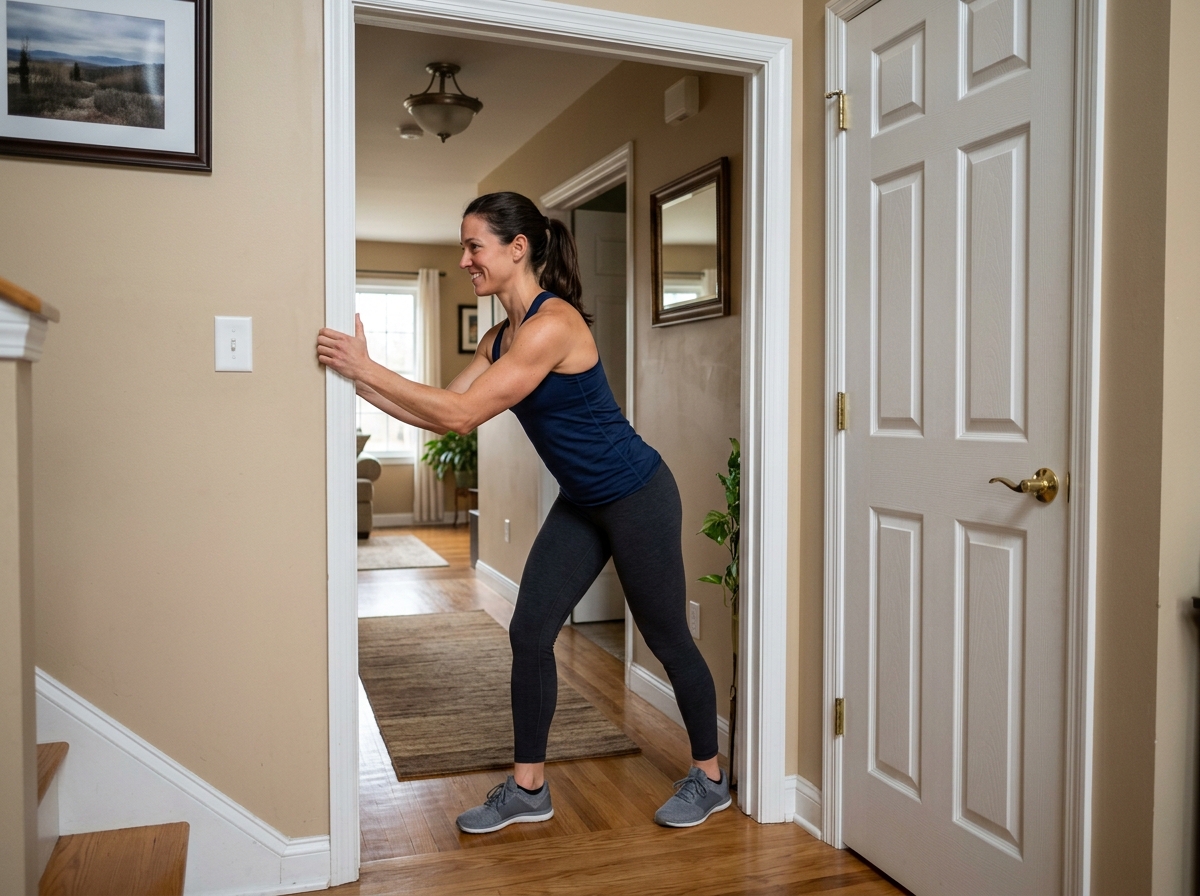
Mastering the Door Frame Bicep Curls Without Weights
The door frame is basically a vertical pull-up bar that every home has. It is arguably the most effective way to perform bicep curls without weights because it allows you to use a significant portion of your body weight as resistance.
How to Perform Door Frame Curls Properly:
- The Grip: Stand in a doorway and grab the frame with a supinated grip (palms facing you).
- The Lean: Place your feet close to the base of the frame and lean your body back until your arms are fully extended.
- The Curl: Keeping your elbows tucked in and pointing forward, pull your chest toward the door frame. Focus on using your biceps rather than your back muscles.
- The Squeeze: At the top of the movement, your face should be close to the frame. Squeeze your biceps as hard as you can before slowly lowering yourself back down.
Form Tips for Success:
- Foot Placement: The further forward you put your feet, the harder the exercise becomes. Start with your feet closer to the frame if you’re a beginner.
- Body Rigidity: Keep your core tight and your body in a straight line. Don’t let your hips sag!
- Wrist Turn: Slightly rotating your wrists inward at the top of the move can help shorten the bicep for a deeper contraction.
- Tempo: Take 3 seconds to pull up and a full 5-10 seconds to lower yourself down.
Using Household Items for Bicep Curls Without Weights
If pure bodyweight moves feel a bit strange at first, you can “cheat” by using improvised weights. Your house is full of heavy objects that work just as well as a $50 dumbbell.
- Water Jugs: A standard gallon of water or milk weighs approximately 8.5 pounds. This is a perfect starting weight for high-rep curls. If that’s too heavy, a pint of water weighs about 1 pound, allowing you to adjust the load easily.
- Backpacks: This is our favorite “pro” tip. Fill a backpack with books, canned goods, or even a bag of rice. You can easily get this up to 20 or 30 pounds. Use the top handle for curls or wear it during door frame rows for added resistance.
- Laundry Detergent: These often have great ergonomic handles that feel just like a kettlebell.
- Paint Cans: A gallon of paint weighs about 10 pounds and is very dense, making it great for hammer curls (grip the handle with your palm facing sideways).
We’ve found that many women enjoy these variations because they feel more familiar than traditional calisthenics. You can read more about at-home strength training for women to see how to incorporate these items into a full routine.
Advanced Bodyweight Variations: Push-Ups and Chin-Ups
Once you’ve mastered the basics, it’s time to level up. If you want arms like a gymnast, you have to train like one. Gymnasts have some of the most impressive biceps in the world, and they rarely touch a barbell.
Bicep Push-Ups
Yes, push-ups are usually for the chest and triceps, but with a simple tweak, we can shift the focus.
- The Modification: Rotate your hands so your fingers are pointing back toward your feet.
- The Execution: Keep your elbows tucked tightly against your ribs as you lower down. This puts a massive stretch on the biceps and forces them to work hard during the “push” phase.
Chin-Ups vs. Pull-Ups
If you have access to a sturdy park bar or a door-mounted bar, these are the gold standard.
- Chin-Ups (Underhand): Palms face you. This grip puts the biceps in a mechanically strong position, allowing them to take the brunt of the load.
- Pull-Ups (Overhand): Palms face away. This targets the back more, but still hits the brachialis.
- Negative Chin-Up Holds: If you can’t do a full chin-up yet, jump to the top and hold yourself there. Lower yourself down as slowly as possible (aim for 10 seconds). This “eccentric” training is a shortcut to muscle growth.
Inverted Rows
Find a sturdy table or a low bar. Lie underneath it, grab the edge with an underhand grip, and pull your chest to the table. It’s like a “reverse” push-up that hammers the biceps.
Building this kind of power is essential for a balanced physique. Check out our tips on building upper body strength for more advanced strategies.
How to Apply Progressive Overload at Home
The biggest mistake people make with bicep curls without weights is doing the same thing every day. To grow, you must apply progressive overload—you have to make the workout harder over time.
Since we can’t just “add a plate” to the bar, we use these intensity techniques:
| Technique | Beginner Level | Advanced Level |
|---|---|---|
| Tempo | 2s up, 2s down | 1s up, 10s down (Slow Eccentrics) |
| Isometrics | 5s hold at the top | 30s max-effort squeeze |
| Volume | 2 sets of 10-12 reps | 4-5 sets to failure |
| Rest | 60-90 seconds | 30 seconds (Short rest periods) |
| Leverage | Vertical body position | Horizontal body position |
The Power of the Squeeze
Isometric strength is a game-changer. Research published on NCBI suggests that maximal isometric contractions can significantly increase muscle thickness and strength. Don’t just move through the range of motion; fight against the resistance at every inch of the rep.
Training to Failure
When you don’t have heavy weights, you need to “fatigue” the muscle fibers by doing more repetitions. Don’t stop at 10 just because a book said so. Keep going until you literally cannot perform another rep with perfect form.
Frequently Asked Questions about No-Weight Bicep Training
How often should I train biceps without weights?
We recommend training your biceps 2 to 3 times per week. Because bodyweight exercises generally put less stress on your joints than heavy heavy lifting, you can recover fairly quickly. However, you still need to give your muscles at least 48 hours to repair and grow between sessions.
How long does it take to see results from bodyweight curls?
You will likely notice strength gains in 2-3 weeks. You’ll feel “tighter” and more capable during your workouts. Visible definition usually takes about 4-6 weeks. Your biceps live under a layer of body fat—if you want them to “pop,” nutrition plays a massive role. High protein intake and a slight caloric deficit (if you’re looking to lean out) will help that definition show.
What are the most common mistakes in no-equipment bicep training?
- Using Momentum: If you’re swinging your body to get through a door frame curl, you’re using your back, not your arms. Stay still!
- Partial Range of Motion: Always go from a full stretch at the bottom to a full contraction at the top. Half-reps give half-results.
- Elbow Flare: Keep your elbows pinned to your sides. When they flare out, the shoulders take over the work.
- Poor Core Engagement: Even in a bicep move, your core should be braced. This provides a stable base for your arms to pull from.
Conclusion
At Casa e Jardim Web, we believe that fitness should be accessible to everyone, regardless of whether they have a home gym or a fancy club membership. Building impressive arms with bicep curls without weights isn’t just a “backup plan”—it’s a highly effective way to build functional, real-world strength.
The secret isn’t the equipment; it’s your consistency and your willingness to push yourself. Start with the door frame curls and towel holds today. As you get stronger, move to chin-ups and slow eccentrics.
Ready to take the next step in your fitness journey? Explore our full-body home workout plan to see how to pair your new arm strength with a powerful core and lower body. Remember: No weights? No problem. You’ve got everything you need right where you are.
For more inspiration on staying active at home, check out our other guides on bodyweight-exercises-for-home. Keep curling, keep squeezing, and we’ll see those results in no time!
