
You Don’t Need a Gym to Build a Strong Chest
Bodyweight chest exercises are movements that use your own body weight as resistance to train your pectoral muscles — no barbells, benches, or machines required.
The best bodyweight chest exercises include:
- Standard push-up – targets the whole chest, triceps, and shoulders
- Decline push-up – emphasizes the lower chest
- Incline push-up – great for beginners and upper chest
- Diamond push-up – hits the inner chest and triceps
- Wide push-up – shifts focus to the outer pecs
- Archer push-up – unilateral loading for chest symmetry
- Pike push-up – upper chest and shoulder emphasis
- Plyometric push-up – builds explosive chest power
- Dips – one of the best lower chest activators
- Deficit push-up – increases range of motion for deeper muscle stretch
You might think you need heavy weights to build a real chest. You don’t.
Research shows push-ups can produce similar muscle growth and strength gains to the bench press — when matched for intensity and effort. Gymnasts have built impressive chests using nothing but bodyweight training for decades.
The real key isn’t the equipment. It’s progressive overload and targeting all areas of your chest with the right exercise variations.
Whether you’re a complete beginner who can’t do a single push-up yet, or an advanced athlete looking to train while traveling, this guide covers everything you need.
The Science and Benefits of Bodyweight Chest Exercises
When we talk about building a powerful upper body, the conversation usually starts and ends with the bench press. However, bodyweight chest exercises offer unique physiological advantages that external weights simply can’t match.
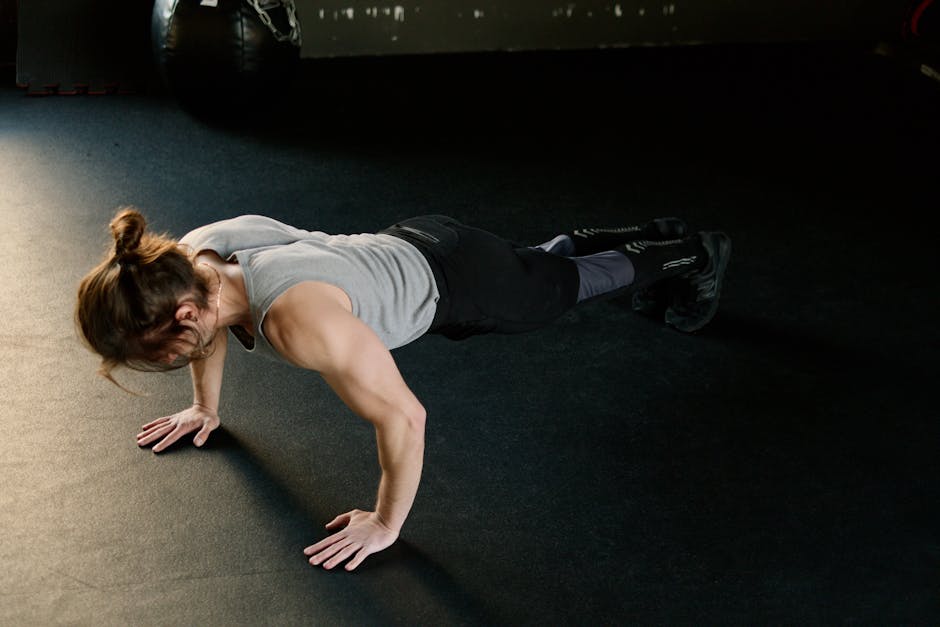
The primary benefit lies in the “closed-chain” nature of these movements. In a bench press, your hands move while your torso remains fixed. In a push-up, your hands are fixed while your entire body moves. This requires much higher levels of core integration and stabilizer recruitment. According to Scientific research on push-up vs bench press hypertrophy, when intensity is matched, the muscle thickness gains in the pectoralis major are nearly identical between the two.
Beyond just muscle size, bodyweight training is often kinder to our joints. Because we aren’t pinned under a heavy barbell, our shoulders can move through a more natural range of motion. This promotes better scapular health and long-term joint longevity. If you’re looking for a foundation of fitness, starting with no-equipment-home-exercises is the smartest way to build functional strength that translates to the real world.
Why Bodyweight Beats the Bench for Stability
One of the “secret” benefits we often overlook is the activation of the serratus anterior—the fan-shaped muscle on the side of your ribs. In a standard bench press, your shoulder blades are pinned against the bench, which limits their movement. In bodyweight chest exercises, your shoulder blades are free to move.
This freedom allows the serratus anterior to work properly, stabilizing the scapula and protecting the rotator cuff. This is why many physical therapists use push-up variations for shoulder rehabilitation. By focusing on bodyweight-exercises-for-home, we aren’t just building a “show” chest; we are building a resilient, stable upper body frame.
Improving Posture and Daily Function
We spend most of our days hunched over keyboards or steering wheels. This leads to tight, weak chest muscles and rounded shoulders. Training our pecs with bodyweight movements helps us regain control over our anterior chain. Strong pecs, when balanced with back training, actually help us sit up straighter and breathe more deeply.
Furthermore, the strength gained from these exercises is highly functional. Think about how often you push open a heavy door, lift groceries, or get yourself up off the floor. These are all “push” patterns. By building-upper-body-strength-easy-home-workouts, we make these daily tasks effortless while also improving our bone density and heart health.
Top 15 Bodyweight Chest Exercises for Every Level
To build a complete physique, we need variety. You wouldn’t just eat one type of vegetable for the rest of your life, so why do just one type of push-up? Here is our curated list of the 15 most effective bodyweight chest exercises to add to your routine. For a deeper look at how these fit into a broader plan, check out our at-home-workout-for-upper-body guide.
- Standard Push-Up: The gold standard. Keep your hands slightly wider than shoulder-width and your body in a straight line.
- Wide-Grip Push-Up: By moving your hands further out, you increase the stretch on the outer pecs and put more demand on the chest muscles rather than the triceps.
- Incline Push-Up: Placing your hands on an elevated surface (like a couch or table) makes the movement easier, targeting the lower chest.
- Decline Push-Up: Elevating your feet shifts the weight to your upper chest and shoulders, making it significantly harder.
- Diamond Push-Up: Bringing your hands together so your thumbs and index fingers form a diamond shape. This hammers the inner chest and triceps.
- Archer Push-Up: A stepping stone to the one-arm push-up. You keep one arm straight while the other does the majority of the work.
- Pike Push-Up: With your hips high in the air, this mimics an overhead press, hitting the upper clavicular head of the chest and the deltoids.
- Plyometric (Clapping) Push-Up: Pushing off the ground with enough force to clap your hands. This builds explosive power.
- Spider-Man Push-Up: As you lower yourself, bring one knee toward your elbow. This adds a massive core and oblique challenge.
- Staggered Push-Up: One hand is higher than the other. This challenges your stabilizers and prepares you for uneven surfaces.
- Typewriter Push-Up: Lower yourself to one side, then slide your chest across the floor to the other side while staying low.
- Dive Bomber Push-Up: A fluid motion where you swoop down like you’re going under a wire and then arch your back upward.
- Pseudo-Planche Push-Up: Lean your shoulders forward past your wrists. This puts an incredible amount of tension on the chest and front delts.
- Deficit Push-Up: Using two sturdy objects (like books or parallettes) to allow your chest to sink lower than your hands for a deeper stretch.
- Dips (using chairs or a counter): Pushing your entire body weight vertically. This is arguably the king of lower chest movements.
Beginner Bodyweight Chest Exercises
If you can’t do a full push-up yet, don’t sweat it! We all start somewhere. The key is to reduce the percentage of body weight you are lifting.
Wall push-ups are the perfect entry point. Stand a few feet from a wall, place your hands on it, and perform the movement. Once that becomes easy, move to kneeling push-ups. Research shows that kneeling push-ups reduce the amount of body weight lifted to about 53%, compared to 66% for a standard push-up.
For those ready to bridge the gap, we recommend beginners-upper-body-strength-workout which focuses on building the foundational strength needed for full repetitions.
| Variation | % of Bodyweight Lifted |
|---|---|
| Wall Push-Up | ~25-30% |
| Kneeling Push-Up | ~53% |
| Standard Push-Up | ~66% |
| Hands-Shifted-Back (Pseudo-Planche) | ~73% |
| Decline Push-Up (Feet Elevated) | ~70-75% |
Advanced Bodyweight Chest Exercises
Once you can comfortably knock out 20-30 standard push-ups, it’s time to increase the intensity. Doing more reps will build endurance, but to build muscle size (hypertrophy), we need more tension.
Plyometric push-ups are fantastic for athletes because they train the nervous system to fire rapidly. One-arm push-ups are the ultimate display of relative strength and core stability. If you want to dive deep into these high-level moves, our ultimate-guide-to-full-body-weight-training-at-home has the progression steps you need.
How to Target Specific Chest Regions
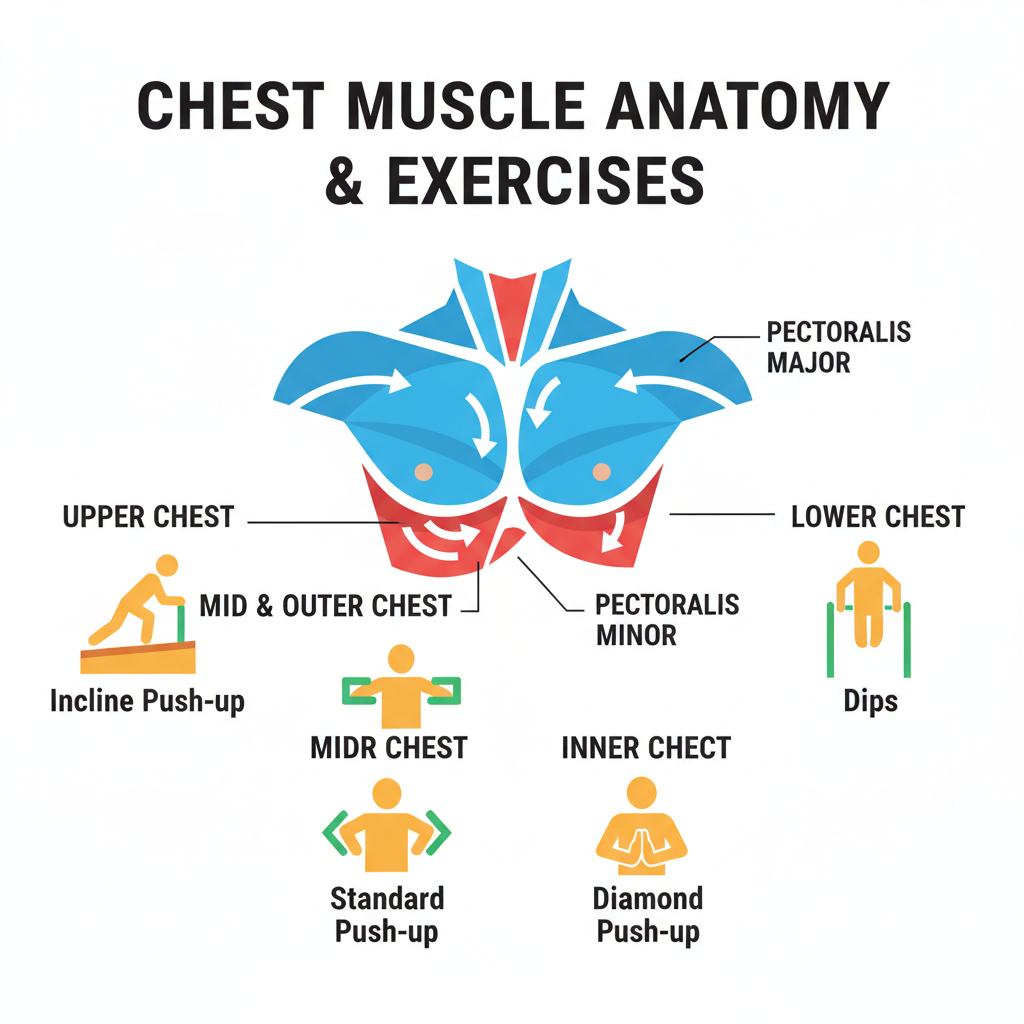
The “chest” isn’t just one big muscle; it’s composed of the pectoralis major (which has two distinct heads) and the pectoralis minor underneath. To get that “3D” look, we have to manipulate the angle of our arms to target different fibers.
Mechanical tension is the primary driver of growth. By changing our hand placement or body angle, we can shift where that tension is most concentrated. This is backed by Scientific research on grip width and muscle activation, which suggests that varying our grip can significantly alter which part of the muscle is doing the heavy lifting.
Targeting the Upper Chest
The upper chest, or the clavicular head, is often the most difficult part to develop. To target this area, we need to perform “low-to-high” pushing movements or increase the angle of shoulder flexion.
- Decline Push-Ups: By elevating your feet, you force the upper fibers of the pec to work harder.
- Wide Reverse Grip Push-Ups: This is a pro-tip! Flipping your hands so your fingers point toward your feet (with a wide stance) has been shown to boost upper chest activation by about 30% compared to a standard grip.
- Pike Push-Ups: While often thought of as a shoulder move, the initial press-off from the bottom heavily involves the upper pec fibers.
Targeting the Lower and Inner Chest
The lower chest (sternal head) gives the pecs that well-defined “bottom” line. The inner chest isn’t a separate muscle, but we can emphasize the “squeeze” at the center through horizontal adduction—bringing our hands toward the midline of the body.
- Incline Push-Ups: By placing your hands on a bench or chair, you target the lower sternal fibers.
- Dips: EMG analyses consistently show that dips are among the best exercises for activating the lower chest. If you don’t have dip bars, use the corner of a kitchen countertop or two sturdy chairs.
- Diamond Push-Ups: The close hand position forces the chest to contract hard at the top of the movement, emphasizing the inner portion of the pecs.
Progressive Overload: Building Muscle Without Equipment
The biggest myth in fitness is that you need heavier weights to keep growing. In reality, your muscles don’t have “eyes”—they only feel tension. If we can make 150 lbs of body weight feel like 250 lbs through leverage and technique, the muscle will grow.
One simple way to add weight is a backpack filled with books or water bottles. This is a classic “old school” method that works wonders. However, we can also use “internal” methods of progression:
- Time Under Tension (TUT): Slow down! Try taking 3 seconds to lower yourself and 3 seconds to push back up.
- Tempo Training: Spend more time in the “stretched” position at the bottom of the rep to cause more micro-tears in the muscle fibers.
- Mechanical Drop Sets: This is a technique where you start with a hard exercise (like decline push-ups) and immediately move to an easier one (like standard or incline) once you hit failure. This keeps the metabolic stress high.
For a structured approach, see our full-body-home-workout-plan.
Mastering Form and Avoiding Common Mistakes
We’ve all seen the “ego” push-ups: hips sagging, neck craning, and only moving two inches. Not only does this not build muscle, but it also invites injury.
- Elbow Flare: This is the #1 mistake. Don’t let your elbows flare out at 90 degrees. This puts immense pressure on the rotator cuff. Keep them tucked at about a 45-degree angle from your torso.
- Sagging Hips: Your body should be a rigid plank. Engage your glutes and core. If your hips sag, you’re losing the connection between your upper and lower body.
- Scapular Retraction: At the bottom of the rep, think about pinching a pencil between your shoulder blades. At the top, push the floor away and “protract” your shoulders. This ensures full range of motion.
For more on perfecting your technique, check out our full-body-weight-training-routine-at-home.
Sample Bodyweight Chest Workout Routines
Ready to put this into practice? We recommend training your chest 2-3 times per week, allowing at least 48 hours for recovery between sessions. We use the RPE (Rate of Perceived Exertion) scale to measure intensity. Aim for an RPE of 8 or 9—meaning you should feel like you only had 1 or 2 “clean” reps left in the tank.
The Warm-Up (5 Minutes):
- Arm Circles: 30 seconds
- Scapular Slides: 10 reps
- Inchworms: 5 reps
- Standard Push-ups (Easy pace): 10 reps
The 20-Minute Home Chest Blast
This circuit is designed to hit every angle of the chest while keeping the heart rate up for a metabolic finish.
- Decline Push-Ups: 3 sets of 8-12 reps (Upper Chest)
- Standard or Wide Push-Ups: 3 sets of 12-15 reps (Middle Chest)
- Dips or Incline Push-Ups: 3 sets of 10-15 reps (Lower Chest)
- Diamond Push-Up “Burnout”: 2 sets to absolute failure (Inner Chest/Triceps)
Rest 60-90 seconds between sets. If you can do more than 20 reps of any exercise, it’s time to move to a harder variation!
Frequently Asked Questions about Bodyweight Chest Exercises
How often should I train my chest with bodyweight?
Generally, we recommend training the chest every second or third day. Muscles need 48-72 hours to fully recover and grow. If you are still incredibly sore, take an extra rest day or focus on lower body work. Consistency is king, but recovery is where the actual growth happens.
Can push-ups reduce breast size in women?
This is a common concern, but the answer is a resounding “No.” Breast tissue is composed of fatty and glandular tissue, while the pectoral muscles sit underneath that tissue. Training your chest will actually provide more lift and support, potentially giving a firmer, more “lifted” appearance. It does not “burn away” the breast tissue itself.
Can I build significant muscle size without weights?
Yes! The science of hypertrophy tells us that as long as we are pushing the muscle close to failure and progressively increasing the challenge, the muscle will grow. Look at gymnasts or calisthenics athletes—they have world-class physiques built entirely on bodyweight chest exercises. The key is to never get “comfortable” with your routine.
Conclusion
Building an impressive, strong, and functional chest doesn’t require a monthly gym membership or a garage full of iron. By mastering the various bodyweight chest exercises outlined in this guide, you can sculpt your physique from the comfort of your living room.
At Casa e Jardim Web, we believe that fitness should be accessible to everyone, regardless of their equipment or experience level. The journey to a stronger you starts with that very first push-up. Remember to focus on form, embrace the “burn,” and stay consistent with your training.
Your turn starts now! Start your strength journey today and feel the difference in your strength and confidence, one rep at a time.
