
The Only Exercise You’ll Ever Need (If You Do It Right)
Fun push up variations are one of the best ways to build real upper body strength without a gym, a single piece of equipment, or a complicated workout plan.
Here’s a quick look at some of the most effective and engaging options:
| Variation | Difficulty | Best For |
|---|---|---|
| Wall Push-Up | Beginner | Building confidence and form |
| Knee Push-Up | Beginner | Foundational strength |
| Diamond Push-Up | Intermediate | Triceps and arm size |
| Spiderman Push-Up | Intermediate | Core and hip mobility |
| Archer Push-Up | Advanced | Single-arm strength prep |
| Plyometric/Clap Push-Up | Advanced | Explosive power |
| Divebomber Push-Up | Advanced | Mobility and full-body challenge |
| Handstand Push-Up | Elite | Shoulder strength and balance |
The standard push-up is already a powerhouse. It works your chest, shoulders, triceps, and core all at once. But if you’ve been doing the same version on repeat, you know how fast it gets stale.
The good news? Changing your hand position, adding movement, or shifting your body angle is enough to completely transform the exercise. You can target new muscles, build explosive power, improve mobility, or just make your workout feel less like a chore.
Push-ups are also incredibly practical. As one fitness expert put it: “You always have ground.” No gym membership required.
Whether you’re just starting out or you can already bang out 30 reps without breaking a sweat, there’s a variation here that will challenge you in a new way.

Why You Should Try Fun Push Up Variations
If you’ve ever felt like your progress has stalled, it might be because your muscles have gotten too comfortable. Science suggests that push-ups are more than just a “chest exercise.” According to research on push-up benefits, they are a complex, compound movement that recruits the pectorals, deltoids, triceps, and even the serratus anterior and core for stability.
By incorporating fun push up variations, you tap into several key physiological benefits:
- Hypertrophy and Strength: Different angles hit different muscle fibers. For example, elevating your feet shifts the load to your upper chest and shoulders, while narrowing your hands forces the triceps to take over.
- Explosive Power: Plyometric variations, like the clap push-up, train your fast-twitch muscle fibers. This is essential for athletes who need quick, powerful movements.
- Core Stability: Many variations, such as the “Spiderman” or “Shoulder Tap,” turn the push-up into a moving plank. This builds a rock-solid midsection that supports your spine and improves posture.
- Shoulder Health and Mobility: Variations like the Hindu or Divebomber push-up move the shoulder joint through a greater range of motion, improving functional flexibility.
- Metabolic Burn: Adding dynamic movement (like jumping your feet or traveling across the floor) increases your heart rate, turning a strength move into a cardio-boosting metabolic finisher.
| Variation Type | Primary Muscle Focus | Secondary Benefit |
|---|---|---|
| Wide Grip | Outer Chest | Shoulder Stability |
| Diamond | Triceps | Inner Chest Definition |
| Decline | Upper Pecs/Deltoids | Increased Resistance |
| Spiderman | Core/Obliques | Hip Mobility |
Mastering the Foundation: The Perfect Standard Push-Up
Before we dive into the “flashy” stuff, we have to talk about your foundation. A “crappy” push-up variation is worse than no push-up at all because it risks injury to your shoulders and lower back.
To perform a proper standard push-up, start in a high plank position. Your hands should be slightly wider than shoulder-width apart. Think about “screwing” your hands into the floor to engage your lats and stable your shoulders.
Keep a neutral spine—your body should form a straight line from your head to your heels. Avoid the “sagging hip” look (which strains the lower back) or the “tent” look where your butt is high in the air. As you lower yourself, keep your elbows at roughly a 45-degree angle to your torso. Tucking them too tight is a tricep-heavy “military” style, while flaring them out like a “T” can put undue stress on the shoulder capsule.
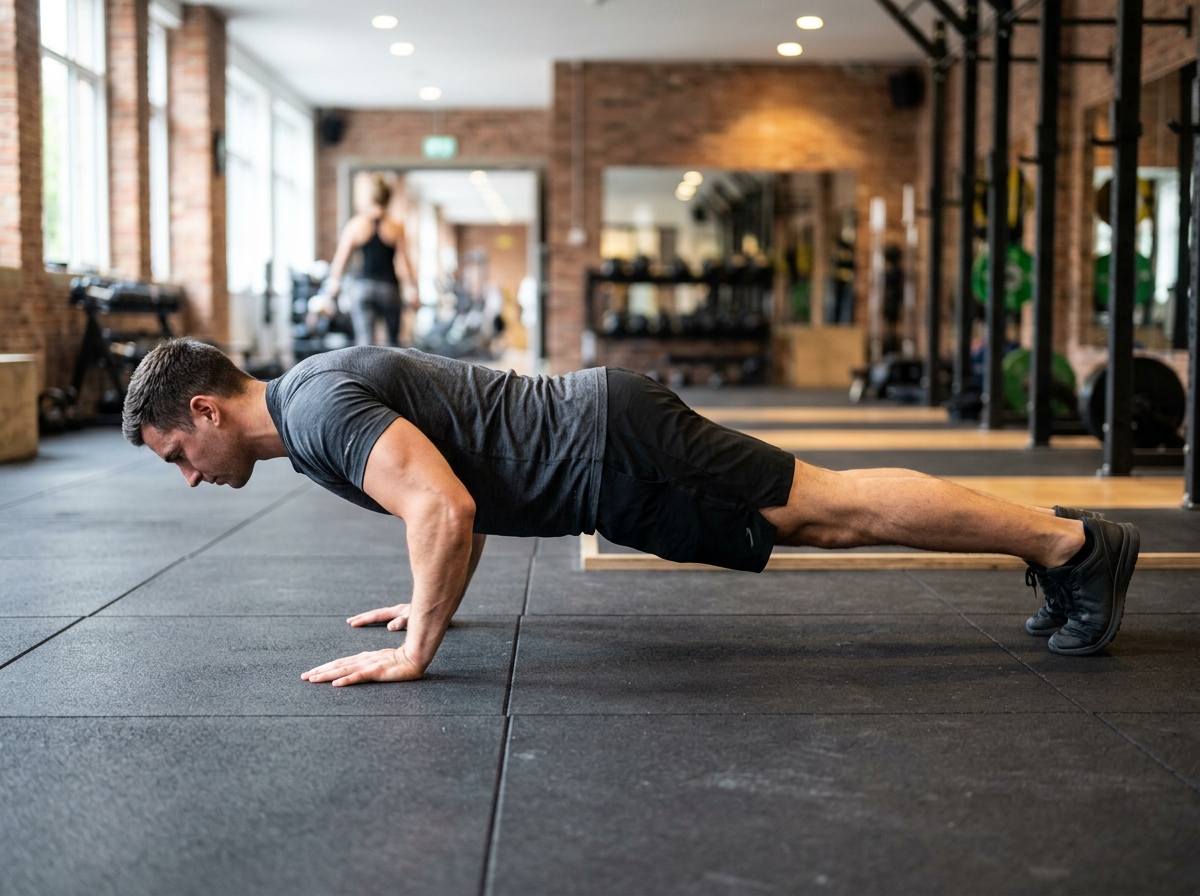
Common mistakes to avoid:
- Head Dropping: Don’t reach for the floor with your chin; keep your neck long and gaze slightly in front of your fingertips.
- Half-Reps: If your chest doesn’t get close to the floor, you aren’t getting the full benefit. For those just starting, check out our beginners upper body strength workout to build the necessary baseline strength.
Beginner-Friendly Variations to Start Your Journey
If a standard push-up feels impossible right now, don’t worry. There is no shame in the “modification game.” In fact, using modifications is the fastest way to build the strength needed for the full version.
1. Wall and Incline Push-Ups
These are the ultimate starting points. By standing a few feet from a wall and pushing off it, you reduce the amount of body weight your arms have to support. As you get stronger, move to a kitchen counter, then a sturdy bench or couch. This progressive scaling allows you to maintain perfect form while gradually increasing the load.
2. Knee Modifications
Often called “modified push-ups,” these involve dropping your knees to the mat. The key here is to keep your hips tucked. Many people leave their butts behind, which negates the core work. Ensure your body still forms a straight line from your head to your knees. You can find more tips on this in our guide on how to push your limits with these beginner variations and challenges.
3. Hand-Release and Negatives
To build “eccentric control,” try Negative Push-Ups. Start at the top and lower yourself as slowly as possible (aim for 5 seconds). Once you hit the floor, reset and repeat. Hand-Release Push-Ups are also great; they force a full range of motion. Lower yourself all the way down, lift your hands off the floor for a second, then press back up. This ensures you aren’t using momentum to “bounce” off the bottom.
Leveling Up: Intermediate and Advanced Fun Push Up Variations
Once you can comfortably perform 10-15 standard push-ups with perfect form, it’s time to make things interesting. This is where fun push up variations really start to shine.
The Spiderman Push-Up
As you lower your chest to the floor, bring one knee out to the side toward your elbow. This mimics the movement of a certain wall-crawling superhero and hits your obliques and core incredibly hard. It’s dynamic, challenging, and great for hip mobility.
Diamond and Wide Push-Ups
To emphasize different muscles, change your hand width.
- Diamond Push-Ups: Place your hands together so your index fingers and thumbs form a triangle. This is the “king” of tricep builders.
- Wide Push-Ups: Place your hands significantly wider than your shoulders. This puts the spotlight on your outer pectorals. If you want a home chest workout: pump up your pecs without leaving the house, these are a must-include.
Archer Push-Ups
The Archer push-up is a beautiful, high-skill movement. Keep one arm straight out to the side while the other arm does the “pushing.” It shifts most of your body weight to a single side, making it a perfect progression toward the elusive one-arm push-up.
Explosive and Plyometric Variations
Ready to fly? Clap Push-Ups require you to push off the ground with enough force to clap your hands before landing. For a softer landing, always keep your elbows “springy.” If you’re feeling elite, try the Superman Push-Up, where both your hands and feet leave the ground simultaneously.
Divebomber and Pike Push-Ups
- Pike Push-Ups: Start in a downward dog position (hips high). Lower your head toward the floor between your hands. This is essentially an overhead press using your body weight, targeting the shoulders.
- Divebomber Push-Ups: Start in a pike, swoop your chest down near the floor, and transition into an upward dog position. Then, reverse the movement. It’s a brutal full-body challenge that feels like a dance.
Programming and Safety: How to Integrate Variations
You don’t need to do 20 different types of push-ups in one session. In fact, “literally nobody needs that many variations” at once. Instead, pick 2 or 3 that align with your current goals and sprinkle them into your routine.
Sample Weekly Integration
- Monday (Strength Focus): 3 sets of Archer or Diamond push-ups (low reps, high intensity).
- Wednesday (Power/Cardio Focus): 3 sets of Plyometric or Spiderman push-ups.
- Friday (Endurance Focus): 3 sets of standard or Incline push-ups (higher reps).
Progressive Overload
To keep seeing results, you must apply progressive overload. This could mean:
- Adding more reps.
- Decreasing rest time.
- Moving to a harder variation (e.g., moving from knee push-ups to full push-ups).
- Adding weight. If you have equipment at home, check out dumbbells 101: beginner friendly home strength exercises or dumbbell strength exercises for home workouts to see how to safely add external resistance to your movements.
Recovery and Warm-Up
Never jump into advanced variations “cold.” Spend 5 minutes warming up your wrists and shoulders. Circles, cat-cow stretches, and a few easy wall push-ups are great. If you need a full plan, our at-home workout for upper body includes excellent warm-up and cool-down protocols to keep your joints “greased” and pain-free.
Frequently Asked Questions about Push-Up Variations
Which fun push up variations are best for triceps?
The Diamond Push-Up is widely considered the best for tricep isolation. Because your hands are close together, the leverage shifts away from the chest and onto the back of the arms. Sphinx Push-Ups (starting in a forearm plank and pressing up to a hand plank) are another fantastic “isolation-style” move for the triceps.
Can I do these fun push up variations without equipment?
Absolutely! That is the beauty of bodyweight training. While you can use medicine balls or resistance bands to spice things up, every variation mentioned in this article—from the Archer to the Divebomber—can be done on any flat surface. You can even use household items like a sturdy chair for inclines or a backpack for weighted versions.
How many reps should I do for muscle growth?
For hypertrophy (muscle growth), the “sweet spot” is generally 6 to 12 reps per set. If you can easily do more than 15-20 reps of a variation, it’s time to move to a harder version to keep the intensity high. The goal is to reach “technical failure”—the point where you can’t do another rep with perfect form.
Conclusion
At Casa e Jardim Web, we believe that fitness should be accessible, effective, and—most importantly—engaging. Moving from “boring to soaring” isn’t just about building a bigger chest; it’s about exploring what your body is capable of doing.
By mixing in fun push up variations, you’ll stay motivated, avoid plateaus, and build a level of functional strength that carries over into your daily life. Whether you’re doing your first wall push-up or your tenth clap push-up, the most important thing is consistency.
Ready to take the next step? Start your strength journey today and join our community of home-fitness enthusiasts. Let’s crush those goals together—one rep at a time!
