
The Muscle You’re Probably Neglecting (And How to Fix It)
The tricep overhead extension is an isolation exercise that targets the back of your upper arm — specifically the long head of the triceps brachii — by extending the elbow from a fully stretched, overhead position.
Quick answer — here’s what you need to know:
- What it is: You hold a weight overhead and lower it behind your head by bending your elbows, then press back up
- Primary muscle: The long head of the triceps (the largest of the three heads)
- Why it matters: The triceps make up roughly two-thirds of your upper arm’s total mass — more than the biceps
- Best for: Building arm size, improving pressing strength, and sculpting that classic horseshoe shape
- Equipment options: Dumbbell, kettlebell, resistance band, or cable machine — all work at home
Here’s something most people don’t think about: while everyone chases a bigger bicep, the triceps are actually the bigger muscle group. They account for the majority of your upper arm’s overall size. Skipping them means leaving serious gains on the table.
The overhead extension is especially valuable because it stretches the long head of the triceps under load — a position that research links to greater muscle growth compared to training with your arms in a neutral position.
Whether you’re working out at home with a single dumbbell or a resistance band, this movement fits easily into any routine — no gym required.
Mastering the Tricep Overhead Extension
To truly master the tricep overhead extension, we first need to understand why it deserves a spot in our routine. It isn’t just about looking good in a t-shirt (though that’s a nice perk). It’s about functional power. Every time you push a heavy door open or lift a box onto a high shelf, your triceps are doing the heavy lifting.
The primary purpose of this movement is to isolate the triceps brachii, specifically by utilizing elbow extension. While many exercises work the triceps, the overhead position is unique. By bringing your arms up past your ears, you place the triceps in a “lengthened” state.
Research, such as this study on tricep hypertrophy in overhead vs neutral arm positions, suggests that training a muscle while it is stretched leads to significantly greater muscle growth (hypertrophy). In fact, triceps brachii hypertrophy is substantially greater after training in the overhead position compared to a neutral position like a standard pushdown.
Beyond aesthetics, this exercise builds incredible shoulder stability. Because you are holding a weight directly over your head, your shoulders and core must work together to keep you from wobbling. For those of us focusing on building upper body strength with easy home workouts, the overhead extension is a fundamental tool for creating a stable, powerful frame.
Why the Tricep Overhead Extension Targets the Long Head
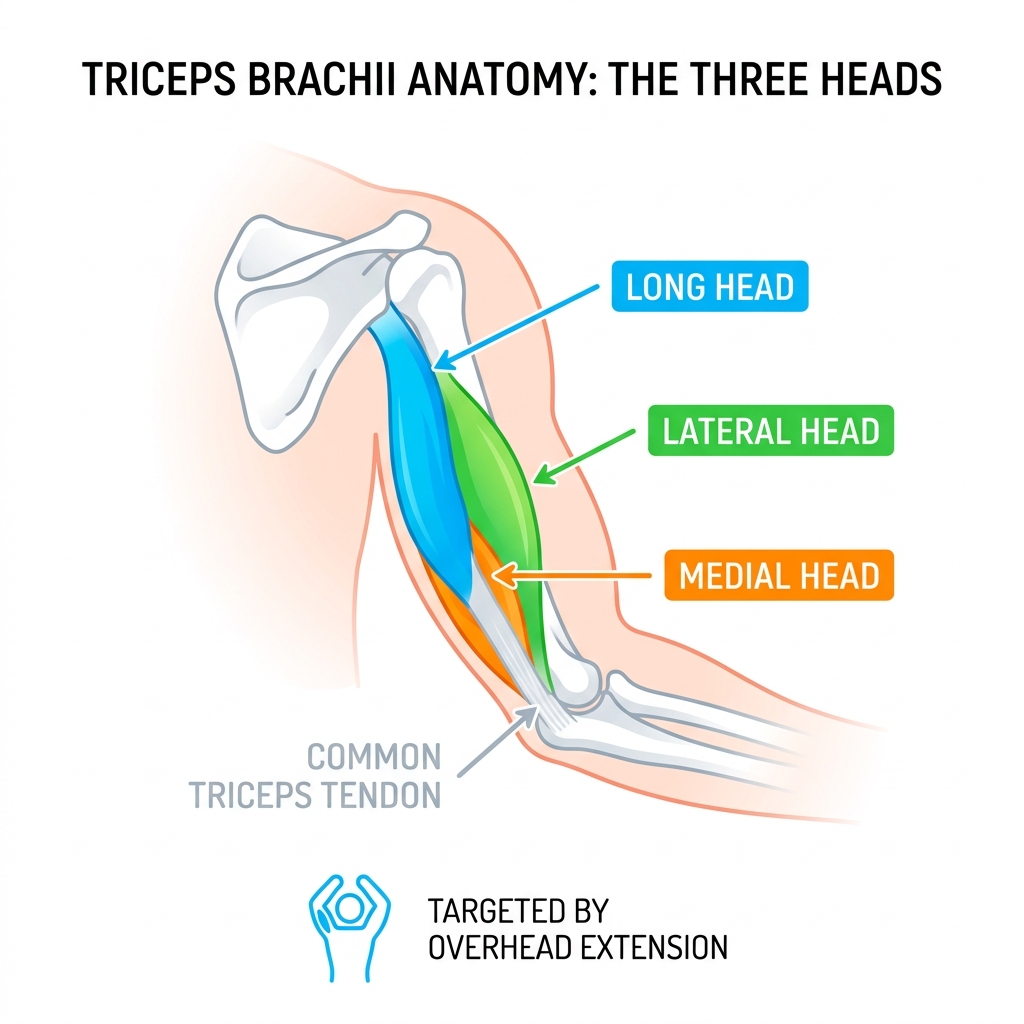
The triceps brachii, as the name implies, has three “heads”: the lateral, the medial, and the long head.
- The Lateral Head: Located on the outside of your arm.
- The Medial Head: Located deeper in the arm.
- The Long Head: The largest part, running down the back of the arm.
The long head is unique because it is the only one that originates at the scapula (shoulder blade) rather than the humerus (upper arm bone). This means that to fully stretch the long head, your arm must be raised overhead.
When we perform a tricep overhead extension, we are putting that long head into its most lengthened position. This deep stretch under load is what triggers the muscle to grow thick and dense, eventually creating that coveted “horseshoe shape” on the back of the arm. A study on tricep muscle activation during overhead movements confirms that the long head tends to be the most active during the entire overhead pressing motion.
Comparing Extensions to Compound Movements
We often get asked: “Can’t I just do more bench presses or dips?” While compound movements are fantastic for overall strength, they don’t always give the triceps the specific attention they need for maximum growth.
| Feature | Overhead Extension | Tricep Pulldown | Close-Grip Bench Press |
|---|---|---|---|
| Exercise Type | Isolation | Isolation | Compound |
| Primary Joint | Elbow | Elbow | Elbow & Shoulder |
| Tricep Stretch | High (Maximum) | Low | Moderate |
| Long Head Focus | Very High | Moderate | Low |
| Core Demand | High (if standing) | Low | Low |
While compound movements like the bench press involve the chest and shoulders, the tricep overhead extension focuses purely on the elbow joint. This allows you to fatigue the triceps without your chest giving out first. If you are a beginner, we recommend checking out our beginners upper body strength workout to see how to balance these isolation moves with bigger lifts.
Step-by-Step Guide to Proper Form
Doing this exercise correctly is the difference between building massive arms and ending up with a nagging elbow injury. We want to focus on a full range of motion while maintaining a neutral spine.
When you start your at-home workout for upper body, “slow and steady” wins the race. Rushing through reps using momentum is a one-way ticket to Faceplant City.
Dumbbell Tricep Overhead Extension Technique
If you have a pair of dumbbells, you’re ready to go. Follow these steps for the perfect rep:
- The Setup: Stand with your feet shoulder-width apart or staggered (one foot slightly in front of the other) for better balance.
- The Grip: Hold the dumbbell with both hands. We recommend an overlapping grip, where your palms face upward and the “bell” of the dumbbell rests in the web of your thumbs.
- The Lift: Press the dumbbell directly overhead until your arms are fully extended.
- The Descent (Eccentric Phase): Slowly lower the weight behind your head by bending only at the elbows. Keep your upper arms vertical and tucked close to your ears.
- The Stretch: Continue lowering until your forearms reach at least parallel to the floor, or until you feel a deep stretch in your triceps.
- The Ascent (Concentric Phase): Contract your triceps to drive the weight back up to the starting position. Stop just short of locking your elbows to keep the tension on the muscle.
For more tips on using weights at home, see our guide on dumbbells 101 beginner friendly home strength exercises.
Seated vs Standing Variations
We often recommend the seated version for those just starting out or those with lower back concerns.
- Seated: Sitting on a bench with back support (or even a sturdy chair at home) provides lumbar support. This makes it much harder to “cheat” by arching your back. It allows you to focus 100% on the triceps.
- Standing: This version is more “functional.” It forces your core and glutes to engage to keep your body upright. It’s a great way to sneak in some extra stability work, but it requires more concentration to keep your spine neutral.
If you’re working out in your living room, you can easily swap between these based on how your back feels that day. Check out our dumbbell strength exercises for home workouts for more ways to adapt your space.
Common Mistakes and Safety Considerations
Even the most experienced lifters can fall into bad habits. Let’s look at the most common “form fails” so we can avoid them.
- Flaring Elbows: If your elbows point out to the sides like wings, you’re shifting the stress from your triceps to your shoulder joints.
- Arching the Back: This usually happens when the weight is too heavy. Your body tries to turn the exercise into a standing chest press by leaning back.
- Using Momentum: If you’re “bouncing” the weight at the bottom, you aren’t actually using your muscles to lift it.
- Tucking the Chin: Don’t look down at your feet! Keep your head in a neutral position to avoid putting pressure on your cervical spine.
If you find yourself arching your back, it might be a sign that you need to work on your core or chest mobility. Our home chest workout can help you build the foundational strength needed to stay upright.
How to Fix Flared Elbows
To keep your elbows tucked, imagine there are two magnets on the inside of your elbows trying to pull them toward your ears. Another great cue is to keep your “biceps close to your head.” If you can see your elbows in your peripheral vision, they are probably flaring too much. Narrowing your grip slightly on the dumbbell can also help keep the tension exactly where it belongs: on the triceps.
Protecting the Lower Back
Protecting your spine is non-negotiable. Before you even lift the weight, engage your core. Think about pulling your ribcage down toward your belly button.
We also recommend glute activation. Squeezing your glutes while standing creates a “pillar” of stability that prevents your pelvis from tilting forward. If you still feel a pinch in your lower back, lower the weight or move to a seated position. Progressive overload is about more than just adding weight; it’s about improving your form and control over time.
Home Workout Variations and Equipment
At Casa e Jardim Web, we believe you don’t need a $100-a-month gym membership to get results. The tricep overhead extension is incredibly versatile.
Resistance Band Tricep Overhead Extension
Resistance bands are one of our favorite tools because they provide “constant tension.” Unlike dumbbells, where the exercise gets “easier” at the top, bands pull back harder the further you stretch them.
To do this:
- Stand on one end of the band with your back foot.
- Grab the other end and pull it behind your head.
- Extend your arms upward just like you would with a dumbbell.
Bands are travel-friendly and great for resistance band exercises to boost strength. If you want even more variety, check out our second guide on resistance band training.
Cable and Kettlebell Alternatives
- Kettlebells: Holding a kettlebell by the “horns” (the sides of the handle) can actually feel more comfortable for some people’s wrists than a dumbbell.
- Cables: If you do have access to a cable machine, set the pulley to the bottom. Using a rope attachment allows for a more natural hand position and lets you “pull the rope apart” at the top for an extra tricep squeeze.
- Unilateral Training: Try performing the extension with just one arm at a time. This is excellent for identifying and correcting muscle imbalances (we all have a “weak” side!). It also forces a much stronger mind-muscle connection.
Frequently Asked Questions about Tricep Extensions
Is the overhead extension better than the tricep pulldown for mass?
Both are effective, but they serve different purposes. A recent study found that muscle activation is actually quite similar between the two. However, because the overhead extension puts the triceps in a stretched position, it is generally considered superior for long-term hypertrophy (muscle mass). If we had to pick just one for size, the overhead extension wins.
Should I perform this exercise seated or standing?
If your goal is maximum tricep isolation and you have back issues, go with seated. If you want a full-body challenge that recruits your core and improves balance, go with standing. Beginners should start seated to master the arm movement before adding the complexity of standing balance.
What should I do if I have limited shoulder mobility?
If you can’t get your arms straight up past your ears without arching your back, don’t force it. You might have tight lats or shoulders. Instead of the overhead extension, try tricep kickbacks or skull crushers on a flat bench. These work the triceps without requiring as much shoulder flexibility. You can also work on your range of motion through daily stretching and mobility drills.
Conclusion
The tricep overhead extension is a powerhouse movement that deserves a permanent home in your fitness routine. By targeting the long head of the triceps, you’re not just building “vanity muscles” — you’re building functional strength that supports your chest, shoulders, and daily activities.
At Casa e Jardim Web, our mission is to make effective, gym-free training accessible to everyone. Whether you’re using a heavy dumbbell, a resistance band, or even a large water jug, the principles remain the same: keep your elbows tucked, your core tight, and your movements controlled.
Consistency is the secret sauce to any transformation. Start with light weights, focus on the feel of the muscle stretching and contracting, and gradually increase the challenge as you get stronger.
Ready to take your training to the next level? Explore more effective home workout strategies and let’s build that upper body power together!
