
Why Every Woman Needs a Solid Upper Body Workout Guide
A good women’s upper body workout guide gives you everything you need to build strength, improve posture, and feel confident — whether you train at home or in a gym.
Here’s a quick overview of what an effective women’s upper body routine looks like:
| Element | Recommendation |
|---|---|
| Frequency | 1-2 times per week |
| Key muscle groups | Chest, back, shoulders, biceps, triceps |
| Best exercise types | Compound lifts (presses, rows, pull-downs) |
| Sets and reps | 2-4 sets of 8-15 reps |
| Equipment needed | Dumbbells, resistance bands, or bodyweight |
| Warm-up time | 8-12 minutes |
| Time to see results | 4-8 weeks of consistent training |
Most women focus heavily on lower body training. That makes sense — but it leaves a lot of strength and health benefits on the table.
A strong upper body does more than make your arms look good in a sleeveless top. It improves your posture, makes everyday tasks easier, and protects your joints as you age.
And here’s the thing most people get wrong: you don’t need a complicated routine or a gym membership to get real results. A handful of well-chosen exercises, done consistently with challenging weights, is genuinely all it takes.
This guide breaks everything down — from anatomy and workout structure to sample routines for every fitness level.
The Science and Benefits of a Women’s Upper Body Workout Guide
When we talk about a women’s upper body workout guide, we aren’t just talking about aesthetics. There is a deep well of physiological benefits that come from resistance training. For starters, did you know that women often recover faster than men from high-intensity upper body sessions? Scientific research on female recovery rates suggests that because women generally have different muscle fiber distributions and hormonal profiles, we can often handle a slightly higher training frequency or volume without burning out.
Beyond the gym floor, the health implications are massive. According to major health organizations like WebMD and the American Council on Exercise (ACE), resistance training is a primary defense against osteoporosis. By putting stress on our bones through lifting, we actually increase bone density, which is vital as we age. Furthermore, strength training helps combat sarcopenia — the natural loss of muscle mass that occurs over time.
Then there’s the “metabolic boost.” Muscle tissue is more metabolically active than fat. This means that by following a women’s upper body workout guide and building lean muscle, we actually increase our resting metabolic rate. You’re essentially turning your body into a more efficient engine, even when you’re just sitting on the couch.
Finally, let’s talk about posture. In an age where we spend hours hunched over laptops and smartphones, our chest muscles become tight and our back muscles become weak. This leads to that “slumped” look and chronic neck pain. Strengthening the muscles of the upper back (like the rhomboids and traps) pulls the shoulders back, instantly making us look taller and more confident.
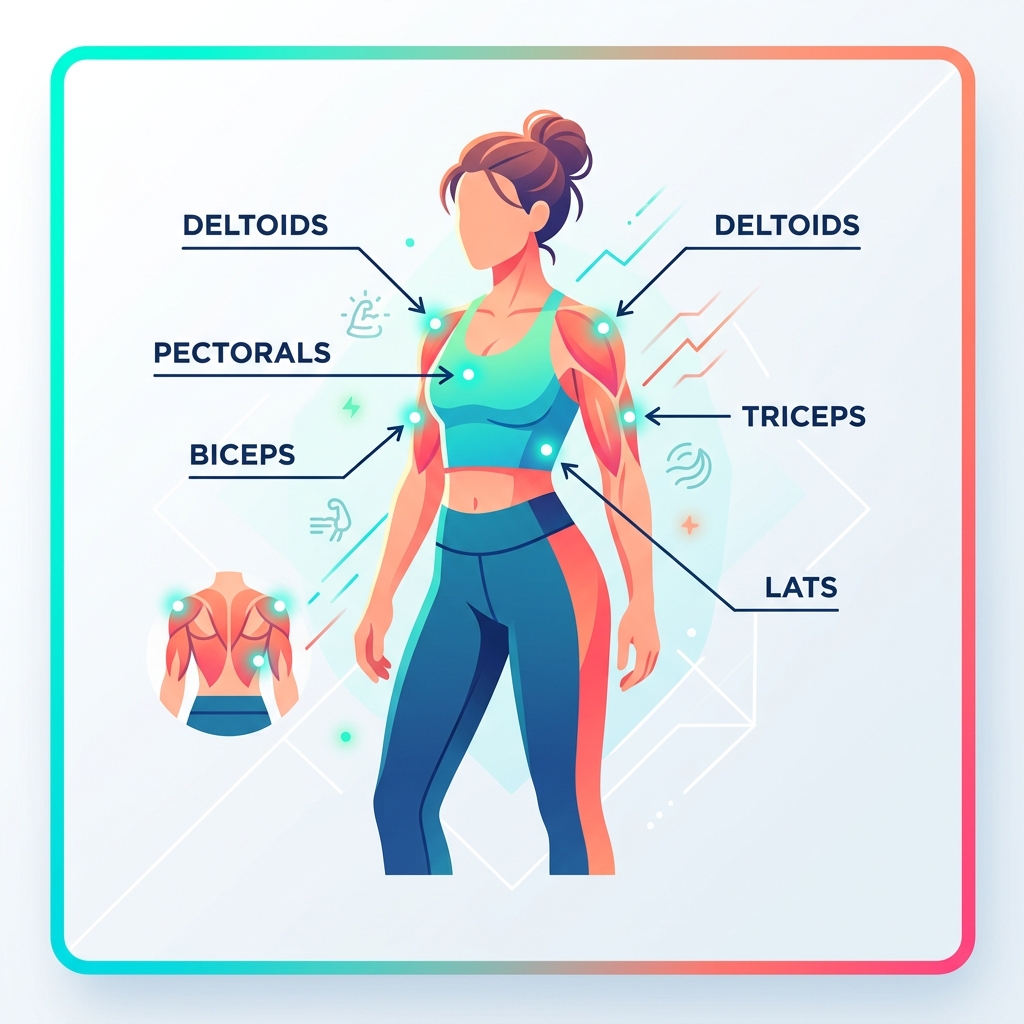
Anatomy of the Upper Body
To train effectively, we need to understand what we are actually working. Think of your upper body as a series of “push” and “pull” machines.
- The Lats (Latissimus Dorsi): These are the large “V-shaped” muscles on your back. They are your primary “pulling” muscles. Strong lats give the illusion of a narrower waist.
- The Rhomboids and Traps: Located between your shoulder blades, these are the “posture muscles.” They help you pull your shoulders back and down.
- The Deltoids (Shoulders): Your shoulders have three “heads” (front, side, and rear). Training all three gives you that rounded, sculpted look.
- The Pectorals (Chest): These are your primary “pushing” muscles. Strengthening the chest helps with functional movements like pushing open a heavy door.
- Biceps and Triceps: The front and back of your arms. Fun fact: the triceps actually make up about two-thirds of your upper arm, so if you want “toned” arms, don’t ignore the back of them!
The secret to a balanced physique is maintaining a “push-pull” balance. For every pushing exercise (like a chest press), we should include a pulling exercise (like a row). This keeps the shoulder joint healthy and prevents that rounded-shoulder posture.
Structuring Your Women’s Upper Body Workout Guide for Success
We’ve all been there: you walk into the gym (or your living room) and realize you have no idea what to do first. A structured plan is the difference between seeing results in a month and spinning your wheels for a year.
At Casa e Jardim Web, we believe in keeping things simple. You don’t need fifty different exercises. You need five or six that you do really, really well. If you are just starting out, we highly recommend checking out our at-home strength training for women guide to get your foundations solid.
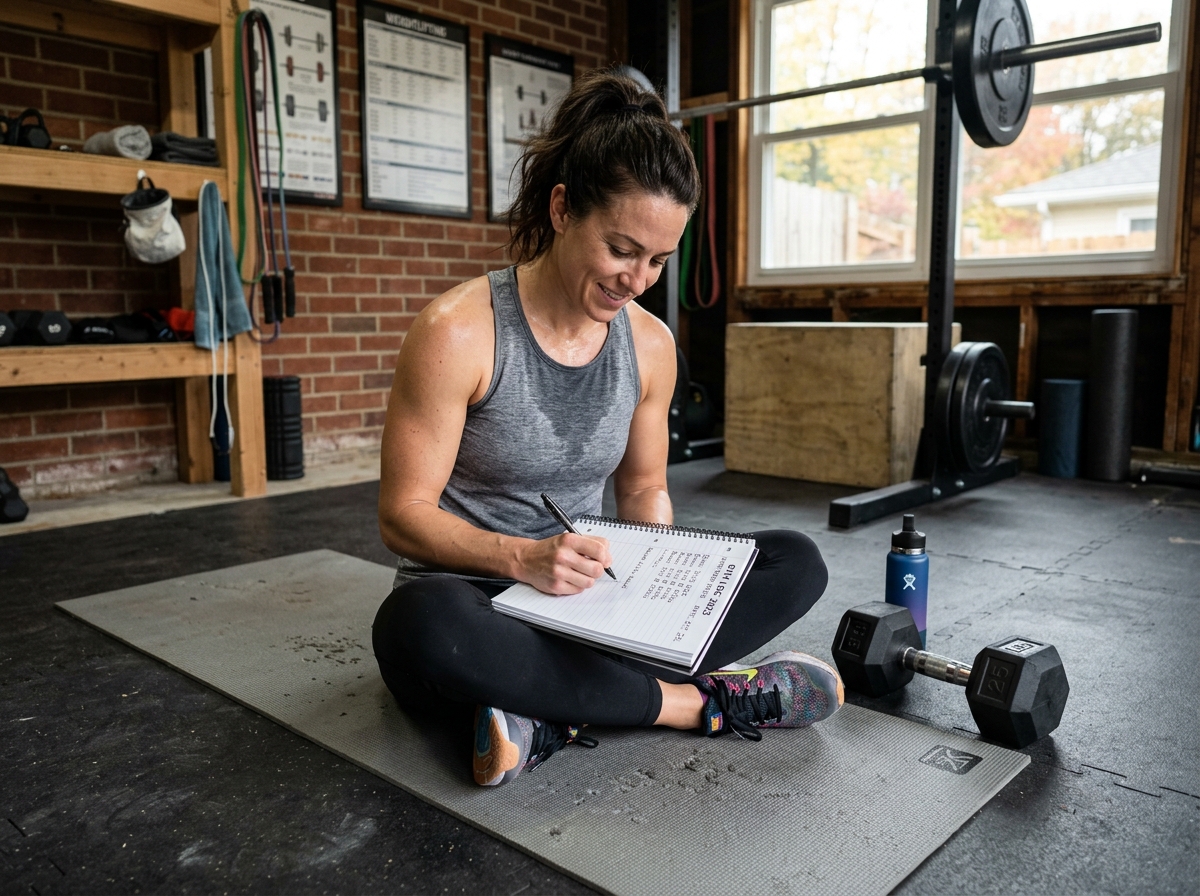
A standard session should include:
- Warm-up (8-12 minutes): This isn’t optional! You need to get blood flowing to the joints. Think arm circles, “wall angels,” and light cardio.
- Compound Lifts: These are moves that use multiple joints (like a shoulder press). Do these first when you have the most energy.
- Isolation Moves: These target one specific muscle (like a bicep curl). Save these for the end.
- Cool-down: Light stretching to help your nervous system transition back to a resting state.
Progressive Overload and Weight Selection
If you lift the same five-pound weights for the next three years, your body will never change. Why? Because it has no reason to! The principle of progressive overload means you must gradually increase the challenge to your muscles.
We suggest using a method called “Double Progression.” First, you aim to increase your repetitions. If our guide says to do 8-12 reps, and you can finally do 12 reps with perfect form, it’s time to increase the weight slightly.
How do you choose the right weight? You should pick a weight where the last 2-3 reps of a set are genuinely challenging. You should feel like you could maybe do 1 or 2 more reps if your life depended on it (this is called “reps in reserve”), but your form should never break down. For more on the basics, see our strength-training-for-women-a-beginners-guide. (Note: Don’t let the URL fool you; the principles of strength are universal!)
Another great method for home workouts is the rep-drop format. You start with a high number of reps (say 12), then 10, then 8, then 6. This allows you to keep using a relatively heavy weight even as your muscles start to fatigue.
Frequency and Recovery for Women
How often should you train? For most women, 1-2 dedicated upper body sessions per week is the “sweet spot.” If you are doing an upper/lower split (Upper body Monday/Thursday, Lower body Tuesday/Friday), you get the benefit of hitting those muscles twice a week while allowing 48-72 hours of recovery in between.
Recovery is where the magic happens. You don’t build muscle during the workout; you build it while you sleep and eat.
- Protein Intake: Aim for 1.6 to 2.2 grams of protein per kilogram of body weight. This provides the “bricks” to rebuild your muscle tissue.
- Sleep: Aim for 7-9 hours. This is when your growth hormones are most active.
- Deload Weeks: Every 8-10 weeks, reduce your weights or intensity by half. This allows your central nervous system to recover.
If you are looking for a way to balance this with a busy schedule, our simple-and-effective-strength-training-for-women-at-home provides a great template for busy professionals.
From Living Room to Lifting Platform: Equipment and Exercises
One of the biggest myths in fitness is that you need a $50-a-month gym membership to get a “toned” upper body. While gym machines are great, your muscles don’t actually know the difference between a fancy cable machine and a $10 resistance band. They only know tension.
For a truly effective women’s upper body workout guide, we focus on compound exercises. These are movements that work more than one muscle group at a time. Think of it as “more bang for your buck.” A push-up, for example, works your chest, shoulders, triceps, and even your core.
If you’re a total newbie, start with our home-workout-for-women-beginners to learn the basic movement patterns before adding heavy resistance.
Effective Home-Based Women’s Upper Body Workout Guide
Training at home is the ultimate way to stay consistent. No commute, no waiting for machines, and you can wear your oldest t-shirt. Here are five essential home exercises we recommend for any women’s upper body workout guide:
- Push-Ups (Chest, Shoulders, Triceps): The gold standard. If full push-ups are too hard, do them with your hands on an elevated surface like a kitchen counter or a sofa. This is much better for your form than dropping to your knees!
- Dumbbell Rows (Back, Biceps): Lean over a sturdy chair, keep your back flat like a table, and pull the weight toward your hip. This targets the “posture muscles” we talked about earlier.
- Arnold Press (Shoulders): Named after a certain famous bodybuilder, this involves rotating your palms as you press dumbbells overhead. It hits all three heads of the shoulder.
- Tricep Dips (Triceps): Use the edge of a chair or coffee table. Keep your back close to the chair as you lower yourself down to protect your shoulders.
- Resistance Band Pull-Aparts (Rear Delts, Upper Back): Hold a band in front of you and pull it apart until it touches your chest. This is the ultimate “anti-slump” exercise.
For more detailed instructions on these moves, check out our at-home-workout-for-upper-body and building-upper-body-strength-easy-home-workouts pages.
Advanced Gym Variations and Compound Lifts
If you do have access to a gym, you can take advantage of heavier weights and specialized machines.
- Barbell Bench Press: This allows you to lift the most weight possible for your chest. It’s a fantastic “benchmark” lift to track your progress over the months.
- Lat Pull-Downs: A great alternative to pull-ups. Focus on pulling your elbows down toward your ribs rather than pulling with your hands.
- Seated Cable Rows: These allow for a constant “tension” on the back muscles that dumbbells sometimes lack.
- Pull-Ups: The ultimate upper body challenge. Most of us can’t do one right away, so use the “assisted pull-up” machine or heavy resistance bands to build up your strength.
When using gym equipment, remember to adjust the machines to your height. If the seat is too low or the handles are too wide, you risk injury. For a full breakdown of gym-based moves, see our beginners-upper-body-strength-workout.
Sample Routines for Every Fitness Level
Consistency is key. You can have the best women’s upper body workout guide in the world, but if you only do it once every three weeks, nothing will happen. We recommend sticking with the same routine for at least 4-8 weeks before changing anything. This gives your brain time to master the movements and your muscles time to grow.
| Feature | Beginner (Home) | Intermediate (Home/Gym) | Advanced (Gym) |
|---|---|---|---|
| Primary Goal | Form & Consistency | Strength & Tone | Hypertrophy & Power |
| Duration | 20 Minutes | 30-40 Minutes | 45-60 Minutes |
| Structure | Circuit (Back-to-back) | Standard Sets | Supersets/Trisets |
| Rest | 30-60 Seconds | 60-90 Seconds | 2-3 Minutes (Heavy) |
The 10-Minute “Rep-Drop” Benchmark: If you’re short on time, try this: Choose 5 exercises (e.g., Push-ups, Rows, Overhead Press, Bicep Curls, Skull Crushers).
- Round 1: 12 reps of each.
- Round 2: 10 reps of each.
- Round 3: 8 reps of each.
- Round 4: 6 reps of each. Rest only as much as you need to keep your form perfect. It’s fast, it burns, and it works!
Frequently Asked Questions about Upper Body Training
We hear a lot of the same concerns when women start an upper body program. Let’s clear the air with some science-backed facts.
Will lifting heavy weights make me look bulky?
This is the number one fear, and we are happy to tell you: No. Building a “bulky” or “bodybuilder” physique requires a specific set of circumstances that don’t happen by accident. You would need significantly higher levels of testosterone than most women naturally possess, a massive calorie surplus (eating way more than you burn), and years of incredibly intense, heavy lifting.
What most women call “bulky” is actually just muscle covered by a layer of body fat. When you lift weights and maintain a healthy diet, you build lean muscle definition. This is what gives you that “toned” or “sculpted” look.
How long does it take to see toned arms?
If you are consistent and using weights that actually challenge you, you can expect to feel a difference in your strength within 2 weeks. However, visible “toning” usually takes about 4-8 weeks.
Your nutrition plays a huge role here. If your goal is definition, you need to be in a slight calorie deficit or at maintenance while keeping your protein high. You can’t see the muscle you’re building if it’s hidden, but don’t rush the process! Slow and steady wins the race.
Can I do upper body workouts every day?
We don’t recommend it. Muscles need time to repair the tiny micro-tears that happen during a workout. This process usually takes about 48 hours. If you train your chest and shoulders on Monday, wait until at least Wednesday to train them again.
Overtraining doesn’t just stall your progress; it can lead to injury and burnout. If you want to train every day, alternate your muscle groups. Do upper body one day, lower body the next, or go for a long walk on your “off” days.
Conclusion
At Casa e Jardim Web, our mission is to make fitness accessible to everyone. You don’t need a locker room full of expensive gear to “raise the bar” on your health. A women’s upper body workout guide is a tool for empowerment. It’s about more than just how your shoulders look in a dress; it’s about the feeling of being able to carry your own groceries, lift your children without back pain, and stand tall with natural confidence.
Whether you are starting with bodyweight push-ups in your living room or hitting a new personal record on the bench press, the most important step is the one you take today. Strength is a journey, not a destination.
Ready to keep going? Explore our other resources and start Raising the Bar for your fitness journey today. You’ve got this!
