
You Don’t Need a Gym to Build a Strong Back
Back exercises without gym equipment are not only possible — they’re surprisingly effective. Here’s a quick look at the best options, organized by difficulty:
| Level | Exercises |
|---|---|
| Beginner | Superman hold, Bird Dog, Glute Bridge, Cat-Cow |
| Intermediate | Inverted Row, Reverse Snow Angel, Plank Row, IYWT Sequence |
| Advanced | Pull-Up, Chin-Up, Wall Walk, Gymnastic Bridge |
Quick answer: The most effective no-equipment back exercises are the Superman hold, Bird Dog, Reverse Snow Angel, and Inverted Row (using a table or low bar). Do 3–4 sets of 8–20 reps, 2–3 times per week, and you’ll build real back strength at home.
Your back is one of the most important muscle groups in your body. It keeps your spine upright, powers your pulling movements, and protects you from everyday injury.
But it’s also one of the most neglected — especially when you’re training at home.
Most home workouts lean heavily on push exercises like push-ups and squats. The back gets left out, and over time, that imbalance shows up as poor posture, nagging pain, or weakness.
Here’s the good thing: you don’t need a barbell, a cable machine, or even a gym membership to fix that.
Eight out of ten people experience back pain at some point in their lives. The research is clear that strengthening your back muscles — even with bodyweight alone — can help reduce that risk significantly.
And some studies even show that a simple bodyweight inverted row activates more back muscle fibers than a traditional bent-over barbell row.
This guide covers everything you need — the right exercises, the right form, and a simple plan — to build a stronger back using nothing but your body and whatever space you have available.
The Benefits of Training Your Back Without a Gym
We often hear that 8 out of 10 people report back pain at some point in their lives. It is a staggering statistic, but it highlights why we need to prioritize posterior chain health. When we focus on back exercises without gym access, we aren’t just “settling” for a secondary option; we are tapping into a highly effective way to improve our quality of life.
One of the primary benefits of bodyweight back training is the recruitment of stabilizer muscles. Unlike machines that lock you into a fixed path, bodyweight movements require your gluteus medius, multifidus, and core to work in unison to keep you steady. This builds functional movement patterns that translate directly to real-life tasks—like lifting groceries, picking up a child, or maintaining an upright posture during a long workday.
Furthermore, training at home fosters a deep mind-muscle connection. Without heavy iron to move, you are forced to focus on the squeeze of the rhomboids and the flare of the lats. This internal focus is the secret sauce for muscle growth and injury prevention. Whether you are traveling or just short on time, having a library of bodyweight exercises for home ensures you never miss a session.
Essential Back Exercises Without Gym for Every Level
To build a complete back, we need to target several key areas. The “back” isn’t just one muscle; it’s a complex network. We want to hit the Latissimus Dorsi (the “wings” that create width), the Trapezius (the diamond-shaped muscle in the upper-mid back), the Rhomboids (which sit between the shoulder blades), and the Erector Spinae (the muscles running along the spine that keep us upright).
Using no-equipment home exercises allows us to manipulate our body’s leverage to make movements easier or harder, ensuring there is a path for everyone from the absolute novice to the seasoned athlete.
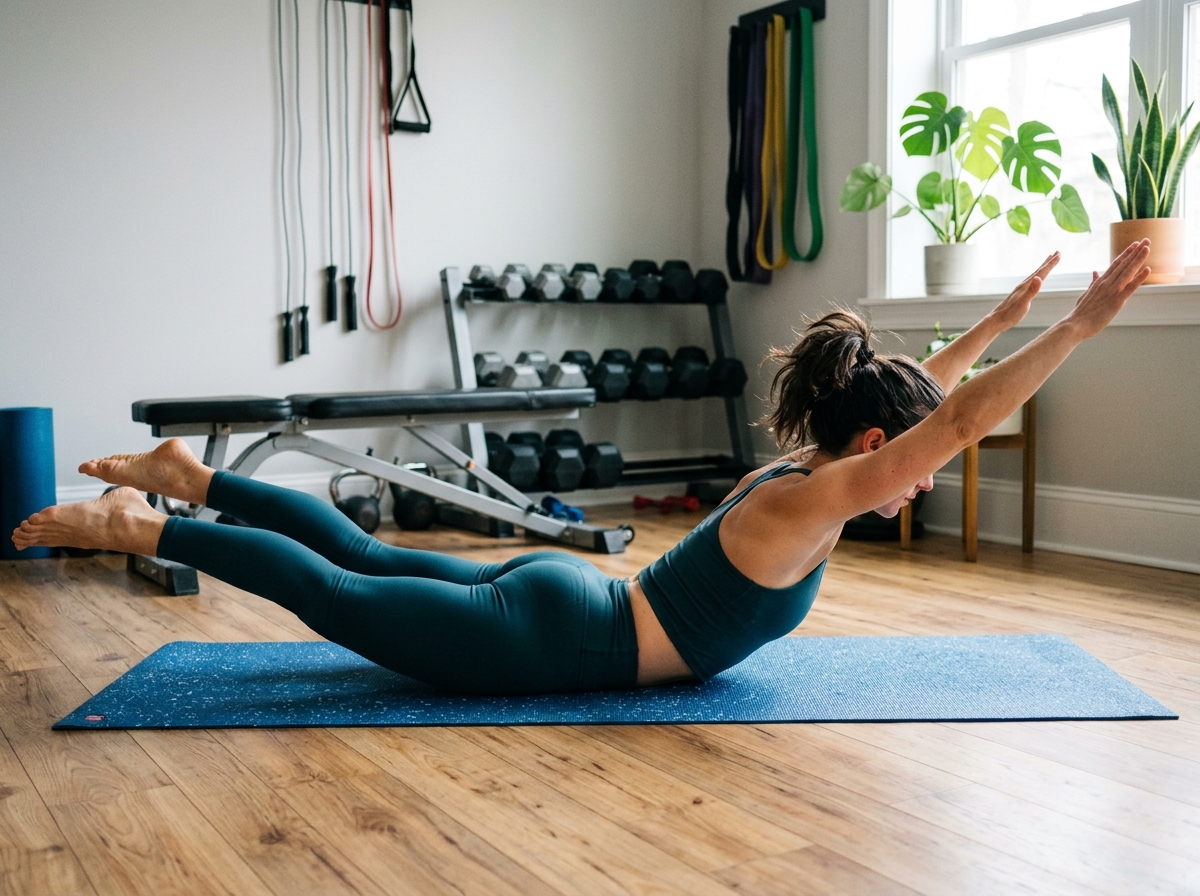
Beginner Foundations
If you are just starting, our goal is to wake up the muscles that have likely been “turned off” by hours of sitting. These moves are low-impact but high-reward.
- Superman Hold: Lie face down with arms extended. Simultaneously lift your chest, arms, and legs off the floor. Squeeze your lower back and glutes. Hold for 2–5 seconds, then lower. This is the ultimate “Man of Steel” move for the erector spinae.
- Bird Dog: Start on all fours. Extend your right arm forward and left leg back simultaneously. Keep your back flat—imagine a glass of water sitting on your lower back that you can’t spill. This builds cross-body stability.
- Glute Bridges: While often seen as a leg move, bridges are essential for lower back health. By driving through your heels and lifting your hips, you strengthen the connection between your glutes and lower spine.
- Cat-Cow Stretch: This is a mobility staple. Arching and rounding your back on all fours helps lubricate the spinal discs and relieves tension.
For those just starting out, these moves form the basis of an easy home workout without equipment that protects the spine while building a baseline of strength.
Intermediate Progressions
Once you’ve mastered the floor work, it’s time to add more tension.
- Inverted Rows: Find a sturdy table or a low bar. Lie underneath it, grab the edge, and pull your chest toward the surface while keeping your body as straight as a plank.
- Reverse Snow Angels: Lie face down. Lift your chest slightly and move your arms in a wide arc from over your head down to your hips, mimicking a snow angel. Keep your hands off the floor the whole time to torch the traps and rhomboids.
- IYWT Sequence: While prone (face down), move your arms into the shapes of the letters I, Y, W, and T. Each position targets the upper back and rear deltoids from a slightly different angle.
- Plank Rows: In a high plank position, pull one hand up to your ribcage while balancing on the other. This adds a massive core stability component to your at-home workout for upper body.
Advanced Back Exercises Without Gym
Ready for the heavy hitters? These moves require significant relative strength and control.
- Pull-Ups and Chin-Ups: The gold standard. If you have a doorframe bar or a sturdy tree branch, these are non-negotiable for building a wide back.
- Wall Walks: Start in a plank with your feet against a wall. Walk your feet up the wall while walking your hands toward the wall until you are in a handstand position. This builds incredible scapular strength.
- Gymnastic Bridges: A full back bridge (pushing up from the floor onto hands and feet) requires and builds elite levels of spinal flexibility and posterior chain strength.
Integrating these into your routine is the key to building upper body strength with easy home workouts that actually produce visible results.
Mastering the Mechanics of Home Training
The biggest mistake people make with back exercises without gym equipment is using momentum. Because we aren’t pinned down by a machine, it’s easy to “cheat” by swinging the body. To get the most out of your home sessions, you must master the mechanics.
The most critical concept is scapular retraction. Before every “pulling” motion, you should imagine pulling your shoulder blades together and down, as if trying to put them in your back pockets. This ensures the back muscles are doing the work, not just your biceps. A beginners upper body strength workout should always start with these small, “micro-movements” to build the right habits.
Mastering Form for Back Exercises Without Gym
To stay safe and effective, keep these three cues in mind:
- Elbow Drive: Don’t think about pulling with your hands. Think about driving your elbows back behind your body. This better engages the lats.
- Neutral Spine: Whether you are doing a Superman or a Row, keep your neck in line with your spine. Don’t look up or “crane” your neck, as this can lead to strain.
- Controlled Eccentric: The “lowering” phase of the exercise is just as important as the “lifting” phase. Take 3 seconds to return to the starting position to maximize muscle fiber recruitment.
Scientific research on muscle activation in inverted rows has shown that this bodyweight move can actually outperform the barbell row in terms of total muscle fiber recruitment, provided the form is strict and the body remains rigid.
Programming Your Home Back Routine
How do you turn these exercises into a plan? We recommend training the back 1–3 times per week. Most experts suggest a total of 6–15 sets per muscle group per week for optimal growth.
| Feature | Beginner | Intermediate | Advanced |
|---|---|---|---|
| Frequency | 2x per week | 3x per week | 3-4x per week |
| Primary Move | Bird Dog / Superman | Inverted Row | Pull-Up / Wall Walk |
| Rep Range | 10-15 reps | 8-12 reps | 5-10 reps (to failure) |
| Rest Period | 60 seconds | 45 seconds | 90 seconds |
To see progress, you must apply progressive overload. Since you can’t just “add a plate” to the bar at home, you have to be creative. You can:
- Add more repetitions.
- Slow down the tempo (take 5 seconds to lower).
- Shorten your rest periods.
- Change the angle (e.g., putting your feet on a chair for inverted rows).
Following a full body home workout plan that includes these progressions will ensure you don’t plateau.
Frequently Asked Questions about Back Training at Home
Can I build muscle with only back exercises without gym equipment?
Yes! Muscle grows in response to tension, metabolic stress, and mechanical damage. Your muscles don’t know the difference between a 20lb dumbbell and the resistance created by your own bodyweight during an inverted row. As long as you are challenging yourself and getting close to “technical failure” (where you can’t do another rep with perfect form), you will build muscle.
How often should I train my back at home?
For most people, 2–3 times per week is the sweet spot. This allows for the recommended 48-hour recovery period between intense sessions. Muscles grow while you rest, not while you work!
What is the best exercise for lower back pain relief?
While we always recommend consulting a professional for chronic pain, the Bird Dog and Cat-Cow are widely regarded as the best “entry-level” moves for relieving tension and strengthening the stabilizers that protect the lower spine.
Conclusion
At Casa e Jardim Web, we believe that fitness should be accessible to everyone, regardless of whether they have a gym membership. Building a strong back is about more than just aesthetics; it’s about long-term mobility, posture, and living a life free from the “8 out of 10” back pain statistic.
By mastering these back exercises without gym equipment, you are taking control of your physical health using the most versatile tool you own: your body. Consistency is the only “secret” to success. Start with the beginner moves, focus on your form, and gradually challenge yourself with more difficult variations.
For a complete transformation, be sure to check out our ultimate guide to full body weight training at home and start your journey with our strength training guides to see how the posterior chain fits into a balanced, healthy lifestyle. Your doorframe is waiting—it’s time to dominate your home workout!
