
Why Advanced Bodyweight Pullups at Home Are Worth Your Time
Advanced bodyweight pullups home training is one of the most effective ways to build serious upper body strength — no gym membership, no fancy machines, just you and gravity.
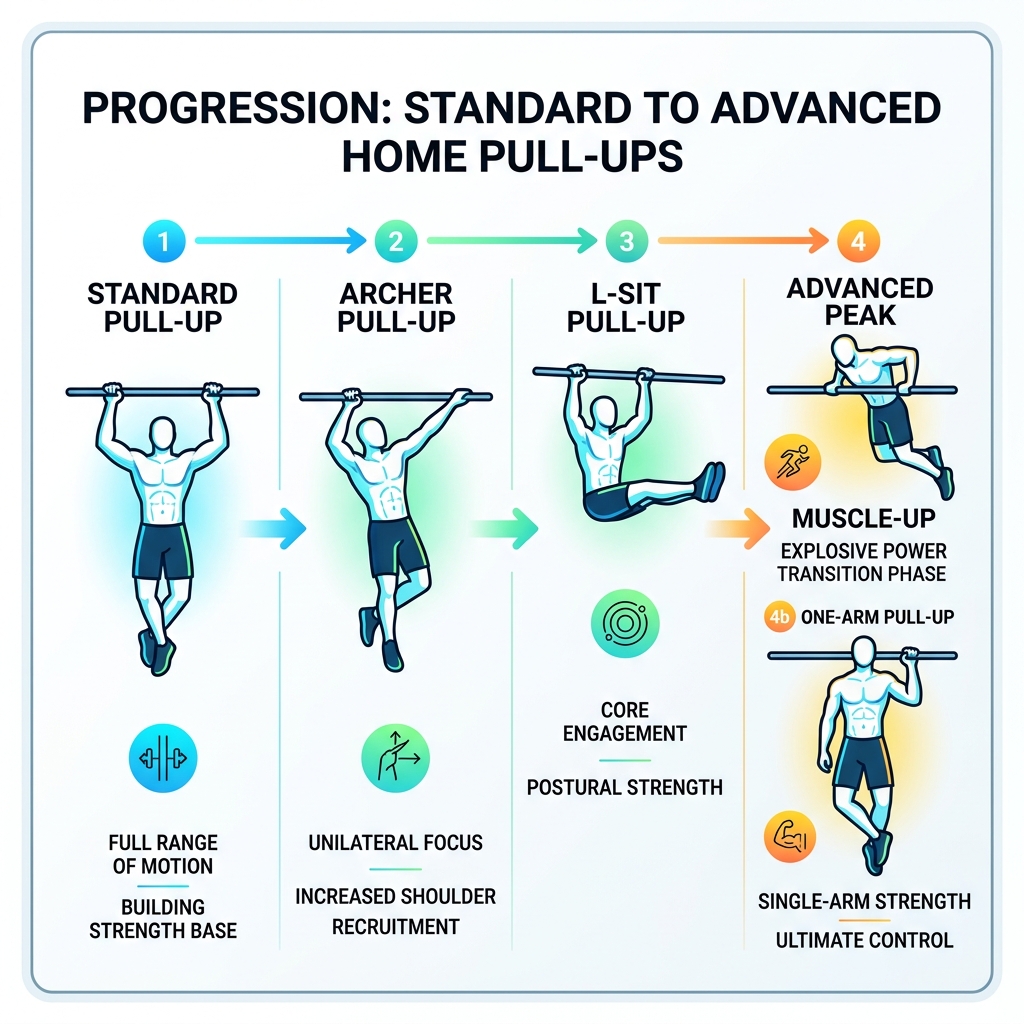
Here are the top advanced pull-up variations you can do at home right now:
- Archer pull-ups – pull toward one arm while the other extends straight
- Typewriter pull-ups – slide laterally across the bar at the top position
- L-sit pull-ups – hold legs parallel to the floor while pulling up
- Muscle-ups – transition from a pull to a push above the bar
- One-arm pull-up progressions – build toward single-arm pulling strength
- Towel pull-ups – grip a towel over a bar or door to challenge your grip
- Weighted pull-ups – add a backpack with books for extra resistance
- Kipping pull-ups – use hip drive for explosive, high-volume reps
- Sternum pull-ups – pull until your chest touches the bar
- Commando pull-ups – alternate sides using a parallel grip
Most people hit a wall after mastering basic pull-ups. They can knock out 10 clean reps, but then progress stalls. The solution isn’t always more reps — it’s smarter variation.
Research published in Physiology & Behaviour confirms that muscle growth can happen without any external load, as long as exercises are performed through a full range of motion. In other words, the difficulty of the movement matters more than the weight on the bar.
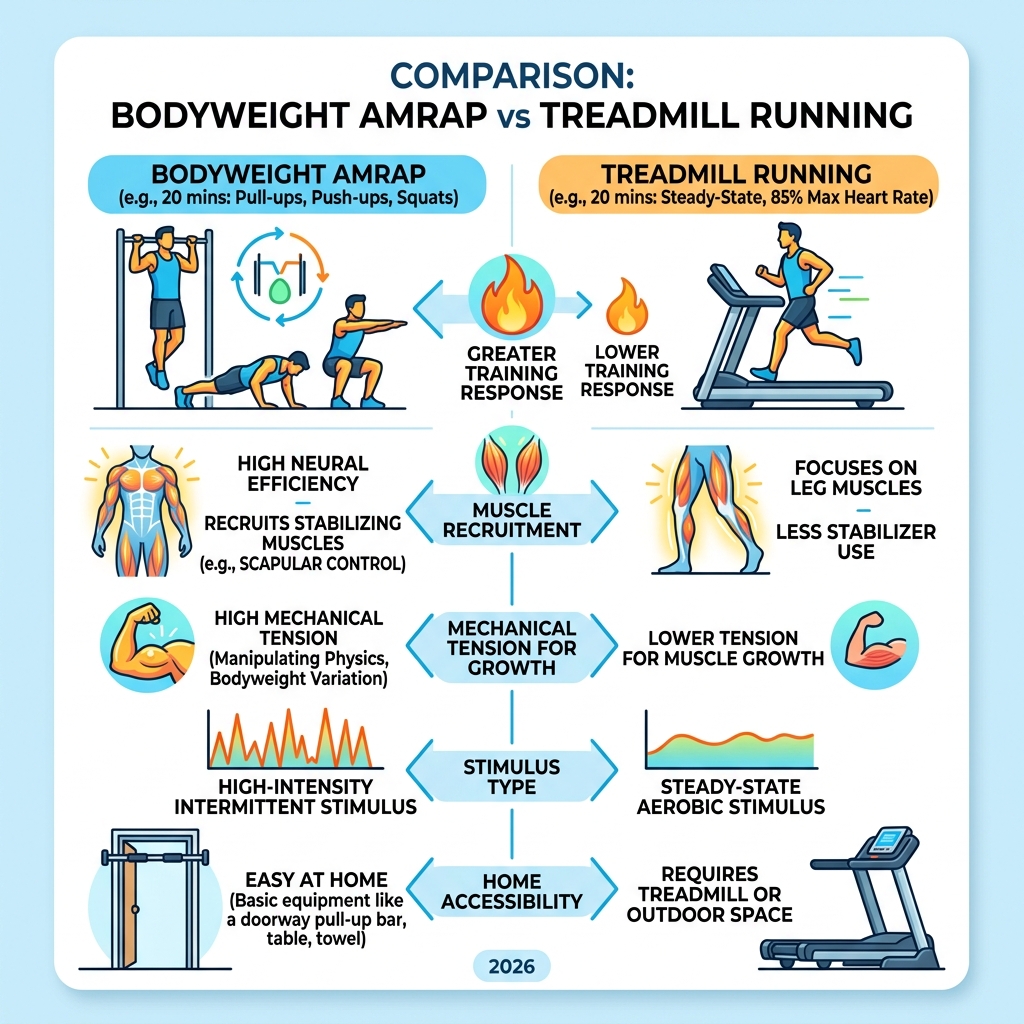
And the stimulus is real. A 20-minute bodyweight circuit including pull-ups, push-ups, and squats has been shown to produce a greater training response than running at 85% of max heart rate for the same duration. That’s a strong case for ditching the treadmill and leveling up your pull-up game at home.
Whether you have a doorway pull-up bar, a sturdy table, or just a towel thrown over a door, there’s an advanced variation that fits your setup.
The Science of Building Muscle with Advanced Bodyweight Pullups Home
When we talk about advanced bodyweight pullups home routines, we aren’t just doing “more of the same.” We are manipulating the physics of our own bodies to create mechanical tension—the primary driver of muscle hypertrophy.
Hypertrophy Without the Iron
Science tells us that muscle growth is independent of the external load used, provided the effort is high and the range of motion (ROM) is full. A study comparing push-ups to bench pressing found that when the load was equivalent to 40% of a 1-rep max, the muscle and strength gains were nearly identical after eight weeks. This means your lats don’t know if you’re pulling a 45-pound plate or if you’re performing an archer pull-up that shifts 70% of your body weight onto a single arm.
The AMRAP Advantage
Bodyweight training often gets a bad rap for being “too easy,” but the data suggests otherwise. A 20-minute CrossFit-style AMRAP (As Many Rounds As Possible) consisting of 5 pull-ups, 10 push-ups, and 15 squats provides a significantly greater training stimulus than steady-state cardio. This is because high-intensity bodyweight movements recruit a massive amount of stabilizing muscles and demand high neural efficiency.
Neural Efficiency and Scapular Control
Advanced variations require your brain to coordinate complex movements. When you move from a standard pull-up to a typewriter pull-up, you aren’t just using your lats; you’re teaching your nervous system to stabilize the shoulder joint through a lateral plane. This builds “bulletproof” shoulders and elite scapular control—the ability to move your shoulder blades independently of your arms.
10 Elite Variations for Your Advanced Bodyweight Pullups Home Routine
If you’re ready to move beyond the basics, these variations will challenge your unilateral strength, explosive power, and time under tension.
Archer and Typewriter Pullups for Lateral Strength
These moves are the kings of asymmetric loading. In an archer pull-up, you pull your body toward one hand while the other arm stays straight, acting as a “guide.” This forces the working side to handle a much higher percentage of your body weight.
Typewriter pull-ups take this a step further. You pull yourself to the top of a standard pull-up and then slide your chin laterally toward one hand, then the other, keeping your height constant. This creates immense time under tension for the lats and rhomboids. For more on building a foundation for these moves, check out our guide on building upper body strength with easy home workouts.
L-Sit and Muscle-Up Progressions
The L-sit pull-up is a masterclass in core compression. By holding your legs parallel to the floor, you shift your center of gravity, making the pull significantly harder on your upper back while torching your abs. It’s a staple for anyone interested in at-home workouts for the upper body.
Muscle-ups are the ultimate “skill” pull-up. They require an explosive pull to the sternum followed by a rapid transition (the “dip”) to push yourself above the bar. At home, this usually requires a sturdy outdoor setup or a high-clearance bar, but the explosive pulling portion can be practiced anywhere.
Grip-Intensive Towel and One-Arm Variations
If your grip is the weak link, towel pull-ups are the answer. Drape two sturdy towels over your bar and grip them instead of the metal. This shifts the focus to your forearms and brachioradialis.
For those chasing the “Holy Grail”—the one-arm pull-up—the journey starts with weighted eccentrics. Use a backpack filled with books to increase the load on the way down. This builds the tendon strength necessary for unilateral pulling. You can learn more about creative home loading in our home chest workout guide, which uses similar DIY principles.
Essential Prerequisites for Advanced Bodyweight Pullups Home
Before you try to “fly” with a muscle-up, you need to ensure your foundation is rock solid. Attempting advanced moves without the prerequisites is a recipe for elbow tendonitis or shoulder impingement.
The 12-Rep Rule
We recommend having a baseline of at least 12 to 15 strict, dead-hang pull-ups before diving into advanced variations. “Strict” means no leg swinging, no chin-reaching, and a full lockout at the bottom. If you aren’t there yet, start with our beginners upper body strength workout to build that initial volume.
Scapular Retraction and Active Hangs
The most common mistake in home training is “passive hanging.” In an active hang, you pull your shoulder blades down and back, creating space between your ears and shoulders. This engages the lats from the very start of the rep. Practice “scapular pull-ups”—moving only your shoulder blades while keeping your arms straight—to master this.
Plugging Energy Leaks
In calisthenics, a “loose” body is a weak body. When we pull, we want to tighten our quads, squeeze our glutes, and point our toes. This turns the body into a single rigid unit, preventing “energy leaks” where force is lost through a sagging core. Mastering the hollow body position on the floor is the best way to carry this tension over to the bar.
How to Safely Execute Advanced Pullups Using Household Items
Not everyone has a professional-grade pull-up station, but that shouldn’t stop you. We can get creative with what we have, provided we prioritize safety.
- Doorway Integrity: If using a doorway pull-up bar, ensure the trim is sturdy. For “doorway rows,” grip the frame itself, lean back, and pull your chest to the door.
- Table Rows: This is a fantastic “no-bar” alternative. Slide under a sturdy dining table, grip the edge, and pull your chest to the underside. It mimics the inverted row perfectly.
- Towel Door Anchors: Tie a large knot in one end of two towels. Throw the knots over the top of a door and close it (ensure the door opens away from you). Now you have a DIY suspension trainer for rows and assisted pull-ups.
- Backpack Weights: To progress toward one-arm pull-ups, fill a backpack with books or water bottles. Wear it on your front to keep your center of gravity stable during eccentric (lowering) phases.
Always test your setup before applying full weight. For more creative ideas, see our list of no-equipment home exercises and easy home workouts without equipment.
Structuring Your Advanced Home Training Program
To see results with advanced bodyweight pullups home workouts, you need a plan that balances intensity with recovery.
Grease the Groove (GTG)
This is a favorite for neural adaptation. Instead of doing one big workout, you perform sub-maximal sets (about 50% of your max) throughout the day. Every time you walk under your pull-up bar, do 2-3 perfect reps. This “teaches” your nervous system the movement without causing fatigue.
Cluster Sets and Pyramids
If you are training for hypertrophy, try cluster sets. Break a set of 10 into mini-sets: do 3 reps, rest 15 seconds, do 3 more, rest 15 seconds, and finish with 4. This allows you to maintain higher power output. Pyramids are also great: do 1 rep, then 2, then 3… up to 5 and back down.
The Importance of Recovery
Pull-ups are taxing on the central nervous system and the small tendons in the elbows. We suggest a 48-hour recovery period between intense pulling sessions. To keep your body balanced, pair your pulling with “antagonist” movements like push-ups or dips. Our full body home workout plan shows you how to integrate these effectively.
If you find yourself hitting a wall, use a “deload week” where you cut your volume in half to let your connective tissues catch up. Even a beginner-friendly home workout plan can be modified for advanced athletes by focusing on tempo and perfect form during these rest phases.
Frequently Asked Questions about Advanced Home Pullups
Can I train advanced pullup variations every day?
While you can use the “Grease the Groove” method to practice daily, you should not train to failure every day. Advanced moves like archer pull-ups or weighted eccentrics put significant stress on your joints. For high-intensity sessions, stick to 2-3 times per week to allow for neural and tissue recovery.
What are the best no-equipment alternatives to pullups?
If you don’t have a bar, focus on “horizontal pulling.” Doorway rows, table rows, and “Superman pull-downs” (lying on your stomach and mimicking the pull-up motion while squeezing your lats) are excellent. Reverse snow angels also help build the rear deltoids and rhomboids necessary for a strong pull.
How do I fix a plateau in my advanced pullup progress?
Plateaus often happen because of grip strength or a weak “sticking point.” Incorporate isometric holds: pull yourself halfway up and hold for 10-20 seconds. Also, don’t underestimate the power of “micro-loading.” Adding just 1-2 pounds to a backpack can be enough to trigger new strength gains without overwhelming your system.
Conclusion
Mastering advanced bodyweight pullups home is a journey of patience, technique, and creative problem-solving. At Casa e Jardim Web, we believe that you don’t need a commercial gym to build an elite physique. By focusing on progressive overload, mastering your own body weight, and staying consistent with your recovery, you can achieve levels of strength that most people think are only possible with heavy weights.
Stop just “hanging around” and start challenging yourself with these elite variations. Your back, arms, and core will thank you. Start your journey with our comprehensive home workout category and find the perfect plan to match your new skills!
