
Muscle Building 101: The Best At Home Workout Routine
You Don’t Need a Gym to Build Muscle — Here’s the Proof
The best at home workout routine to gain muscle combines progressive overload, compound movements, and consistent training — no gym membership required. Here’s a quick snapshot of what works:
Quick Answer: How to Build Muscle at Home
- Train 2-4 days per week using bodyweight or dumbbells
- Focus on compound exercises — push-ups, squats, rows, lunges
- Apply progressive overload — add reps, sets, or resistance over time
- Eat enough protein — 1.6 to 2.2g per kilogram of body weight daily
- Sleep 7-9 hours — that’s when your muscles actually grow
- Rest between sessions — each muscle group needs recovery time
No commute. No monthly fees. No fancy machines.
The truth is, your muscles don’t know the difference between a cable machine and a dumbbell — or even a backpack filled with books. What they respond to is tension, stress, and damage. Give them that, and they grow.
Research backs this up. A 2016 review confirmed that strength training at least twice a week is enough to build muscle. And studies show that adults of all ages — including those over 40 — can gain lean mass with consistent resistance training at home.
Whether you’re a complete beginner or someone who just lost access to a gym, this guide lays out exactly what to do, how often, and why it works.
The Science of Building Muscle at Home
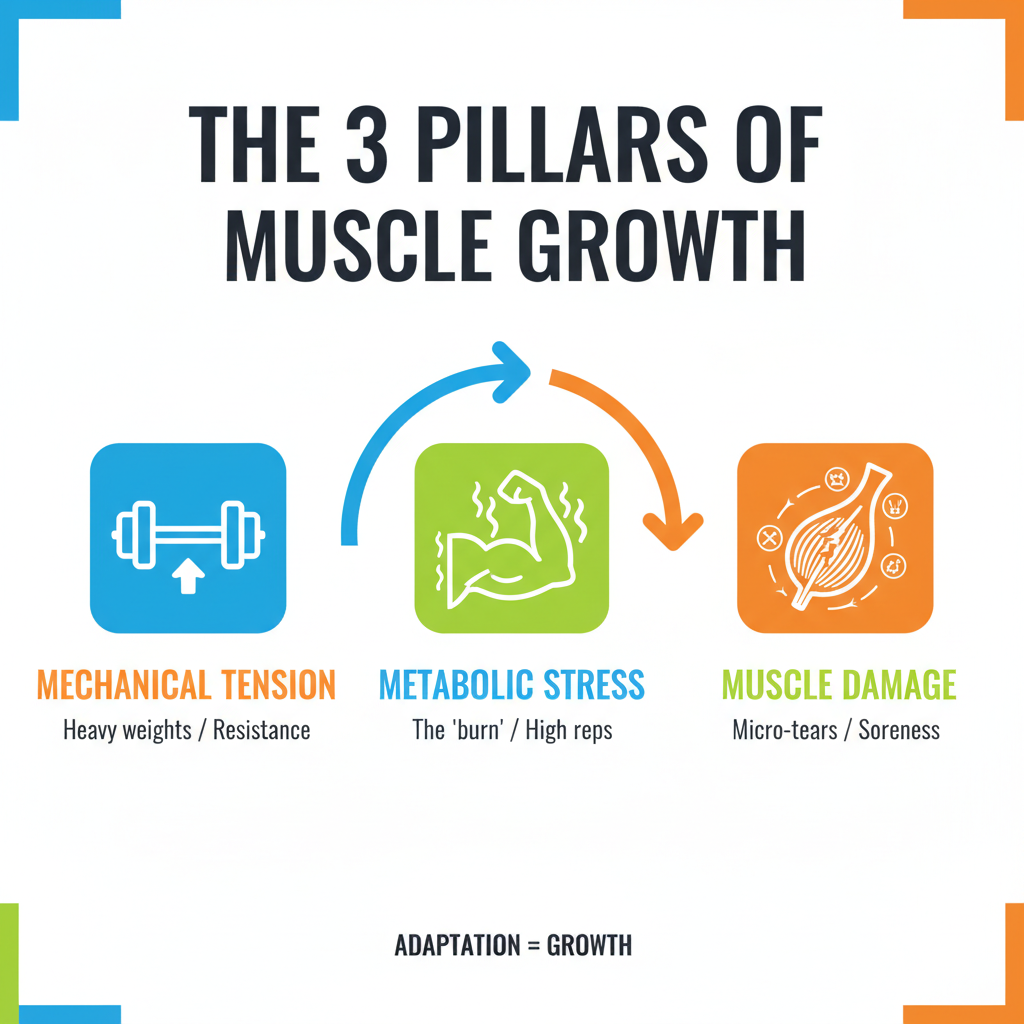
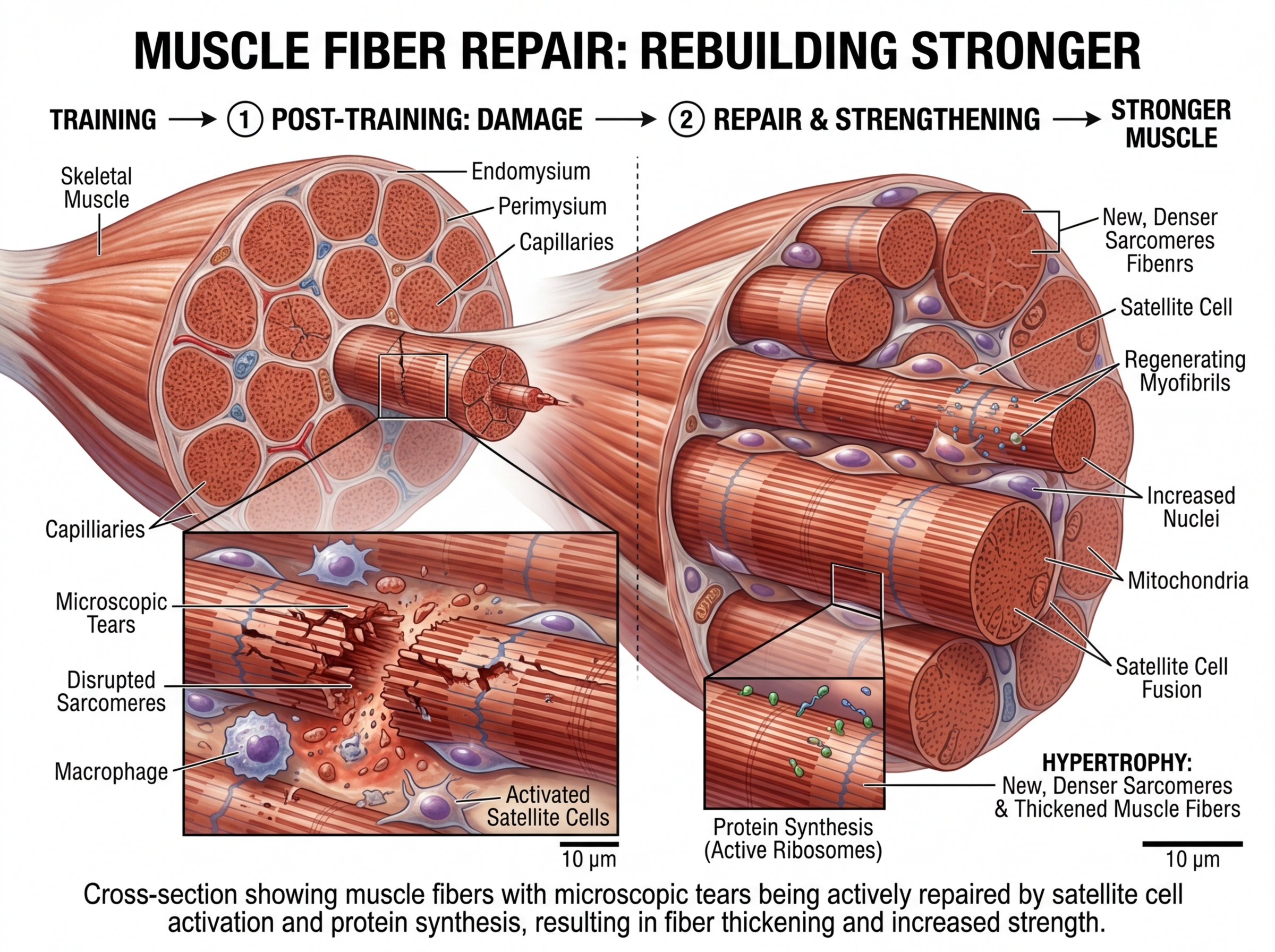
To understand how to craft the best at home workout routine to gain muscle, we first need to look at how biology works. Muscle growth, or hypertrophy, isn’t magic; it is an adaptation to stress. When we lift a weight or push our body weight, we create microscopic tears in the muscle fibers. Our body then repairs these fibers, making them thicker and stronger to handle the stress next time.
The three primary drivers of this growth are:
- Mechanical Tension: Stretching the muscle under load.
- Metabolic Stress: That “burn” you feel when waste products like lactate build up in the muscle.
- Muscle Damage: The actual physical breakdown of tissue that requires repair.
At home, the biggest challenge is often “progressive overload.” This is the non-negotiable principle that you must gradually increase the demands on your musculoskeletal system to keep gaining. Since we don’t have a rack of 100lb dumbbells, we have to get creative. We can increase reps, decrease rest time, or change the “leverage” of an exercise (like putting your feet on a chair during push-ups) to make it harder.
Regarding frequency, a 2016 research review suggests that strength training at least 2 days a week is ideal for growth. However, for the best at home workout routine to gain muscle, we recommend hitting each muscle group twice per week. Science shows this is the “sweet spot” for balancing stimulus and recovery. Aim for a total weekly volume of 12-20 hard sets per muscle group.
Why This is the Best At Home Workout Routine to Gain Muscle for Beginners
If you are just starting, you are in a lucky position. Beginners often experience “newbie gains,” where the body responds incredibly fast to new stimuli. You don’t need complex “bro-splits” where you train chest on Monday and back on Tuesday. Instead, focusing on muscle-building home workouts for beginners that utilize full-body movements is the most efficient path.
For beginners, we prioritize form over weight. It’s better to do ten perfect push-ups than twenty “worm” push-ups with a sagging back. A beginners upper body strength workout should focus on foundational movements: pushing, pulling, and squatting. Start with 2-3 days per week of full-body training, allowing at least one day of rest between sessions to let those newbie muscles recover.
Essential Equipment and Bodyweight Fundamentals
While you can build a great physique with zero equipment, having a few tools makes life much easier. If you’re serious about the best at home workout routine to gain muscle, consider investing in a pair of adjustable dumbbells or a set of resistance bands.
- Dumbbells: These allow for easy progression. You can find dumbbell strength exercises for home workouts that replicate almost every gym machine.
- Resistance Bands: These provide “accommodating resistance,” meaning the exercise gets harder as the band stretches. Check out how resistance band exercises to boost strength can add variety to your routine.
- Household Items: No weights? No problem. A gallon of water weighs about 8 lbs. A backpack filled with textbooks can serve as a weighted vest for squats and lunges.
Bodyweight vs. Dumbbell Alternatives
| Bodyweight Exercise | Dumbbell Alternative | Muscle Targeted |
|---|---|---|
| Push-up | Dumbbell Chest Press | Chest, Triceps |
| Inverted Row (using a table) | One-Arm Dumbbell Row | Back, Biceps |
| Air Squat | Goblet Squat | Quads, Glutes |
| Glute Bridge | Dumbbell Hip Thrust | Glutes, Hamstrings |
| Plank-up | Dumbbell Overhead Press | Shoulders, Core |
If you are new to weights, we suggest starting with dumbbells 101: beginner-friendly home strength exercises to learn the basic movement patterns safely.
The Best At Home Workout Routine to Gain Muscle: 30-Day Plan
To see real changes, you need a schedule. This 30-day plan uses a 4-day split (Upper Body / Lower Body), which is excellent for intermediate trainees but can be adapted for anyone. This full-body home workout plan ensures you hit every muscle group with enough intensity to trigger growth.
- Monday: Upper Body (Push/Pull focus)
- Tuesday: Lower Body (Squat/Hinge focus)
- Wednesday: Active Recovery (Walking or light stretching)
- Thursday: Upper Body (Focus on shoulders and arms)
- Friday: Lower Body (Focus on lunges and glutes)
- Saturday: Optional Cardio or HIIT
- Sunday: Full Rest
If you’re feeling ambitious, you can try a jumpstart your fitness 30-day strength training challenge to build the habit of daily movement. For those who want more detail, our ultimate guide to full body weight training at home provides a deep dive into every exercise.
Customizing the Best At Home Workout Routine to Gain Muscle for Your Level
Fitness isn’t one-size-fits-all. If you are over 40, your priority should be joint health. Research shows that adults over 40 can absolutely build muscle, but recovery takes longer. Instead of training to total failure, use Reps in Reserve (RIR). This means stopping a set when you feel like you could only do 1 or 2 more perfect reps.
Women may also want to tailor their approach. While the physiological principles of muscle growth are the same, many women prefer focusing on at-home strength training for women that emphasizes lower body and core stability. Check out these simple and effective strength training for women at home for specific ideas.
To increase intensity without adding weight, try these techniques:
- Slow Negatives: Take 3-5 seconds to lower the weight.
- Pause Reps: Hold the “bottom” of a squat or push-up for 2 seconds.
- Supersets: Do two exercises back-to-back with no rest.
Top Exercises for Maximum Hypertrophy
If you want the best at home workout routine to gain muscle, you must focus on compound movements. These exercises use multiple joints and muscle groups at once, giving you the “best bang for your buck.”
1. The Push-Up (and its variations)
The humble push-up is the king of home chest exercises. To target the triceps and inner chest more, try diamond push-ups (hands touching to form a diamond). If standard push-ups are too easy, elevate your feet on a couch. For more ideas, see our home chest workout to pump up your pecs.
2. Squats and Bulgarian Split Squats
Squats build the foundation of your lower body. To take it to the next level, try the Bulgarian Split Squat: stand a few feet in front of a chair, place one foot behind you on the seat, and squat down with your standing leg. It’s a “brutal” but effective way to grow your quads and glutes. Start your journey with our lower body weight training plan.
3. Pull-Ups and Inverted Rows
Back training is often the hardest part of a home routine. If you have a doorway bar, pull-ups are essential. If not, you can perform inverted rows by lying under a sturdy table, grabbing the edge, and pulling your chest up. This is a core part of building upper body strength with easy home workouts.
For a complete list of movements, check out our guide on at-home workouts for the upper body.
Nutrition and Recovery: The Secret to Growth
You don’t grow in the “gym” (or your living room); you grow while you sleep. If you aren’t eating and resting correctly, the best at home workout routine to gain muscle won’t do much for you.
The Protein Rule
To build muscle, your body needs the building blocks: amino acids. For optimal growth, aim for a daily protein intake of 1.6 to 2.2 grams per kilogram of body weight. If you weigh 70kg, that’s roughly 112g to 154g of protein a day.
The Calorie Surplus
Unless you are a total beginner, you generally need to be in a slight calorie surplus (eating 200-500 calories more than you burn) to provide the energy needed for new tissue growth. We have a full strength training nutrition guide and specific nutrition tips for muscle building to help you dial this in.
Sleep Hygiene
Aim for 7-9 hours of sleep. This is when your body releases Growth Hormone (HGH) and repairs the damage from your workouts. If you’re also looking to lose fat while building muscle, read our strength training for weight loss beginner’s guide.
Common Mistakes and How to Track Progress
Many people fail at home because they treat it like “maintenance” rather than “training.” Avoid these common pitfalls:
- Neglecting Overload: Doing the same 10 push-ups every day for a year. You must make it harder!
- Poor Form: Using momentum instead of muscle.
- Inconsistency: Skipping days because “it’s just a home workout.”
To stay motivated, track your progress. Use a notebook or an app to record your reps and sets. Take progress photos every 4 weeks — the scale doesn’t always tell the whole story. Muscle is denser than fat, so you might stay the same weight but look completely different. This is often called “toning,” and you can learn more in our guide on home workouts for muscle toning.
For more tips on staying on track, see our strength training for weight loss guide part 2.
Frequently Asked Questions about Home Muscle Building
How long does it take to see muscle gains from home workouts?
For most beginners, “newbie gains” can appear within 4 to 8 weeks. You’ll likely feel stronger within the first fortnight as your nervous system learns to recruit muscle fibers more efficiently. True visual hypertrophy (size) usually takes about 3 months of consistent effort. Try our lower body weight training plan for beginners to see how quickly you can progress.
Can I build muscle with only bodyweight exercises?
Absolutely. The key is to train close to failure. Research shows that doing 30-40 reps of a light exercise to failure can produce similar muscle growth to doing 8-12 reps of a heavy weight. You can also change the leverage (like doing one-legged squats) to keep the tension high. Our full-body weight training routine at home focuses on these bodyweight progressions.
What role does cardio play in a muscle-building routine?
Cardio is important for heart health and recovery, but too much can interfere with muscle gains if you aren’t eating enough. We recommend 2-3 sessions of low-intensity cardio or one session of HIIT per week. Think of it as “tuning the engine” so you can work harder during your strength sessions. You can even use resistance band exercises to boost strength in a circuit format for a cardio effect.
Conclusion
Building an impressive physique doesn’t require a key fob to a commercial gym. By following the best at home workout routine to gain muscle, staying consistent with your nutrition, and respecting the power of recovery, you can achieve professional results in your own living room.
At Casa e Jardim Web, we believe that fitness should be accessible to everyone, regardless of their schedule or equipment. The most important step is the first one. Don’t wait for the “perfect” time or the “perfect” gym — start where you are, use what you have, and do what you can.
Start your muscle-building journey today with Casa e Jardim Web and transform your home into your personal powerhouse.
